ASCL News
-
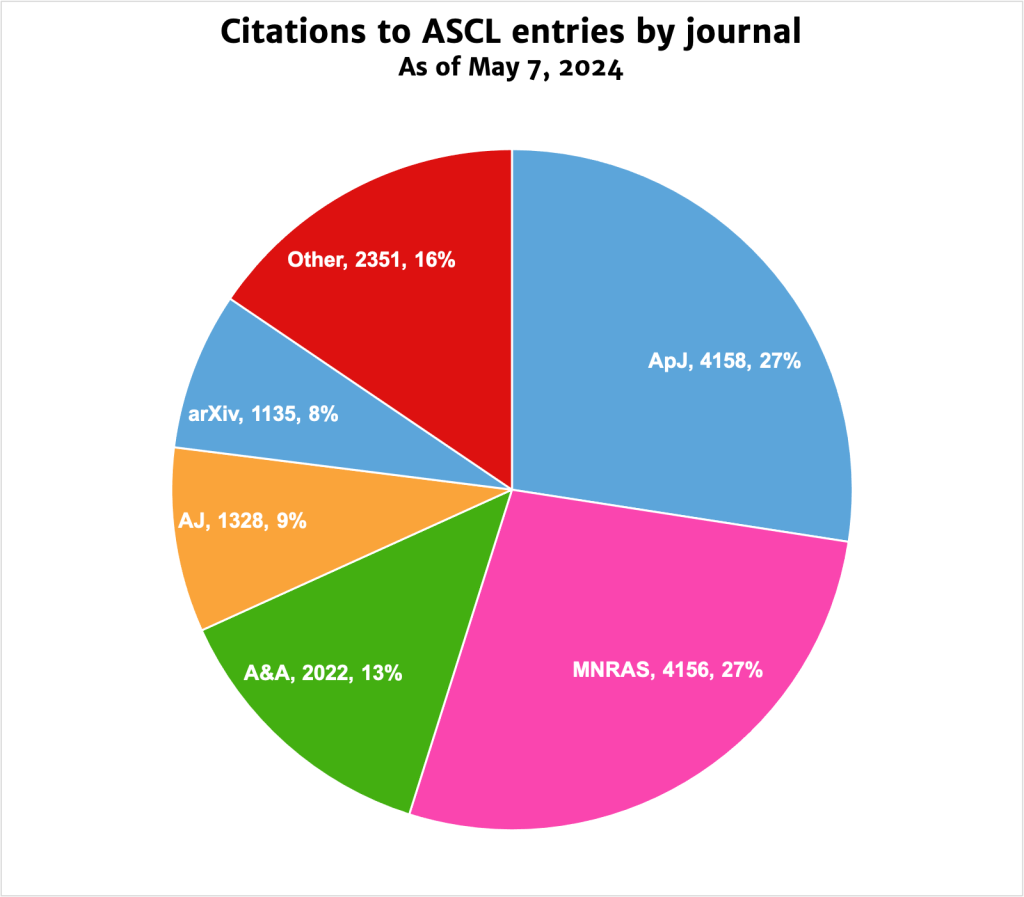
In looking at the ASCL dashboard yesterday, I realized that the Astrophysical Journal (ApJ) now has the most citations to ASCL entries, having overtaken (by a hair) Monthly Notices of the Royal Astronomical Society (MNRAS), which has held the top spot since at least 2015. MNRAS's early (and enduring) lead in software citations was initially the result of one editor, Dr. Keith T. Smith (now a senior editor at Science), who strongly encouraged article authors to cite the software they had used to generate their results. (Though I obviously saw the effect of his work in MNRAS, I had no idea one person was responsible for it until I saw a post in the Astronomers Facebook group and later queried Keith, who was unknown to me at the time.)
AAS Journals, which publishes ApJ, has three data editors, Greg Schwarz, August Muench, and Katie Merrell, who, though primarily consumed with data work, also encourage software citation, obviously to good effect. And so it grows!
-
Thirty codes were added to the ASCL in April, 2024:
astroNN: Deep learning for astronomers with Tensorflow
BayeSN: NumPyro implementation of BayeSN
binary_precursor: Light curve model of supernova precursors powered by compact object companions
cbeam: Coupled-mode propagator for slowly-varying waveguides
cudisc: CUDA-accelerated 2D code for protoplanetary disc evolution simulationsEBWeyl: Compute the electric and magnetic parts of the Weyl tensor
EffectiveHalos: Matter power spectrum and cluster counts covariance modeler
ExoPlex: Thermodynamically self-consistent mass-radius-composition calculator
GalMOSS: GPU-accelerated Galaxy Profile Fitting
GPUniverse: Quantum fields in finite dimensional Hilbert spaces modelerjetsimpy: Hydrodynamic model of gamma-ray burst jet and afterglow
KCWIKit: KCWI Post-Processing and Improvements
LensIt: CMB lensing delensing tools
LEO-vetter: Automated vetting for TESS planet candidates
Mean_offset: Photometric image alignment with row and column meansmhealpy: Object-oriented healpy wrapper with support for multi-resolution maps
MLTPC: Machine Learning Telescope Pointing Correction
NbodyIMRI: N-body solver for intermediate-mass ratio inspirals of black holes and dark matter spikes
pAGN: AGN disk model equations solver
Panphasia: Create cosmological and resimulation initial conditionsPIPE: Extracting PSF photometry from CHEOPS data
PolyBin3D: Binned polyspectrum estimation for 3D large-scale structure
pyilc: Needlet ILC in Python
PySSED: Python Stellar Spectral Energy Distributions
RhoPop: Small-planet populations identifiers2fft: Differentiable and accelerated spherical transforms
stringgen: Scattering based cosmic string emulation
superABC: Cosmological constraints from SN light curves using Approximate Bayesian Computation
TAT: Timing Analysis Toolkit for high-energy pulsar astrophysics
WignerFamilies: Compute families of wigner symbols with recurrence relations -
Nearly every month, ASCL editors notify software authors that their code has been registered in the ASCL. Each editor sends out notifications for the code entries she worked on. I say "nearly every month" because I sometimes get behind in the prep work for the notifications, and that delays all editors who send out these notifications. Editors create their own processes for handling this correspondence.
I refer to my process as "hand-crafted spam." I send out two types of notifications, one to authors who submitted their software to the ASCL, and another to authors for code entries I created. I have standard text into which I add, one by one, the necessary details for each email, by cutting and pasting the info from an Excel spreadsheet I create just for this purpose. I also check the emails against the ASCL entries to make sure I've got the right code and author. This sounds laborious, but it actually doesn't take much time. This afternoon, I sent out 34 emails covering 39 code entries (some authors had two codes added to the ASCL) for code entries processed in February, March, and April, and it took me, working at a steady but unhurried pace, exactly one hour from the first missive to the last.
I'm putting this here to remind future me that this task goes pretty quickly, so, future me, do this more promptly!
