ASCL News
-
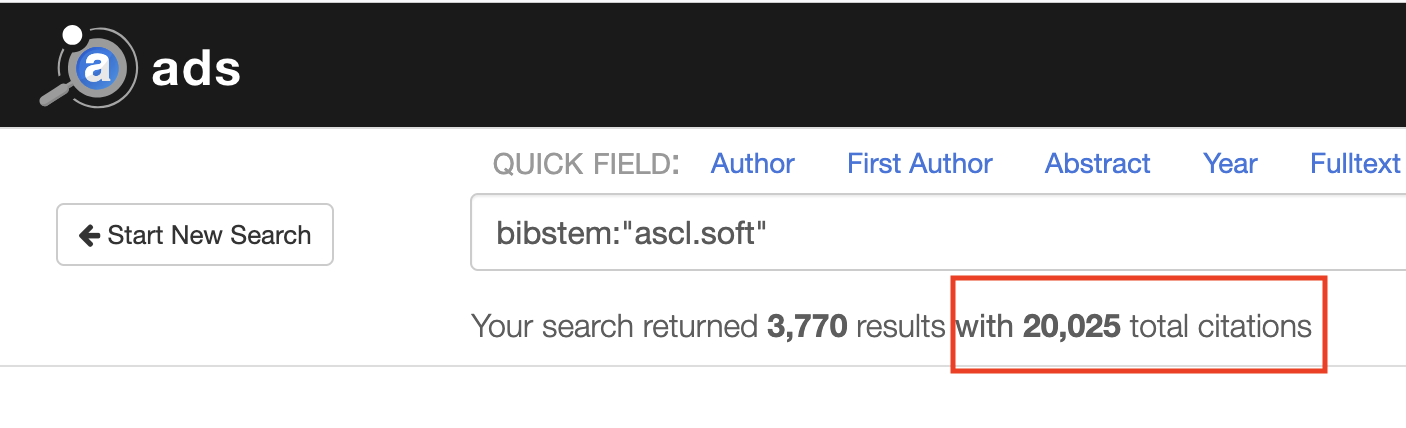
As of today, ADS shows that ASCL entries have over 20,000 citations, w00t! Not that citations are a perfect metric -- they definitely aren't -- but they do show the ASCL is being used and is useful for citing software, thereby allowing code authors to get credit for the computational methods they contribute to the field.
So that's the milestone: 20K citations. Now the question: Who was the first to use the ASCL to cite software? I will provide chocolate (when weather/circumstances allow) to the first person who correctly identifies the first citation to an ASCL entry (using the ASCL ID).
-
Thirty codes were added to the ASCL in July, 2025:
arctic_weather: High Arctic meteorological conditions analyzer
Capivara: Scalable spectral-based segmentation package
COBRA: Optimal Factorization of Cosmological Observables
Coniferest: Python package for active anomaly detection
CosmoWAP: Power spectra and bispectra analyzerDPMhalo: Descriptive Parametric Model for gaseous halos
ExoplanetsSysSim: Exoplanet System Simulation
EXP: nbody EXPansion code
HYDRAD: Field-aligned hydrodynamic equations in coronal loops solver
LSCS: High-contrast space telescopes simulatorMathWAP: Compute power spectra bispectra contributions from peturbation theory
nGIST: The new galaxy integral field spectroscopy tool
Nii-C: Automatic parallel tempering Markov Chain Monte Carlo framework
OW: Opacity Wizard
P-CORONA: Coronal atomic lines intensity and polarizational modelerPCM-HiPT: Planetary Climate Model for High Pressures and Temperatures
PIRATES: Polarimetric Image Reconstruction AI for Tracing Evolved Structures
Sapphire++: Interaction of charged particles with a background plasma simulator
SAUSERO: Software to AUomatize in a Simple Environment the Reduction of Osiris+
show_cube: Show reduced spectra for Gemini NIFSspectool: Spectral data processing and analysis toolkit
spherimatch: Cross-matching and self-matching in spherical coordinates
SPIBACK: Backward-integration-based non-axisymmetric models of the Milky Way disk
spinifex: Ionospheric corrections
SysSimExClusters: Clustered planetary system model for SysSimSysSimPyMMEN: Infer the minimum-mass extrasolar nebula
SysSimPyPlots: Functions for plotting galleries of systems
tayph: Cross-correlation analysis of high resolution spectroscopy
torchmfbd: Multi-object multi-frame blind deconvolution of point-like or extended objects
ysoisochrone: Python package to estimate masses and ages for young stellar objects