ASCL News
-
Twenty codes were added to the ASCL in December, 2025:
ACor: Automated Correlation and processing for radio interferometry
FGOC: Focal-Geometry and Curvature classifier
H21F: Gaussian Process based 21-cm foreground separation code
iSTARMOD: Chromospheric activity in cool stars
Karabo: Validation and benchmarking radio telescopes and algorithmsmegaradrp: Data reduction pipeline for MEGARA
numina: Data reduction pipeline interface
PANCAKE: Color–magnitude diagram fitting for stellar populations
PAOS: Physical optics propagation and system modeling
polarpy: POLAR gamma-ray polarimetry data processingPST: Stellar population synthesis in galaxies
PyLongslit: Astronomical long-slit spectra processor
RVSNUpy: Spectroscopic redshift measurement by cross-correlation
SolarZip: Error-bounded compression of solar EUV images
STARDIS: LTE radiative transfer for synthetic stellar spectrasynax: All sky Synchrotron emission simulation with JAX
tilsotua: WCS reconstruction for LRIS multislit masks
TOAExtractor: Calculate TOAs and residuals of X-ray pulsars
xmm_simulator: XMM mock data simulator
ztfquery: Programmatic access to ZTF data products -
Thirty codes were added to the ASCL in November, 2025:
Aperture: High-performance particle-in-cell framework for plasma simulations
BNS_NURATES: Neutrino-Matter interaction rates for binary neutron star mergers
CASSL: Conventional and Sub-Conventional Strong Lensing forecasts and simulations
CompactObject: Bayesian EOS inference for neutron stars
deepCR: Deep-learning based cosmic ray removal for astronomical imagesfrb_covariance: Fast radio burst covariance
GalClean: Remove bright sources from a FITS image
GAMA Quasar Hosts: Star formation analysis pipeline
HERACLES++: Multidimensional compressible hydrodynamics solver
HyperGal: Supernovae extraction and classificationkdcount: KDTree for low dimensional spatial indexing
lenscov: Full CMB and lensing covariances
Limbdark.jl: Analytical transit light curves for limb darkened stars
MicroLIA: MicroLensing Identification Algorithm
ml4ptp: Machine learning for PT profiles of exoplanet atmospheresnirwals: Data-reduction and monitoring pipeline for SALT NIRWALS
PIXON: Reverberation mapping analysis in active galactic nuclei
pulses: Periodic spectral modulation analysis
PyCALI: Intercalibrate light curves
pyDIA: Star detection, difference imaging, and photometrypyhdust: Analysis tools for multi-technique astronomical data and hdust models
redmonster: Automated redshift measurement and spectral classification
SFR_ChebyFit_example: Chebyshev-based correction of SFR estimators
Shamrock: Multi-GPU hydrodynamics framework for astrophysics
skaro: Unveiling planet demographics in the Milky Wayspinosaurus: Lagrangian perturbation theory for galaxy shape and density correlations
Starkiller: Removing stars and satellites from IFU data
STDWeb: Simple Transient Detection for the Web
vis-r: Fast radial profile modeling for radio interferometric data
ViSL3D: Interactive 3D Visualization of Spectral‑Line Datacubes -
It's mid-November and we have already met one important yearly goal: that of curating entries not edited since January 1 of the current year minus 3. Woo-hoo! Usually this task is not complete until well into December (*cough* possibly not until New Year's Eve *cough*), so I'm pretty chuffed that this work is done with weeks (weeks!) to spare.
 One might think this is an impossible and/or onerous task, and indeed, someone once scoffed at the idea of its being possible, but done consistently throughout the year at the rate of 15-17 entries per week, it's very manageable. I usually queue up five entries at a time for curation.
What's involved, you ask? Mostly checking all links to make sure they work and go where we expect them to, finding replacements for those that need to be replaced, adding missing links, updated ADS links to resolved links (peer-reviewed versions rather than pre-prints), downloading the most recent version of the software if necessary, and checking preferred citation information -- where available (and for all that is science, please make this info available for all your software!) -- to ensure it is up-to-date. Basically, we make sure an entry is healthy and remediate anything that needs remediation.
And now we're done for the year, woo-hoo!!
-
 Our science depends on public digital resources, including data archives, software repositories, computational infrastructures, and catalogs. Recent actions by non-scientists have led to the loss of important digital resources in other fields, and even astrophysics assets may face uncertain futures. This poster invites astronomers to reflect on how dependent our research is on shared resources and which of these may be vulnerable to loss. It also asks what actions we can take to safeguard these resources to ensure they remain secure for the future.
Download (PDF)
-
Twenty-six codes were added to the ASCL in October, 2025:
BoGEMMS-HPC: Large-scale simulations for X-ray and Gamma-ray observations
CMDFitter: Fit a probabilistic generative model to a color-magnitude diagram
CorrCal: Calibration code for semi-redundant arrays
DISCO-DJ: Differentiable Simulations for Cosmology, Done with JAXFitPDF: Bayesian distribution fitting for pulsar and FRB data
GraFIT: Frequency response function identification in Gravitational Wave detectors
GrayHawk: Gray-body factor calculations for black holes
Lux: Generative latent-variable modeling of astronomical dataMadVoro: Massively distributed construction of Voronoi diagrams
MARFA: Broad-spectrum high-resolution atmospheric absorption analyzer
NP_TMC: Nano-particle Transition Matrix Code
pPXF-SEW: Full-spectrum fitting with penalized pixel-fitting and equivalent width extractionpyEFPE: Waveform model for inspiralling precessing-eccentric compact binaries
pyproffit: Analyze X-ray brightness profiles from clusters of galaxies
RotCurveTool: Streamlined framework for simulating and fitting galactic rotation curves
RUN Pipeline: Strong lens classification and detection of small Einstein radius systemsSIROCCO: Simulating Ionization and Radiation in Outflows Created by Compact Objects
SNITCH: Bayesian inference of star formation histories
SourceDetect: CNN-based event search for TESS data
spike: All-in-one tool to generate and correctly drizzle HST, JWST, and Roman PSFsSpyDust: Improved implementation of SPDust for modeling spinning dust radiation
Streaktools: Simulation, measurement, and fitting of satellite-generated streaks
Synthpop: Modular Galactic population synthesis
TABASCAL: Modeling and subtraction of moving radio-frequency interference in interferometric dataTripleLens: Calculating light curves for triple microlensing systems
TRIPP: TRansient Image Processing Pipeline -
Twenty-four codes were added to the ASCL in September, 2025:
ArchNEMESIS: Python version of the NEMESIS radiative transfer and retrieval tool
CODES: Benchmarking surrogates for coupled ODE systems
Dazzle: Detecting and characterizing transient phenomena in crowded fields
DeepExtractor: Deep learning time-domain reconstruction for Gravitational Wave power excesses
FindPOTATOs: Candidate detection set tracklet assemblerGRTresna: Solving the initial data constraints in numerical relativity
MANTA-Ray: Optical properties of fractal aggregates estimator
microlux: Binary lensing light curve calculator
moons-sim: 1D Spectral Simulator for VLT-MOONS
nazgul: GRB triangulation via non-stationary time-series modelsNutMaat: Stellar spectra classifier based on MKCLASS
PAPI: PANIC Pipeline
PolyCLEAN: Radio interferometric imaging based on Polyatomic Frank-Wolfe
pyCARPool: Convergence Acceleration by Regression and Pooling
PyEMILI: Spectral line identification toolpyLDT-cosmo: Matter PDF predictions in Large Deviation Theory
PySCo: Cosmological N-body code with modified gravity theories
pySELFI: Python implmentation of the Simulator Expansion for Likelihood-Free Inference algorithm
Simbelmynë: Hierarchical probabilistic simulator for generating synthetic galaxy survey data
SOAP: Spherical Overdensity and Aperture ProcessorSTELA: Sampling Time for Even Lightcurve Analysis Toolkit
VacuumTunneling: Evaluating bubble profile with a renomalization factor
volcano: Mapping exoplanet surfaces from one-dimensional time-series data
wolensing: Lensed gravitational waves simulator -
This morning, I gave a short presentation on the ASCL, sharing some tips and tricks for using it (and ADS), as part of this month's Virtual Astronomy Software Talks (VAST) seminar. The slides from it are linked below and contain hotlinks that demonstrate some of the tips and resources available.
Slides (PDF)
-
Twenty-two codes were added to the ASCL in August, 2025:
ABC-SN: Spectroscopic supernova classifier
AGNI: Model for extreme atmospheres on rocky exoplanets
AstroWISP: Astronomical Widefield Images Stellar Photometry
AutoWISP: High-precision photometry pipeline
DeepSSM: Cosmological emulator for the GW spectrum from the modified sound-shell modelEllipSect: Analysis tool for GALFIT output
FiCUS: FItting the stellar Continuum of Uv Spectra
fm4ar: Inferring atmospheric properties of exoplanets using flow matching posterior estimation
FRion: Time averaged correction of Faraday Rotation from the IONosphere
gwsnr: Gravitational Wave Signal-to-Noise Ratio computationHipFT: High-performance Flux Transport
IAR_Model: Autoregressive model to irregularly spaced data
MPI-Rockstar: Hybrid MPI and OpenMP parallel implementation of Rockstar
OFT: Open-source Flux Transport
pyPLUTO: Tool for analyzing PLUTO code outputspySTARBURST99: Python port of STARBURST99
RheoVolution: Rheology evolution in the time domain
SIGWAY: Compute second-order, scalar induced gravitational wave signals
sMV: Serial MultiView phase plane estimation
SoFT: Solar Feature Tracking suitetropygal: Entropy estimates for galactic dynamics
Twinkle: GPU-based high-efficiency binary-lens microlensing -
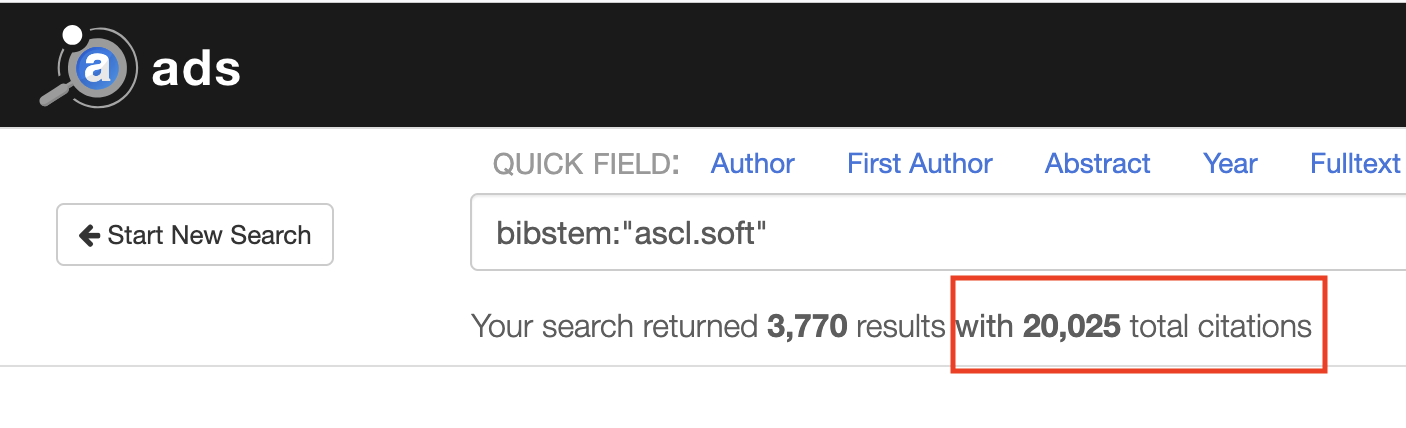
As of today, ADS shows that ASCL entries have over 20,000 citations, w00t! Not that citations are a perfect metric -- they definitely aren't -- but they do show the ASCL is being used and is useful for citing software, thereby allowing code authors to get credit for the computational methods they contribute to the field.
So that's the milestone: 20K citations. Now the question: Who was the first to use the ASCL to cite software? I will provide chocolate (when weather/circumstances allow) to the first person who correctly identifies the first citation to an ASCL entry (using the ASCL ID).
-
Thirty codes were added to the ASCL in July, 2025:
arctic_weather: High Arctic meteorological conditions analyzer
Capivara: Scalable spectral-based segmentation package
COBRA: Optimal Factorization of Cosmological Observables
Coniferest: Python package for active anomaly detection
CosmoWAP: Power spectra and bispectra analyzerDPMhalo: Descriptive Parametric Model for gaseous halos
ExoplanetsSysSim: Exoplanet System Simulation
EXP: nbody EXPansion code
HYDRAD: Field-aligned hydrodynamic equations in coronal loops solver
LSCS: High-contrast space telescopes simulatorMathWAP: Compute power spectra bispectra contributions from peturbation theory
nGIST: The new galaxy integral field spectroscopy tool
Nii-C: Automatic parallel tempering Markov Chain Monte Carlo framework
OW: Opacity Wizard
P-CORONA: Coronal atomic lines intensity and polarizational modelerPCM-HiPT: Planetary Climate Model for High Pressures and Temperatures
PIRATES: Polarimetric Image Reconstruction AI for Tracing Evolved Structures
Sapphire++: Interaction of charged particles with a background plasma simulator
SAUSERO: Software to AUomatize in a Simple Environment the Reduction of Osiris+
show_cube: Show reduced spectra for Gemini NIFSspectool: Spectral data processing and analysis toolkit
spherimatch: Cross-matching and self-matching in spherical coordinates
SPIBACK: Backward-integration-based non-axisymmetric models of the Milky Way disk
spinifex: Ionospheric corrections
SysSimExClusters: Clustered planetary system model for SysSimSysSimPyMMEN: Infer the minimum-mass extrasolar nebula
SysSimPyPlots: Functions for plotting galleries of systems
tayph: Cross-correlation analysis of high resolution spectroscopy
torchmfbd: Multi-object multi-frame blind deconvolution of point-like or extended objects
ysoisochrone: Python package to estimate masses and ages for young stellar objects