ASCL News
-
As those familiar with the ASCL know, those working on it take an active approach to sharing astrophysical source code, ferreting out codes, looking for their download sites, and creating entries for them in the ASCL. We welcome and indeed (enthusiastically!) encourage code authors to create entries for their codes, but most of the indexing of codes is currently done by ASCL associate editor Kim DuPrie and me.
I regularly read through pre-prints looking for mention of codes not yet indexed by the ASCL; Advisory Committee Chairman Peter Teuben does the same. He has access to publications I cannot get to, such as MNRAS, and looks there for codes as well. A paper may yield a code new to the ASCL, and sometimes, a paper will reveal what Peter and I refer to as Russian dolls: the deeper we get into a paper, the more codes it reveals. One paper he sent to me recently revealed 37 (!) codes, only 5 of which the ASCL had indexed. Thirty-two new codes to try to find!
 Other times, a paper will mention two or three or more codes which lead us to other papers which mention yet more codes, which lead us to papers which mention even more codes... and though the ASCL indexes over 600 codes, there are still hundreds, probably thousands, out there it hasn't indexed, so some of these more more MORE codes that we come across also need to be found. Like Russian nesting dolls, the codes go on and on and on.
It's times like that -- finding 32 new codes in just one paper! peeling back layers and layers of new codes! -- I wish I could work on the ASCL full-time. Well, also the times I look at the list we'd already compiled (a list I stopped adding to over a year ago) of ~ 200 codes to find. Also the times I look at the list of things still to be done for/on/about the ASCL beyond indexing new codes.
So many codes, so little time to spend on them, alas!
-
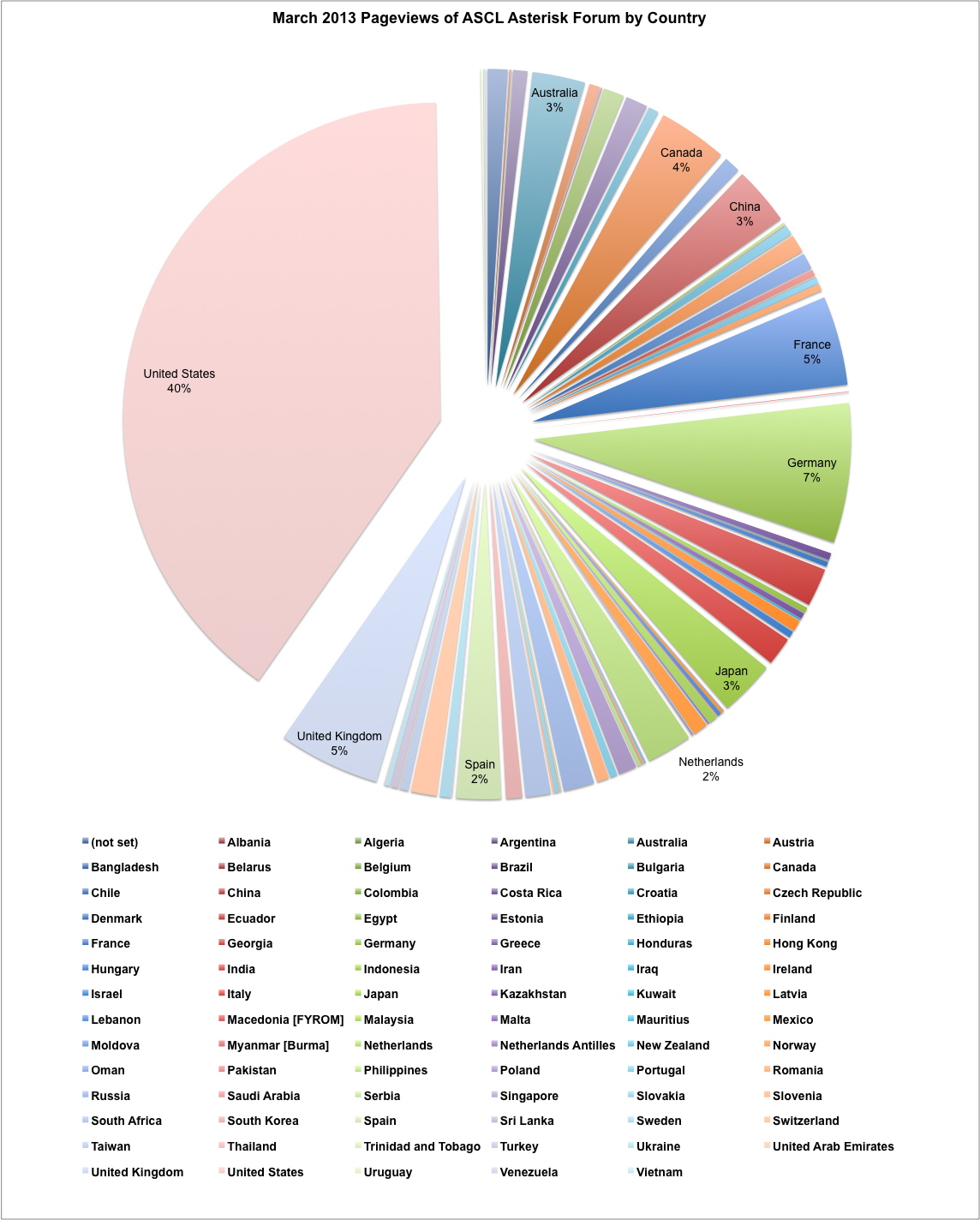
Idly browsing through Google Analytics statistics on the ASCL, I pulled out pageviews by country, these just of the ASCL forum on Asterisk for this month so far. Of the 4,843 pageviews, 1,939 (40%) are from the US, which means of course that 60% are not. People from eighty-three countries have accessed the code entries forum; I've tagged the pie slices below of the ten countries with at least 2% of the total pageviews. Click on the pie to see the chart at full size.
-
Yay!
That is all.
-
Advisory Committee member Bruce Berriman has a nice post about the ASCL on his excellent Astronomy Computing Today blog.
Thanks, Bruce!
-
Gyula Józsa has been updating TiRiFiC and fixing minor bugs, and has added features and made the code standalone software, no longer requiring GIPSY; instead, input files are in FITS format now. You can be alerted to updates by subscribing to the TiRiFiC thread on the ASCL.
Peter Teuben reported on the ASCL that an updated version of ZEUS-MP (V1.5) has been made public by the U.Maryland group. Please find the updated version here: http://www.netpurgatory.com/zeusmp.html
He also provided an additional download site for new code GRID-core.
If you would like to receive an email whenever a new post is made on the ASCL forum which houses the code entries, instructions for subscribing to the forum are available.
-
Seventeen codes were added to the ASCL in February:
ACS: ALMA Common Software
DisPerSE: Discrete Persistent Structures Extractor
EPICS: Experimental Physics and Industrial Control System
ESO-MIDAS: General tools for image processing and data reduction
FASTPHOT: A simple and quick IDL PSF-fitting routineGALA: Stellar atmospheric parameters and chemical abundances
GRID-core: Gravitational Potential Identification of Cores
IAS Stacking Library in IDL
ICORE: Image Co-addition with Optional Resolution Enhancement
ISIS: Interactive Spectral Interpretation System for High Resolution X-Ray SpectroscopyMARX: Model of AXAF Response to X-rays
ME(SSY)**2: Monte Carlo Code for Star Cluster Simulations
Minerva: Cylindrical coordinate extension for Athena
NIFTY: A versatile Python library for signal inference
pNbody: A python parallelized N-body reduction toolboxSYNMAG Photometry: Catalog-level Matched Colors of Extended Sources
XDQSO: Photometic quasar probabilities and redshiftsWe also added CSCview: A Graphical User Interface to the Chandra Source Catalog to our web tools page, and pyro: hydro by example — A simple python-based tutorial on computational methods for hydrodynamics to our list of online resources. As of February 28, there were 585 codes in the ASCL.
-
The ASCL has a new home page! ascl.net continues to be the permalink but now redirects to the index page of this site, which provides easy navigation and access to information. Code entries remain on the Asterisk phpbb, which offers full-text searching capability and subscription service.
Suggestions for improving the resource are always welcome! They can be made here or emailed to editor@ascl.net.
-
They are here.
-
Yesterday, Peter Teuben (UMd) moderated the splinter meeting "Astrophysics Code Sharing?" at the AAS 221 meeting in Long Beach. Panelists Omar Laurino (CfA), Robert Hanisch (STScI/VAO), Bruce Berriman (IPAC, Caltech), and I (that'd be Alice, editor of the ASCL) made short presentations before the floor was opened for comments. Spirited, even passionate, discussion, ensued, touching on why codes might not be released, sociological changes needed to foster release, the difference between release for transparency and release for reuse, the need to find a way to recognize those who join a collaborative coding project after the initial code paper is written, how to improve software writing skills among astrophysicists, and how nice it would be if the ASCL had a system and funding like the Neuroimaging Informatics Tools and Resources Clearinghouse's. Okay, that last thing might have just been in my head, but it would, indeed, be nice!
The slides for the splinter meeting are online and will be made available shortly as a downloadable PDF.
-
Omar Laurino (Harvard-Smithsonian Center for Astrophysics) has joined the panel for the ASCL-sponsored splinter meeting "Astrophysics Code Sharing?" at the upcoming AAS meeting in Long Beach. The topic of his short presentation is What do we want to accomplish?
Session date/time/location:
Wednesday, January 9
2:00 PM – 3:00 PM
Regency Ballroom D (Downtown Hyatt Long Beach)Peter Teuben (Astronomy Department, UMD) will discuss the results of sessions on code release and discoverability from earlier conferences; he will also moderate the discussion. Robert Hanisch (STScI/VAO) will talk on Integrity in the publication process and Bruce Berriman (IPAC, Caltech) will cover Code repositories in other disciplines. ASCL editor Alice Allen will share a little information about (surprise!) the ASCL. The floor will be open for discussion and sharing after the five-minute presentations. And we'll have glow-in-the-dark pencils to give away, too!