ASCL News
-
Twenty-two codes were added to the ASCL in June 2019:
Astroalign: Asterism-matching alignment of astronomical images
Blimpy: Breakthrough Listen I/O Methods for Python
centerRadon: Center determination code in stellar images
FREDDA: A fast, real-time engine for de-dispersing amplitudes
GPUVMEM: Maximum Entropy Method (MEM) GPU algorithm for radio astronomical image synthesisKalman: Forecasts and interpolations for ALMA calibrator variability
limb-darkening: Limb-darkening coefficients generator
Lizard: An extensible Cyclomatic Complexity Analyzer
LIZARD: Particle initial conditions for cosmological simulations
mcfit: Multiplicatively Convolutional Fast Integral TransformsMEGAlib: Medium Energy Gamma-ray Astronomy library
MORPHEUS: A 3D Eulerian Godunov MPI-OpenMP hydrodynamics code with multiple grid geometries
Morpheus: Pixel-level analysis of astronomical image data
OIT: Nonconvex optimization approach to optical-interferometric imaging
PandExo: Instrument simulations for exoplanet observation planningPlasmaPy: Core Python package for plasma physics
PyA: Python astronomy-related packages
pyLIMA: Microlensing modeling package
PyMORESANE: Python MOdel REconstruction by Synthesis-ANalysis Estimators
T-RECS: Tiered Radio Extragalactic Continuum SimulationThe Exo-Striker: Transit and radial velocity interactive fitting tool for orbital analysis and N-body simulations
turboSETI: Python-based SETI search algorithm -
Twenty-seven codes were added to the ASCL in May, 2019:
Astrocut: Tools for creating cutouts of TESS images
Bandmerge: Merge data from different wavebands
beamModelTester: Model evaluation for fixed antenna phased array radio telescopes
Binospec: Data reduction pipeline for the Binospec imaging spectrograph
CASI-2D: Convolutional Approach to Shell Identification - 2DClusterPyXT: Galaxy cluster pipeline for X-ray temperature maps
evolstate: Assign simple evolutionary states to stars
FastPM: Scaling N-body Particle Mesh solver
Fermitools: Fermi Science Tools
Fitsverify: FITS file format-verification toolGrizli: Grism redshift and line analysis software
HAOS-DIPER: HAO Spectral Diagnostic Package For Emitted Radiation
LensCNN: Gravitational lens detector
LensQuEst: CMB Lensing QUadratic Estimator
MMIRS-DRP: MMIRS Data Reduction PipelineNAPLES: Numerical Analysis of PLanetary EncounterS
ODEPACK: Ordinary differential equation solver library
PICASO: Planetary Intensity Code for Atmospheric Scattering Observations
Prospector: Stellar Population inference from spectra and SEDs
Py4CAtS: PYthon for Computational ATmospheric SpectroscopyPyPDR: Chemistry, thermal balance, and molecular excitation code
Q3C: A PostgreSQL package for spatial queries and cross-matches of large astronomical catalogs
rPICARD: Radboud PIpeline for the Calibration of high Angular Resolution Data
SEDPY: Modules for storing and operating on astronomical source spectral energy distribution
SICON: Stokes Inversion based on COnvolutional Neural networksSPARK: K-band Multi Object Spectrograph data reduction
THALASSA: Orbit propagator for near-Earth and cislunar space -
Thirty codes were added to the ASCL in April, 2019:
AutoBayes: Automatic design of customized analysis algorithms and programs
CausticFrog: 1D Lagrangian Simulation Package
CDAWeb: Coordinated Data Analysis Web
CGS: Collisionless Galactic Simulator
CLEAR: CANDELS Ly-alpha Emission at Reionization processing pipeline and librarycovdisc: Disconnected covariance of 2-point functions in large-scale structure of the Universe
deproject: Deprojection of two-dimensional annular X-ray spectra
dfitspy: A dfits/fitsort implementation in Python
digest2: NEO binary classifier
ehtim: Imaging, analysis, and simulation software for radio interferometryEightBitTransit: Calculate light curves from pixel grids
eleanor: Extracted and systematics-corrected light curves for TESS-observed stars
FortesFit: Flexible spectral energy distribution modelling with a Bayesian backbone
GALAXY: N-body simulation software for isolated, collisionless stellar systems
JVarStar: Variable Star Analysis Librarynbodykit: Massively parallel, large-scale structure toolkit
nudec_BSM: Neutrino Decoupling Beyond the Standard Model
OoT: Out-of-Transit Light Curve Generator
Properimage: Image coaddition and subtraction
pyRSD: Accurate predictions for the clustering of galaxies in redshift-space in Pythonrate: Reliable Analytic Thermochemical Equilibrium
repack: Repack and compress line-transition data
SARAH: SUSY and non-SUSY model builder and analyzer
SBGAT: Small Bodies Geophysical Analysis Tool
simuTrans: Gravity-darkened exoplanet transit simulatorSMILI: Sparse Modeling Imaging Library for Interferometry
Specstack: A simple spectral stacking tool
sxrbg: ROSAT X-Ray Background Tool
TP2VIS: Total Power Map to Visibilities
Vevacious: Global minima of one-loop effective potentials generator -
Twelve codes were added to the ASCL in February, 2019:
dyPolyChord: Super fast dynamic nested sampling with PolyChord
ExPRES: Exoplanetary and Planetary Radio Emissions Simulator
GraviDy: Gravitational Dynamics
LiveData: Data reduction pipelineLPNN: Limited Post-Newtonian N-body code for collisionless self-gravitating systems
PINT: High-precision pulsar timing analysis package
PyMF: Matched filtering techniques for astronomical images
Radynversion: Solar atmospheric properties during a solar flareRPFITS: Routines for reading and writing RPFITS files
SNTD: Supernova Time Delays
Specutils: Spectroscopic analysis and reduction
SpecViz: 1D Spectral Visualization ToolAnd sixteen codes were added to the ASCL in March, 2019:
allesfitter: Flexible star and exoplanet inference from photometry and radial velocity
AsPy: Aspherical fluctuations on the spherical collapse background
brutifus: A Python module to post-process datacubes from integral field spectrographs
DAVE: Discovery And Vetting of K2 ExoplanetsGalIMF: Galaxy-wide Initial Mass Function
Galmag: Computing realistic galactic magnetic fields
HelioPy: Heliospheric and planetary physics library
ICSF: Intensity Conserving Spectral FittingNFWdist: Density, distribution function, quantile function and random generation for the 3D NFW profile
NIFTy5: Numerical Information Field Theory v5
PLATON: PLanetary Atmospheric Transmission for Observer Noobs
PRF: Probabilistic Random ForestSimSpin: Kinematic analysis of galaxy simulations
SIXTE: Simulation of X-ray Telescopes
SPICE: Observation Geometry System for Space Science Missions
SpiceyPy: Python wrapper for the NAIF C SPICE Toolkit -
Twelve codes were added to the ASCL in January, 2019:
bettermoments: Line-of-sight velocity calculation
Bilby: Bayesian inference library
CCL: Core Cosmology Library
cFE: Core Flight Executiveeddy: Extracting Disk DYnamics
Galaxia_wrap: Galaxia wrapper for generating mock stellar surveys
OCFit: Python package for fitting of O-C diagrams
Photon: Python tool for data plottingSEDobs: Observational spectral energy distribution simulation
ssos: Solar system objects detection pipeline
stellarWakes: Dark matter subhalo searches using stellar kinematic data
unwise_psf: PSF models for unWISE coadds -
Eighteen codes were added to the ASCL in December 2018:
aesop: ARC Echelle Spectroscopic Observation Pipeline
AUTOSPEC: Automated Spectral Extraction Software for integral field unit data cubes
distlink: Minimum orbital intersection distance (MOID) computation library
easyaccess: SQL command line interpreter for astronomical surveys
ExoGAN: Exoplanets Generative Adversarial NetworkFermipy: Fermi-LAT data analysis package
galclassify: Stellar classifications using a galactic population synthesis model
GENGA: Gravitational ENcounters with Gpu Acceleration
GLADIS: GLobal Accretion Disk Instability Simulation
GRAND-HOD: GeneRalized ANd Differentiable Halo Occupation DistributionJuliet: Transiting and non-transiting exoplanetary systems modelling tool
Lightkurve: Kepler and TESS time series analysis in Python
OctApps: Octave functions for continuous gravitational-wave data analysis
PFANT: Stellar spectral synthesis code
psrqpy: Python module to query the ATNF pulsar cataloguePynPoint 0.6.0: Pipeline for processing and analysis of high-contrast imaging data
SPAMCART: Smoothed PArticle Monte CArlo Radiative Transfer
WISP: Wenger Interferometry Software Package -
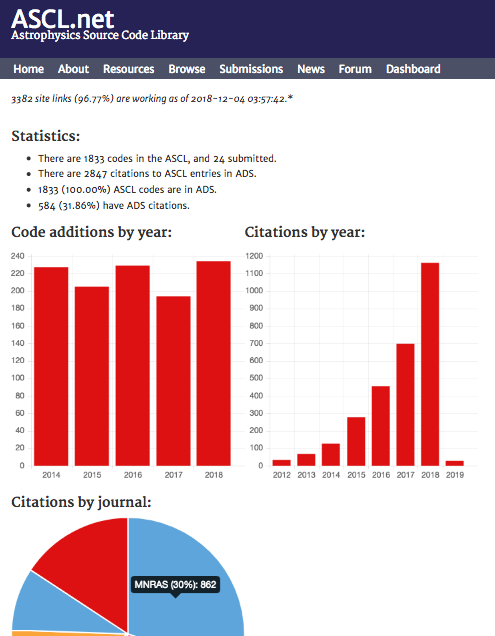
The ASCL makes it easy to cite the software astro research depends on. Every astronomy journal and many others such as Science and Nature accept ASCL references; ADS shows citations to ASCL entries from nearly 90 journals. Citations to ASCL entries are tracked by ADS, Web of Science, and other indices.
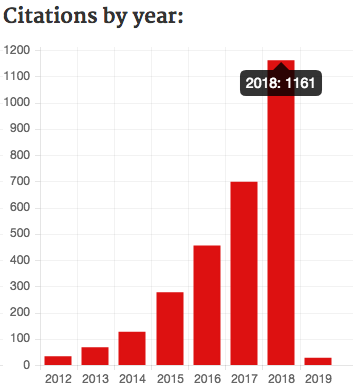
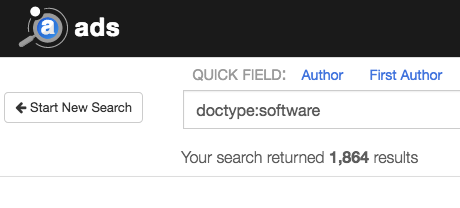
Citations to ASCL entries from ADS as of 12/05/2018ADS makes it easy to search for software in its holdings through the use of the "software" doctype.
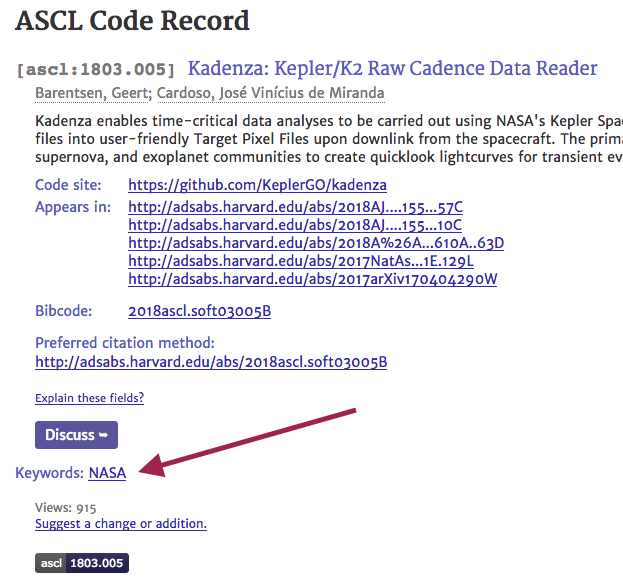
ASCL has started tagging NASA software among its entries, allowing you to search ASCL and ADS for this software.
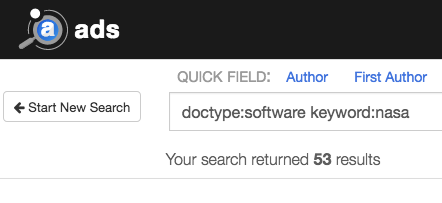
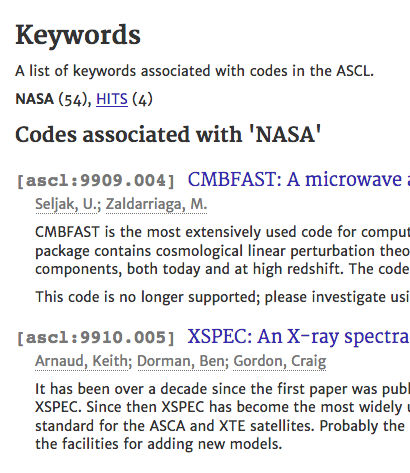
You can find the tags on an entry below the "Discuss" button.
Citation information and other statistics, such as the number of site links we most recently checked, when we checked them, and how many are healthy, appear on our dashboard, which is updated on Tuesdays and Fridays.
If you have any questions about citing ASCL entries, we're happy to help! Email editor@ascl.net or tweet to @asclnet. -
Twenty codes were added to the ASCL in November 2018:
binaryBHexp: On-the-fly visualizations of precessing binary black holes
DiskSim: Modeling Accretion Disk Dynamics with SPH
DRAGONS: Gemini Observatory data reduction platform
Flame: Near-infrared and optical spectroscopy data reduction pipeline
gdr2_completeness: GaiaDR2 data retrieval and manipulationMillCgs: Searching for Compact Groups in the Millennium Simulation
muLAn: gravitational MICROlensing Analysis Software
PENTACLE: Large-scale particle simulations code for planet formation
PulsarHunter: Searching for and confirming pulsars
pygad: Analysing Gadget Simulations with PythonPylians: Python libraries for the analysis of numerical simulations
QuickSip: Project survey image properties onto the sky into Healpix maps
radon: Streak detection using the Fast Radon Transform
RLOS: Time-resolved imaging of model astrophysical jets
SEP: Source Extraction and PhotometryShark: Flexible semi-analytic galaxy formation model
SIM5: Library for ray-tracing and radiation transport in general relativity
synphot: Synthetic photometry using Astropy
VoigtFit: Absorption line fitting for Voigt profiles
Vplanet: Virtual planet simulator -
Twenty-one codes were added to the ASCL in October 2018:
APPLawD: Accurate Potentials in Power Law Disks
ARTES: 3D Monte Carlo scattering radiative transfer in planetary atmospheres
Barcode: Bayesian reconstruction of cosmic density fields
catsHTM: Catalog cross-matching tool
cuFFS: CUDA-accelerated Fast Faraday SynthesisDDS: Debris Disk Radiative Transfer Simulator
Echelle++: Generic spectrum simulator
Eclairs: Efficient Codes for the LArge scales of the unIveRSe
Firefly: Interactive exploration of particle-based data
galfast: Milky Way mock catalog generatorGiRaFFE: General relativistic force-free electrodynamics code
JETGET: Hydrodynamic jet simulation visualization and analysis
MIEX: Mie scattering code for large grains
ODTBX: Orbit Determination Toolbox
pycraf: Spectrum-management compatibilityPyUltraLight: Pseudo-spectral Python code to compute ultralight dark matter dynamics
SOPHISM: Software Instrument Simulator
STARRY: Analytic computation of occultation light curves
STiC: Stockholm inversion code
VaeX: Visualization and eXploration of Out-of-Core DataFrames -
The Astronomy Department at the University of Maryland (College Park) offers a one-credit astronomy scientific computing class, ASTR 288P: Introduction to Astronomical Programming, to provide undergraduates with a foundation in computing. This course is a prerequisite to an advanced-level three-credit course on Computational Astrophysics (ASTR 415).
In ASTR 288P, students learn to work with the UNIX terminal, get the basics of coding with Python and some C, and learn what makefiles are and how to install software, among other topics. The course also introduces students to the ASCL, as for the final class project, students (either alone or in pairs) pick a code from the ASCL, give a short presentation on how they installed and used it, and discuss how that code fits in the large scheme of computing in astrophysics. This allows the students to get a feel for the computational work the astro community is doing and is a good match to test the skills they should have learned in the class.