ASCL News
-
Until this week, a search in ADS for doctype:"software" keyword:"NASA" returned zero results. NASA has funded the ASCL to make its astronomy research software discoverable in ASCL and ADS. This required changes to the ASCL structure and the ADS data feed, and edits to some current records; it also entails mining various NASA software sites for codes that meet the ASCL's criteria and creating appropriately tagged entries for them. In the first phase of the project, started in July, our wonderful developer Judy Schmidt (@SpaceGeck) worked her magic on our infrastructure, keywords have been added to some existing records, and ADS has ingested the first entries we’ve tagged with the NASA keyword. We can now see first results from this two-year project:

Additional changes will be coming to the ASCL in the coming months as we continue this funded work. We love this project; at its core, it's a simple concept, and leverages existing resources (ADS, various NASA code sites, and ASCL) to make research software more discoverable and provides information about NASA software that was not readily available before. It furthers the excellent work NASA has been doing to release software, demonstrates yet another value of ADS (which has many superpowers!), and makes the ASCL more useful, too. -
Sixteen codes were added to the ASCL in September 2018:
dynesty: Dynamic Nested Sampling package
Isca: Idealized global circulation modeling
LEMON: Differential photometry pipeline
MrMoose: Multi-Resolution Multi-Object/Origin Spectral Energy distribution fitting procedureNEBULA: Radiative transfer code of ionized nebulae at radio wavelengths
nestcheck: Nested sampling calculations analysis
PASTA: Python Astronomical Stacking Tool Array
PCCDPACK: Polarimetry with CCDperfectns: "Perfect" dynamic and standard nested sampling for spherically symmetric likelihoods and priors
PyQSOFit: Python code to fit the spectrum of quasars
qp: Quantile parametrization for probability distribution functions
RequiSim: Variance weighted overlap calculatorspops: Spinning black-hole binary population synthesis
stepped_luneburg: Stacked-based ray tracing code to model a stepped Luneburg lens
surfinBH: Surrogate final black hole properties for mergers of binary black holes
VBBINARYLENSING: Microlensing light-curve computation -
Eleven codes were added to the ASCL in August 2018:
2DSF: Vectorized Structure Function Algorithm
Barycorrpy: Barycentric velocity calculation and leap second management
CPF: Corral Pipeline Framework
Fips: An OpenGL based FITS viewer
hfof: Friends-of-Friends via spatial hashinghi_class: Horndeski in the Cosmic Linear Anisotropy Solving System
ImPlaneIA: Image Plane Approach to Interferometric Analysis
py-sdm: Support Distribution Machines
PyMieDap: Python Mie Doubling Adding Program
Robbie: Radio transients and variables detection workflow -
Thirty-three codes were added to the ASCL in July 2018:
AngPow: Fast computation of accurate tomographic power spectra
ARKCoS: Radial kernel convolution on the sphere
ASP: Ames Stereo Pipeline
BARYCORR: Python interface for barycentric RV correction
CAESAR: Compact And Extended Source Automated RecognitionCLASSgal: Relativistic cosmological large scale structure code
DAMOCLES: Monte Carlo line radiative transfer code
EVEREST: Tools for de-trending stellar photometry
GLS: Generalized Lomb-Scargle periodogram
HELIOS: Radiative transfer code for exoplanetary atmospheresHII-CHI-mistry_UV: Oxygen abundance and ionizionation parameters for ultraviolet emission lines
HII-CHI-mistry: Oxygen abundance and ionizionation parameters for optical emission lines
kplr: Tools for working with Kepler data using Python
ktransit: Exoplanet transit modeling tool in python
LSC: Supervised classification of time-series variable starsMAPPINGS V: Astrophysical plasma modeling code
MIDLL: Markwardt IDL Library
nfield: Stochastic tool for QFT on inflationary backgrounds
NRPy+: Code generator for Numerical Relativity
POLARIS: POLArized RadIation SimulatorPOWER: Python Open-source Waveform ExtractoR
PUMA: Low-frequency radio catalog cross-matching
PyAutoLens: Strong lens modeling
pyqz: Emission line code
SENR: Simple, Efficient Numerical RelativitySPEGID: Single-Pulse Event Group IDentification
SSMM: Slotted Symbolic Markov Modeling for classifying variable star signatures
TBI: Three-Body Integration
THOR: Global Circulation Model for planetary atmospheres
Warpfield: Winds And Radiation Pressure: Feedback Induced Expansion, colLapse and Dissolutionwdmerger: Simulate white dwarf mergers with CASTRO
xGDS: Exploration Ground Data Systems
ZBARYCORR: Barycentric redshift calculator -
Thirty-two codes were added to the ASCL in June 2018:
ASPIC: Accurate Slow-roll Predictions for Inflationary Cosmology
BHDD: Primordial black hole binaries code
BRATS: Broadband Radio Astronomy ToolS
BWED: Brane-world extra dimensions
DirectDM-mma: Dark matter direct detectionDirectDM-py: Dark matter direct detection
EXO-NAILER: EXOplanet traNsits and rAdIal veLocity fittER
exoinformatics: Compute the entropy of a planetary system's size-ordering
fcmaker: Creating ESO-compliant finding charts for Observing Blocks on p2
feets: feATURE eXTRACTOR FOR tIME sERIESfoxi: Forecast Observations and their eXpected Information
GLASS: Parallel, free-form gravitational lens modeling tool and framework
gsf: galactic structure finder
Indri: Pulsar population synthesis toolset
Keras: The Python Deep Learning libraryLASR: Linear Algorithm for Significance Reduction
OMEGA: One-zone Model for the Evolution of GAlaxies
P2DFFT: Parallelized technique for measuring galactic spiral arm pitch angles
pile-up: Monte Carlo simulations of star-disk torques on hot Jupiters
pwv_kpno: Modeling atmospheric absorptionPyAMOR: AMmOnia data Reduction
PyMUSE: VLT/MUSE data analyzer
pyZELDA: Python code for Zernike wavefront sensors
QE: Quantum opEn-Source Package for Research in Electronic Structure, Simulation, and Optimization
RadFil: Radial density profile builder for interstellar filamentsRMextract: Ionospheric Faraday Rotation calculator
SpaghettiLens: Web-based gravitational lens modeling tool
Spheral++: Coupled hydrodynamical and gravitational numerical simulations
SpS: Single-pulse Searcher
SYGMA: Modeling stellar yields for galactic modelingWDEC: White Dwarf Evolution Code
WiseView: Visualizing motion and variability of faint WISE sources -
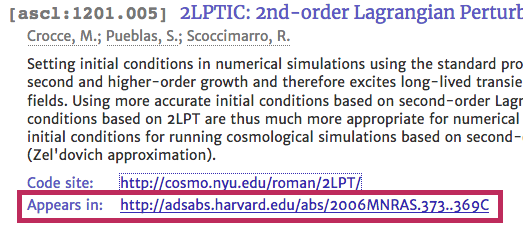
Most ASCL code entries have one or more links to articles that either describe or use the software in that entry. ADS ingests this information to associate the code with relevant literature. For example, the entry for 2LPTIC: 2nd-order Lagrangian Perturbation Theory Initial Conditions includes a link for an MNRAS paper in the Appears in field:
Going to the ADS entry for this software shows that the code is associated with a paper under Associated Articles: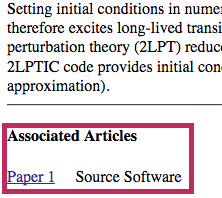 This, however, doesn't tell you anything about the relationship between the article and the software. ADS and the ASCL have been working to improve this. The ASCL has been disambiguating these article links into Described in and Used in. At the ADS Hack Day event last month, ASCL provided ADS with disambiguated links for over 900 entries, and Carolyn Grant had these uploaded into ADS in a matter of minutes. (ADS folks are wizards, I tell you! Wizards! They work magic!!)
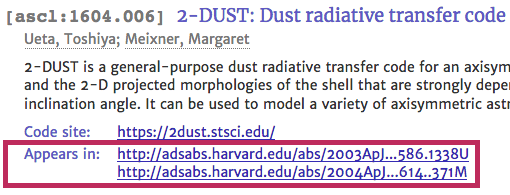
Currently, ASCL records appear the same, but for those records we have provided disambiguated article links, ADS displayed them as Described in and Used in, as you can see in the 2-DUST: Dust radiative transfer code entry, for which the ASCL lists two papers:
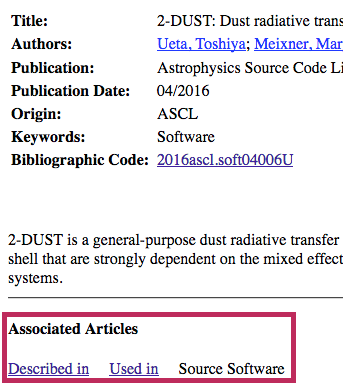
For ASCL records in which the Appears in link(s) have not been disambiguated, there is no change in how they are displayed in ADS. We have over 700 entries with article links still to be disambiguated and we continue this work; ADS will be ingesting the changes with their regular weekly ingest of ASCL data.
-
Thirty-two codes were added to the ASCL in May 2018:
3DCORE: Forward modeling of solar storm magnetic flux ropes for space weather prediction
AGAMA: Action-based galaxy modeling framework
Arcmancer: Geodesics and polarized radiative transfer library
ASTROPOP: ASTROnomical Polarimetry and Photometry pipeline
BCcodes: Bolometric Corrections and Synthetic Stellar PhotometryBinMag: Widget for comparing stellar observed with theoretical spectra
CUBE: Information-optimized parallel cosmological N-body simulation code
CubiCal: Suite for fast radio interferometric calibration
DeepMoon: Convolutional neural network trainer to identify moon craters
dftools: Distribution function fittingEARL: Exoplanet Analytic Reflected Lightcurves package
exocartographer: Constraining surface maps orbital parameters of exoplanets
GLACiAR: GaLAxy survey Completeness AlgoRithm
grid-model: Semi-numerical reionization code
HENDRICS: High ENergy Data Reduction Interface from the Command Shelllcps: Light curve pre-selection
MontePython 3: Parameter inference code for cosmology
OSS: OSSOS Survey Simulator
PampelMuse: Crowded-field 3D spectroscopy
PoMiN: A Post-Minkowskian N-Body Solverpowerbox: Arbitrarily structured, arbitrary-dimension boxes and log-normal mocks
PROM7: 1D modeler of solar filaments or prominences
PyCBC: Gravitational-wave data analysis toolkit
PyCCF: Python Cross Correlation Function for reverberation mapping studies
PySE: Python Source Extractor for radio astronomical imagesSNSEDextend: SuperNova Spectral Energy Distributions extrapolation toolkit
SP_Ace: Stellar Parameters And Chemical abundances Estimator
STARBLADE: STar and Artefact Removal with a Bayesian Lightweight Algorithm from Diffuse Emission
StarSmasher: Smoothed Particle Hydrodynamics code for smashing stars and planets
StePS: Stereographically Projected Cosmological SimulationsSWIFT: SPH With Inter-dependent Fine-grained Tasking
xspec_emcee: XSPEC-friendly interface for the emcee package -
Twenty-six codes were added to the ASCL in April 2018:
3DView: Space physics data visualizer
Agatha: Disentangling period signals from correlated noise in a periodogram framework
allantools: Allan deviation calculation
APPHi: Automated Photometry Pipeline for High Cadence, Large Volume Data
ASERA: A Spectrum Eye Recognition AssistantAstroCV: Astronomy computer vision library
CAT-PUMA: CME Arrival Time Prediction Using Machine learning Algorithms
chroma: Chromatic effects for LSST weak lensing
DaCHS: Data Center Helper Suite
DESCQA: Synthetic Sky Catalog Validation FrameworkDPPP: Default Pre-Processing Pipeline
EGG: Empirical Galaxy Generator
FastChem: An ultra-fast equilibrium chemistry
IMNN: Information Maximizing Neural Networks
ipole: Semianalytic scheme for relativistic polarized radiative transportKSTAT: KD-tree Statistics Package
Lenstronomy: Multi-purpose gravitational lens modelling software package
LFlGRB: Luminosity function of long gamma-ray bursts
LFsGRB: Binary neutron star merger rate via the luminosity function of short gamma-ray bursts
NR-code: Nonlinear reconstruction codeorbit-estimation: Fast orbital parameters estimator
ProFound: Source Extraction and Application to Modern Survey Data
SMERFS: Stochastic Markov Evaluation of Random Fields on the Sphere
surrkick: Black-hole kicks from numerical-relativity surrogate models
UniDAM: Unified tool to estimate Distances, Ages, and MassesViSBARD: Visual System for Browsing, Analysis and Retrieval of Data
-
Fifteen codes were added in March 2018:
3D-PDR: Three-dimensional photodissociation region code
CIFOG: Cosmological Ionization Fields frOm Galaxies
DaMaSCUS-CRUST: Dark Matter Simulation Code for Underground Scatterings - Crust Edition
ExoCross: Spectra from molecular line lists
ExtLaw_H18: Extinction law codeFAST: Fitting and Assessment of Synthetic Templates
IMAGINE: Interstellar MAGnetic field INference Engine
Kadenza: Kepler/K2 Raw Cadence Data Reader
LWPC: Long Wavelength Propagation Capability
MulensModel: Microlensing light curves modelingnanopipe: Calibration and data reduction pipeline for pulsar timing
optBINS: Optimal Binning for histograms
RAPTOR: Imaging code for relativistic plasmas in strong gravity
scarlet: Source separation in multi-band images by Constrained Matrix Factorization
SETI-EC: SETI Encryption Code -
Sixteen codes were added in February 2018:
AntiparticleDM: Discriminating between Majorana and Dirac Dark Matter
ARTIP: Automated Radio Telescope Image Processing Pipeline
astroplan: Observation planning package for astronomers
BHMcalc: Binary Habitability Mechanism CalculatorCMacIonize: Monte Carlo photoionisation and moving-mesh radiation hydrodynamics
collapse: Spherical-collapse model code
eqpair: Electron energy distribution calculator
FAC: Flexible Atomic CodeGlimpse: Sparsity based weak lensing mass-mapping tool
HiGal_SED_Fitter: SED fitting tools for Herschel Hi-Gal data
mrpy: Renormalized generalized gamma distribution for HMF and galaxy ensemble properties comparisons
PyOSE: Orbital sampling effect (OSE) simulatorrunDM: Running couplings of Dark Matter to the Standard Model
venice: Mask utility
Verne: Earth-stopping effect for heavy dark matter
VISIBLE: VISIbility Based Line Extraction