ASCL News
-
Ten codes were added to the ASCL in September 2015:
AFR (ASPFitsReader): A pulsar FITS file reader and analysis package
FalconIC: Initial conditions generator for cosmological N-body simulations in Newtonian, Relativistic and Modified theories
FARGO3D: Hydrodynamics/magnetohydrodynamics code
GFARGO: FARGO for GPU
OPERA: Objective Prism Enhanced Reduction AlgorithmsTempo: Pulsar timing data analysis
TRUVOT: True Background Technique for the Swift UVOT Grisms
pycola: N-body COLA method code
PyCS: Python Curve Shifting
XSHPipelineManager: Python Wrapper for the VLT/X-shooter Data Reduction Pipeline -
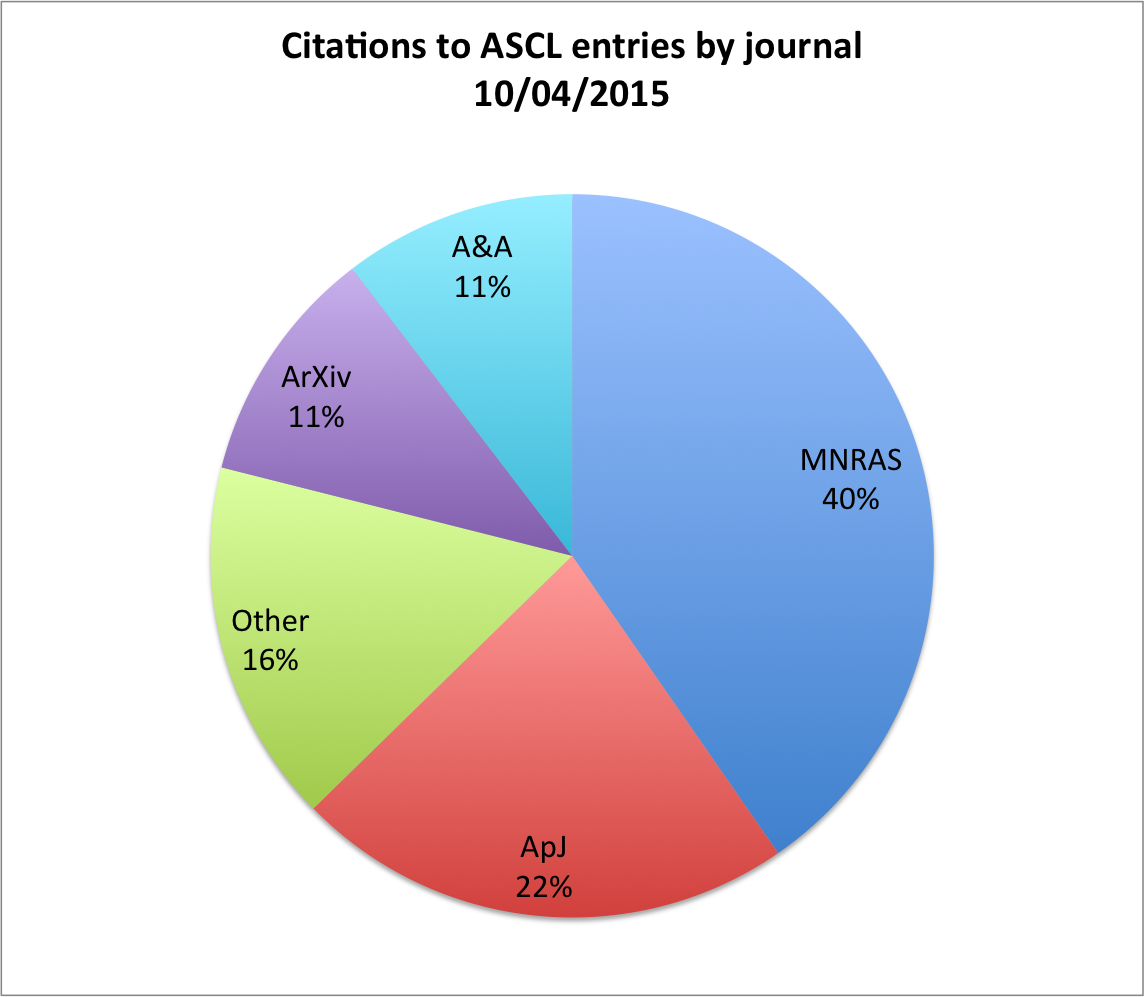
... and which journals have the most?
 I had software citations on my mind all last week, as the 3rd Workshop on Sustainable Software for Science: Practice and Experiences (WSSSPE3) was held last Monday and Tuesday in Boulder, CO, and I spent a good bit of my time there in the work group for Hacking the credit and citation ecosystem (making it work, or work better, for software). This made me curious as to which journals have citations to ASCL entries, and which have the most citations to ASCL entries. I was pretty sure I knew the answer to the latter, but it's always good to test what one knows. So I went looking, and this what I found...
These three journals and arXiv hold 84% of citations to ASCL entries:
Monthly Notices of the Royal Astronomical Society
The Astrophysical Journal
ArXiv e-prints
Astronomy and AstrophysicsOther publications with citations to the ASCL include:
The Astronomical Journal
Astronomy and Computing
The Astrophysical Journal Supplement Series
Computational Astrophysics and Cosmology
Computer Physics Communications
Galaxies
Icarus
Journal of Cosmology and Astro-Particle Physics
Journal of Physics Conference SeriesJournal of Physics G Nuclear Physics
The Messenger
Physical Review C
Physical Review D
Physical Review Letters
Physics Uspekhi
Publications of the Astronomical Society of Japan
Publications of the Astronomical Society of the Pacific
Revista Mexicana de Astronomia y AstrofisicaProceedings, too, including:
18th European White Dwarf Workshop
19th European Workshop on White Dwarfs
Astronomical Society of India Conference Series
Asymmetrical Planetary Nebulae VI ConferenceEAS Publications Series
IAU Symposium
SF2A-2014: Proceedings of the Annual meeting of the French Society of Astronomy and Astrophysics
Society of Photo-Optical Instrumentation Engineers (SPIE) Conference SeriesI appreciate ADS all over again for making it possible to compile this information so quickly.
-
Ten codes were added to the ASCL in August 2015:
ColorPro: PSF-corrected aperture-matched photometry
FRELLED: FITS Realtime Explorer of Low Latency in Every Dimension
HMcode: Halo-model matter power spectrum computation
NGMIX: Gaussian mixture models for 2D images
NICOLE: NLTE Stokes Synthesis/Inversion CodeREDUCEME: Long-slit spectroscopic data reduction and analysis
SExSeg: SExtractor segmentation
SHDOM: Spherical Harmonic Discrete Ordinate Method for Atmospheric Radiative Transfer
TreeCorr: Two-point correlation functions
Trilogy: FITS image conversion software -
From feedback we received about the "Ref" field, we've relabeled that field to lessen the confusion about the article link(s) in the Code Record. What had appeared is:

What now appears is:

We supply a link, too, to a page that explains what the Website, Appears in, and Bibcode fields are, and hope this makes things clearer.If you have suggestions for the ASCL, please feel free to post them here or email editor@ascl.net. Thank you!
-
Twenty codes were added to the ASCL in July 2015:
3D-Barolo: 3D fitting tool for the kinematics of galaxies
abo-cross: Hydrogen broadening cross-section calculator
Astrochem: Abundances of chemical species in the interstellar medium
AstroStat: Statistical analysis tool
DALI: Derivative Approximation for LIkelihoodsDRAMA: Instrumentation software environment
FAT: Fully Automated TiRiFiC
getsources: Multi-scale, multi-wavelength source extraction
HLINOP: Hydrogen LINe OPacity in stellar atmospheres
IEHI: Ionization Equilibrium for Heavy IonsK-Inpainting: Inpainting for Kepler
L-PICOLA: Fast dark matter simulation code
Least Asymmetry: Centering Method
Pelican: Pipeline for Extensible, Lightweight Imaging and CAlibratioN
PPInteractions: Secondary particle spectra from proton-proton interactionspyro: Python-based tutorial for computational methods for hydrodynamics
REDSPEC: NIRSPEC data reduction
slimplectic: Discrete non-conservative numerical integrator
SUPERBOX: Particle-multi-mesh code to simulate galaxies
Toyz: Large datasets and astronomical images analysis framework -
ASCL entries include a field called "Ref," for "refereed." As the ASCL indexes codes used in research, this field contains at least one link to a research article which describes a code or in which the code was used.
Screen capture showing Site and Ref fields in an ASCL entry The information in the Ref field is used by ADS to link papers and the codes they use, making it easy for someone reading an article to find the code(s) used in that research. You can find these associations in the "Associated Articles" section of an ADS entry.
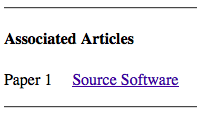
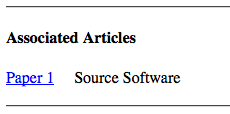
In the first image below, which is a screen clip from an ADS entry, the Source Software link brings up the ASCL entry for a code used in the article; in the second image, the Paper 1 link brings up a paper that used the code:
Some papers have several links in the Ref field:
 These are papers we found while researching a code or were entered by a code author when submitting code to the ASCL. Associating article entries with entries for the codes used in those articles makes finding the software used in the research easier. And though software is increasingly cited (in a variety of ways), it isn't always, so using the Ref/Associated Articles links can help a code author demonstrate the impact of a particular software package.
I know the ASCL is missing many of these associations; ADS and the ASCL would like to improve this linkage. If you have ideas on how to do this, please post them here, or send them to editor@ascl.net. Thanks!
-
Ten codes were added to the ASCL in June 2015:
dmdd: Dark matter direct detection
EATCVB: Coronal heating rate approximations
fsclean: Faraday Synthesis CLEAN imager
multiband_LS: Multiband Lomb-Scargle Periodograms
PLATO Simulator: Realistic simulations of expected observationspyKLIP: PSF Subtraction for Exoplanets and Disks
PyMC: Bayesian Stochastic Modelling in Python
REALMAF: Magnetic power spectra from Faraday rotation maps
SPRITE: Sparsity-based super-resolution algorithm
VAPID: Voigt Absorption-Profile [Interstellar] Dabbler -
... maybe not like topsy, but steadily nonetheless. In looking at the ASCL's growth over the past year, I see that on June 15 of last year, ADS held 818 ASCL entries with 168 cumulative citations. 78 different codes had been cited by their ASCL ID, or 9.5% of codes in the ASCL.
Today, there are 1079 ASCL records in ADS with a total of 334 citations, nearly double last year, and the number of codes cited by ASCL ID has just more than doubled; that number now stands at 158, which is 14.6% of codes in the ASCL cited using the ASCL record.
So if my figuring is correct (no guarantees...), the ASCL has grown 32% in the past year (by 261 codes, from 818 to 1079), while codes in the ASCL cited by these entries is up 100%.
We are very interested in code citation, however that happens; we want software authors to gain exposure and credit for their work! A number of excellent ways to cite codes exist, and so long as codes do get cited, we don't care how. We track citations to ASCL entries because this is one way to determine whether the ASCL is being used; page views are another measure we employ.
And yes, it's being used. Yay! Thank you!
-
Thirty-four codes were added to the ASCL in May 2015:
2dfdr: Data reduction software
ARoME: Analytical Rossiter-McLaughlin Effects
ASteCA: Automated Stellar Cluster Analysis
Athena3D: Flux-conservative Godunov-type algorithm for compressible magnetohydrodynamics
BAYES-X: Bayesian inference tool for the analysis of X-ray observations of galaxy clustersCALCEPH: Planetary ephemeris files access code
CANDID: Companion Analysis and Non-Detection in Interferometric Data
caret: Classification and Regression Training
COBS: COnstrained B-Splines
cosmoabc: Likelihood-free inference for cosmologyCUTE: Correlation Utilities and Two-point Estimation
dStar: Neutron star thermal evolution code
FCLC: Featureless Classification of Light Curves
fits2hdf: FITS to HDFITS conversion
HALOGEN: Approximate synthetic halo catalog generatorKS Integration: Kelvin-Stokes integration
Lensed: Forward parametric modelling of strong lenses
LSSGALPY: Visualization of the large-scale environment around galaxies on the 3D space
missForest: Nonparametric missing value imputation using random forest
Planck Level-S: Planck Simulation PackagePOKER: P Of K EstimatoR
pyMCZ: Oxygen abundances calculations and uncertainties from strong-line flux measurements
PyTransit: Transit light curve modeling
relline: Relativistic line profiles calculation
RESOLVE: Bayesian algorithm for aperture synthesis imaging in radio astronomyrvfit: Radial velocity curves fitting for binary stars or exoplanets
SCEPtER: Stellar CharactEristics Pisa Estimation gRid
SNEC: SuperNova Explosion Code
Snoopy: General purpose spectral solver
SNooPy: TypeIa supernovae analysis toolsStarfish: Robust spectroscopic inference tools
StellaR: Stellar evolution tracks and isochrones tools
TEA: Thermal Equilibrium Abundances
TFIT: Mixed-resolution data set photometry package -
Here are a few handy links to find astro software, whether used for research or not; some resources required two searches.
BitBucket: astronomy and astrophysics
GitHub
IDL
PyPi: astronomy and astrophysics
R
SourceForge