ASCL News
-
On Tuesday, January 6, the ASCL, AAS Working Group on Astronomical Software (WGAS), and the Moore-Sloan Data Science Environment at NYU sponsored a special session on software licenses, with support from the AAS. This subject was suggested as a topic of interest in the Astrophysics Code Sharing II: The Sequel session at AAS 223.
Frossie Economou from the LSST and chair of the WGAS opened the session with a few words of welcome and stressed the importance of licensing. I gave a 90-second overview of the ASCL before turning the podium over to Alberto Accomazzi from NASA/Astronomy Data System (ADS), who introduced the panel of speakers and later moderated the open discussion (opening slides), after which Frossie again took the podium for some closing remarks. The panel of six speakers discussed different licenses and shared considerations that arise when choosing a license; they also covered institutional concerns about intellectual property, governmental restrictions on exporting codes, concerns about software beyond licensing, and information on how much software is licensed and characteristics of that software. The floor was then opened for discussion and questions.
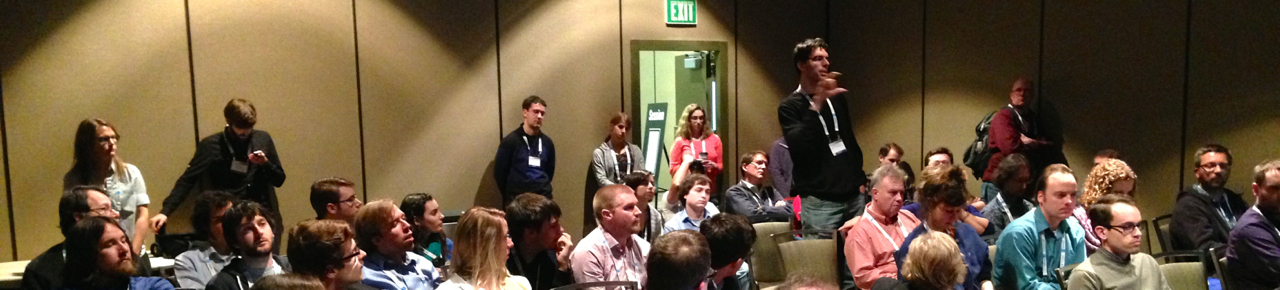
Discussion period moderated by Alberto Accomazzi Presentations
Some of the main points from each presentation are summarized below, with links to the slides used by the presenters.-
- Copy-left and Copy-right, Jacob VanderPlas (eScience institute, University of Washington)
Jake extolled everyone to always license codes, as in the US, copyright law defaults to "all privileges retained" unless otherwise specified. He pointed out that "free software" can refer to the freedoms that are available to users of the software. He covered the major differences between BSD/MIT-style "permissive" licensing and GPL "sticky" licensing while acknowledging that the difference between them can be a contentious issue.
slides (PDF)
- Copy-left and Copy-right, Jacob VanderPlas (eScience institute, University of Washington)
-
- University tech transfer perspective on software licensing, Laura L. Dorsey (Center for Commercialization, University of Washington)
Universities care about software licenses for a variety of reasons, Laura stated, which can include limiting the university's risk, respecting IP rights, complying with funding obligations, and retaining academic and research use rights. She also covered factors software authors may care about, among them receiving attribution, controlling the software, and making money. She reinforced the importance of licensing code and discussed the common components of a software license.
slides (PDF)
- University tech transfer perspective on software licensing, Laura L. Dorsey (Center for Commercialization, University of Washington)
-
- Relicensing the Montage Image Mosaic Engine, G. Bruce Berriman (Infrared Processing and Analysis Center, Caltech)
In last year's Astrophysics Code Sharing session, Bruce had discussed the limitations of the Caltech license under which the code Montage was licensed; since then, Montage has been relicensed to a BSD 3-Clause License. Following on the heels of Laura's discussion and serving as a case study for institutional concerns regarding software, Bruce related the reasons for and concerns about the relicensing, and discussed working with the appropriate office at Caltech to bring about this change.
slides (PDF)
- Relicensing the Montage Image Mosaic Engine, G. Bruce Berriman (Infrared Processing and Analysis Center, Caltech)
-
- Export Controls on Astrophysical Simulation Codes, Daniel Whalen (Institute for Theoretical Astrophysics, University of Heidelberg)
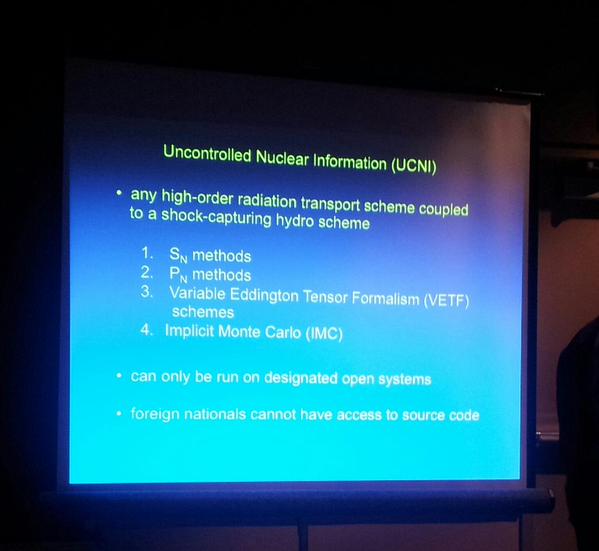
Restricted algorithms; image by Adam M. Jacobs Dan's presentation covered some of the government issues that arise from research codes, including why certain codes fall under export controls; a primary reason is to prevent the development of nuclear weapons.Dan also brought up how foreign intelligence agencies collect information and what specific simulations are restricted, and stated that Federal rules are changing, but slowly.
slides (PDF)
- Export Controls on Astrophysical Simulation Codes, Daniel Whalen (Institute for Theoretical Astrophysics, University of Heidelberg)
-
- Why licensing is just the first step, Arfon M. Smith (GitHub Inc.)
Arfon went beyond licensing in his presentation to discuss open source and open collaborations, and how GitHub delivers on a "theoretical promise of open source." He shared statistics on the growth of collaborative coding using GitHub, and demonstrated how a collaborative coding process can work and pointed out that through this exposed process, community knowledge is increased and shared. He challenged the audience to contemplate the many reasons for releasing a project and to ask themselves what kind of project they want to create.
slides (PDF)
- Why licensing is just the first step, Arfon M. Smith (GitHub Inc.)
-
- Licenses in the wild, Daniel Foreman-Mackey (New York University)
First, I have to note that Dan made it through 41 slides in just over the six minutes allotted for his talk, covering about seven slides/minute; I don't know whether to be more impressed with his presentation skills or the audience's information-intake abilities!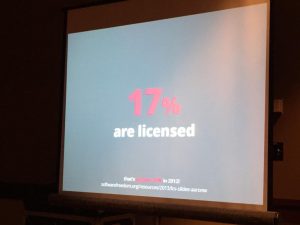
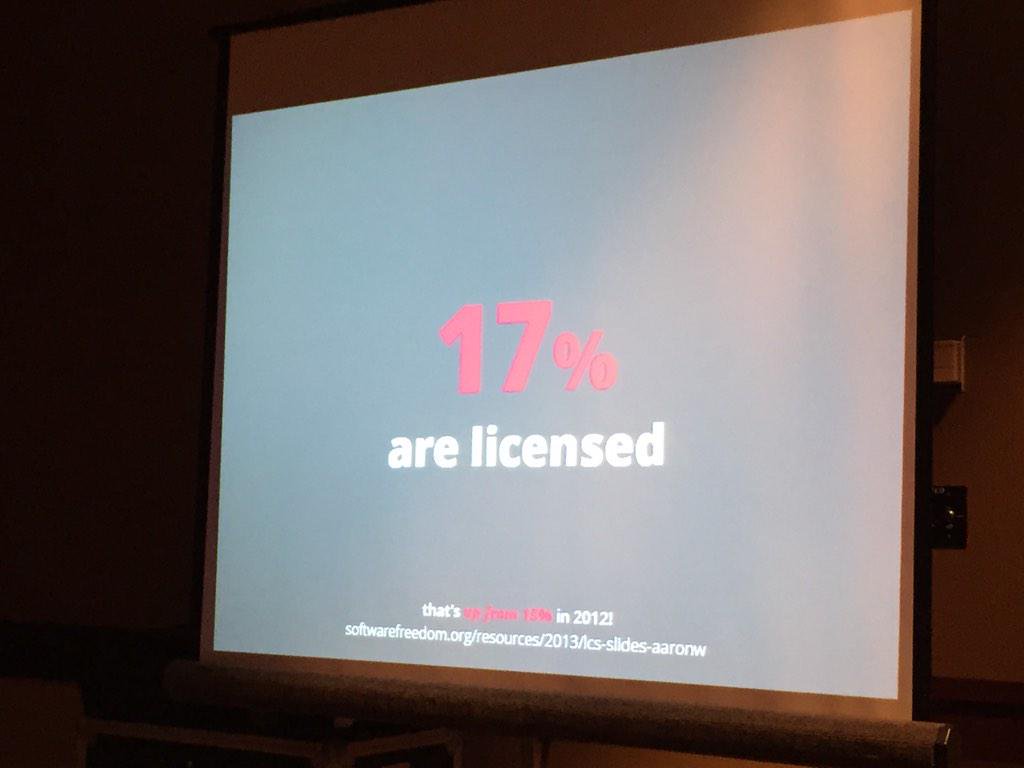
Percentage of licensed GitHub repos; image by Arfon Smith After declaring that he knows nothing about licensing, Dan showed us, and how, that he knows plenty about mining data and extracting information from it. From his "random" selection of 1.6 million GitHub repositories, he noted with some glee that 63 languages are more popular on GitHub than IDL is, the number of repositories with licenses have increased since 2012 to 17%, and that only 28,972 of the 1.6 million mentioned the license in the README file. Dan also determined the popularity of various licenses overall and by language and shared that information as well.
slides (PDF)
- Licenses in the wild, Daniel Foreman-Mackey (New York University)
Open Discussion
After Dan's presentation, Alberto Accomazzi opened the floor for discussion. Takeaway points included:- Discuss licensing with your institution; it's likely there is an office/personnel devoted to deal with these issues
- This office is likely very familiar with issues you bring to it, including who to refer you to when the issues are outside their purview
- "Friends don't let friends write their own licenses." IOW, select an existing license rather than writing your own
- License your code
- Let others know how you want your code cited/acknowledged
My thanks to David W. Hogg, Kelle Cruz, Matt Turk, and Peter Teuben for work -- which started last March! -- on developing the session, to Alberto for his excellent moderating and to Frossie for opening and closing it. My thanks also to the wonderful Jake, Laura, Bruce, Dan W, Arfon, and Dan F-M for presenting at this session, and to the Moore-Sloan Data Science Environment at NYU and AAS for their sponsorship.
Resources
Many resources on licensing, including excellent posts by Jake and Bruce, can be found here. -
-
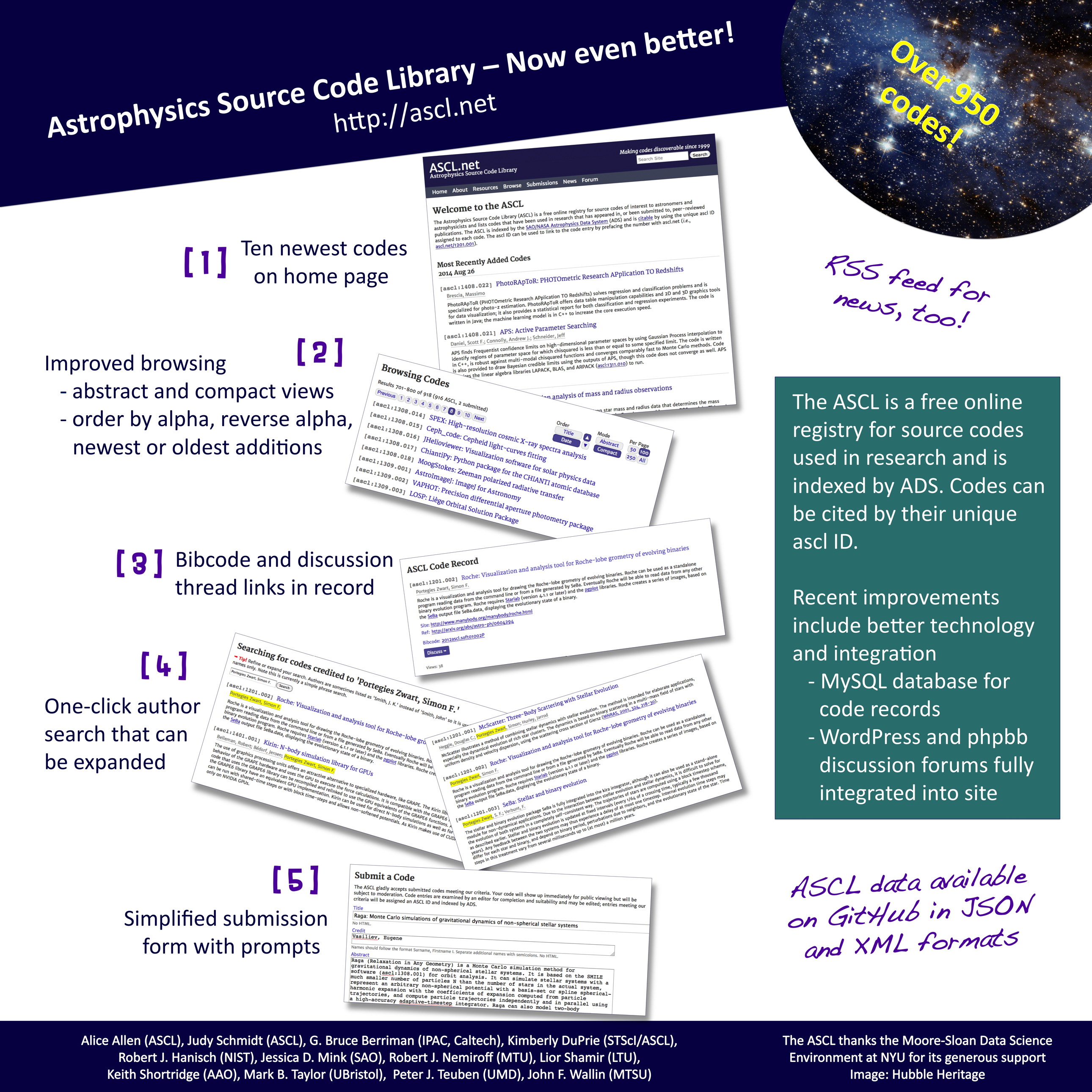
Abstract: The Astrophysics Source Code Library (ASCL, ascl.net) is a free online registry of codes used in astornomy research. Indexed by ADS, it now contains nearly 1,000 codes and with recent major changes, is better than ever! The resource has a new infrastructure that offers greater flexibility and functionality for users, including an easier submission process, better browsing, one-click author search, and an RSS feeder for news. The new database structure is easier to maintain and offers new possibilities for collaboration. Come see what we've done!
Authors: Alice Allen (ASCL), Judy Schmidt (ASCL), Bruce Berriman (IPAC/Caltech), Kimberly DuPrie (ASCL/STScI), Robert J. Hanisch (NIST), Jessica D. Mink (SAO), Robert J. Nemiroff (MTU), Lior Shamir (LTU), Keith Shortridge (AAO), Mark B. Taylor (UBristol), Peter J. Teuben (UMD), John F. Wallin (MTSU)
-
A short list without the descriptions, other information, and Saturday-start bootcamp the longer list has, because short is beautiful, too! Some may require registration/charge a fee.
Astropy Tutorial, Sunday, 8:00-11:00 (Tutorial)
Location: 612 (Convention Center)SciCoder@AAS: Intro to Databases for Astronomers, Sunday, 9:00-5:00 (Workshop)
Location: 607 (Convention Center)Astrostatistics, Sunday, 9:30-6:00 (Workshop)
Location: 618/619 (Convention Center)Collaborating Online with GitHub and Other Tools, Sunday, 12:00-5:00 (Workshop)
Location: 303 (Convention Center)232. Licensing Astrophysics Codes: What You Need to Know, Tuesday, 2:00-3:30 (Special Session)
Location: 615 (Convention Center)Software Publication Special Interest Group (SPSIG) Inaugural Meeting, Tuesday, 3:45-4:45 (Special Interest Group meeting)
Location: 615 (Convention Center)Catalogs, Surveys, and Computation Posters, Wednesday, 9:00-5:30
315 Astroinformatics and Astrostatistics in Astronomical Research: Steps Towards Better Curricula, Wednesday, 10:00-11:30 (Special Session)
Location: 620 (Convention Center)The SKA Telescope: Global Project, Revolutionary Science, Extreme Computing Challenges, Wednesday, 12:30-3:30 (Splinter Meeting)
Location: 4C-4 (Convention Center)332. Catalogs/Surveys/Computation – UVOIR, Wednesday, 3:10-3:20 PM (Oral Session)
Location: 620 (Convention Center)434. Computation, Data Handling and Other Matters Posters, Thursday, 9:00-2:00
Hack Day, Thursday, 10:00-7:00 (Workshop)
Location: 4C-2 (Convention Center) -
One of the unconference sessions (proposed during the event) held at December's .Astronomy was on software citation, this subject having come up in an earlier session on improving credit for software.
Discussion and comments in the session inspired me to look at astronomy's current practices for citing software. Though not an exhaustive list, I looked in more than a dozen journals for citations for codes used in research, and below are some of the examples I gathered.
The most common way to cite software is to reference a paper describing the code. This is how, for example, the authors of yt would like that software cited, as shown from a recent MNRAS paper:

Sometimes a link to the website for a code is listed as a reference to it, as was done in a Classical and Quantum Gravity paper:

Conference proceedings are cited in some cases, as the citation below for WCSTools in an The Astrophysical Journal paper demonstrates:
ASCL entries can be cited, too, as shown in this citation for pynbody in a paper published in Physical Review D:
 Someone -- I don't remember who -- reported that Google Scholar does not index mentions of codes, GitHub repos, etc. as citations, because they are not papers. An opinion tweeted out about this summed up the sentiment in the room pretty well! I plan to take this up with Google after the AAS meeting. Fortunately, ADS does index properly formatted software references; the only reference listed in this post that I didn't see captured by ADS was the URL for CAMB, which is not surprising (nor expected).
A subsequent post will include additional information and a list of resources about software citation, to be posted before the first Special Interest Group on software publishing meeting scheduled at AAS225 that will be held on Tuesday, January 6, from 3:45 PM – 4:45 PM in 615 in the Convention Center. The main topic of this meeting will be software citation, and all interested parties are welcome to attend.
The journals below were part of my hunting grounds for software citations. Ever had a citation to software you used in research refused by a publication? If so, I'm interested in knowing the details; please share here or send them to editor@ascl.net. Thanks!
American Institute of Physics Proceedings
Astronomy & Astrophysics
Astronomy and Computing
The Astronomical Journal
The Astrophysical Journal
The Astrophysical Journal Supplement
Classical and Quantum Gravity
Icarus
Monthly Notices of the Royal Astronomical Society
Nature
Physical Review D
Proceedings of the SPIE
Publications of the Astronomical Society of Australia
Publications of the Astronomical Society of Japan
Publications of the Astronomical Society of the PacificAdditional screenshots of software citations:








Formatting counts! Below, two citations for Turbospectrum, the first formatted in a way ADS can pick up and count the citation, the second one not.


-
The AAS's Working Group on Astronomical Software (WGAS) has invited the ASCL to form a Special Interest Group (SIG) on software publication. We think this is a dandy idea and have accepted the invitation. The inaugural meeting will be held on Tuesday, January 6, from 3:45 PM - 4:45 PM in 615 in the Convention Center. This is immediately after the Licensing Astrophysics Codes: What You Need to Know special session that is from 2:00-3:30 in that same room.
As issues around software citation came up several times at this month's .Astronomy meeting and has received subsequent discussion online since, it seems fitting for this to be the main topic for the first meeting of the SPSIG.
Please note that this SIG meeting does not appear in the AAS schedule. The meeting is open to anyone who is interested, and additional information will be posted here as it becomes available.
-
Software is an integral part of astronomy research and the American Astronomical Society meetings reflect this. The upcoming AAS meeting in Seattle (January 4-8) offers workshops, sessions, posters, tutorials, and discussions that focus on many aspects of astronomical software. On Tuesday, join us for a special session on code licensing; immediately after, the inaugural meeting of the Software Publishing Special Interest Group will be held. On Thursday, the wildly successful and fun Hack Day returns. Hack Day includes but is not limited to hacking software; whatever skills you have or project you want to take on, there's a place for you at Hack Day!
Organized by day, below is a list of software-related offerings at the AAS meeting. See you there!
Saturday
Software Carpentry Bootcamp, Saturday-Sunday, 9:00-5:30, organized by August Muench
Computing is now an integral part of every aspect of science, but most scientists are never taught how to build, use, validate, and share software well. As a result, many spend hours or days doing things badly that could be done well in just a few minutes. The goal of AAS 225 Software Carpentry 2 day “bootcamp” is to change that so that astronomers can spend less time wrestling with software and more time doing useful research. Further, good quality, well tested code means science results are easier to verify, share, and update. More information on the Software Carpentry project can be found <http://software-carpentry.org>. The AAS 225 Software Carpentry bootcamp consists of short tutorials alternating with hands-on practical exercises and will cover the core software skills needed build, use, validate, and share software in astronomy: Saturday’s tutorials will comprise shell automation, basic python programming, and unit testing; Sunday’s sessions will shift to focus on advanced python, including numerical and astronomy oriented computing, and version control. Registration is for both days. The target audience for the bootcamp consists of graduate students and early career scientists. The Software Carpentry @ AAS 225 Bootcamp will be run by a set of three certified instructors and a team of helpers. Participants will be required to bring laptops and to install software in advance of the workshop. Some basic familiarity with shell based computing was assumed in setting the bootcamp schedule. See also a FAQ at http://software-carpentry.org/faq.html for more information.
Event Type: Workshop
Organizer: August A. Muench
Location: 609 (Convention Center)
Sunday
Software Carpentry Bootcamp, 9:00-5:00, Day 2; see description above
Astropy Tutorial, Sunday, 8:00-11:00, organized by Perry Greenfield
This tutorial will cover the features and capabilities of Astropy and affiliated packages.
Event Type: Splinter Meeting
Organizer: Perry Greenfield
Location: 612 (Convention Center)SciCoder@AAS: Intro to Databases for Astronomers, Sunday, 9:00-5:00, organized by Demitri Muna
The volume of data available to astronomers today is enormous. The standard pattern of working with flat files doesn't scale to what's available now, let alone with the increasing amount of data that is coming. Every astronomer should have the skills to work with databases both for their own data sets and what is publicly available. This workshop will teach how a database is designed, how to create your own, how to populate it with data, how to query that data, how to work with other databases, and how to write scripts against a database. Exercises and examples will be geared to astronomical data but will be applicable to nearly any data. Participants should have a basic comfort level with Python and will be required to install some software on their laptops before the workshop. The workshop will be presented by Demitri Muna (Ohio State University), creator of the SciCoder workshop, and Alex Hagen (Pennsylvania State University).
Event Type: Workshop
Organizer: Demitri Muna
Location: 607 (Convention Center)Astrostatistics, Sunday, 9:30-6:00, organized by Eric Feigelson
The fields of astronomy and statistics diverged in the 20th century so that astronomers are often not well informed about the wealth of powerful modern methodologies developed by statisticians. Statistics is needed for: characterizing astronomical images, spectra and lightcurves; inferring properties of underlying populations from limited samples; linking astronomical observations to astrophysical theories; and many other aspects of data and science analysis. An additional difficulty has been the inaccessibility of software implementing modern statistical methods for most astronomers. Fortunately, a large, integrated and user-friendly public domain software system has emerged in recent years to implement modern methods. R with its >5000 add-on CRAN packages has >100,000 statistical functionalities, extensive graphics, links to other languages, and more. Over 100 recipe books and extensive on-line support provide guidance for the sophisticated R user. The AAS astrostatistics tutorials are presented by astronomer Eric D. Feigelson and statistician G. Jogesh Babu, authors of the textbook `Modern Statistical Methods for Astronomy with R Applications' that won the PROSE Award for best astronomy book of 2012. Participants should bring laptops with R installed (http://www.r-project.org). R scripts and astronomical datasets will be provided. Schedule for Sunday January 4: 9:30-10:30 Introduction to astrostatistics (lecture) 10:30-11:30 Fundamentals of statistical inference (lecture) 11:30-12:30 Introduction to R (tutorial) -- Lunch (not provided) -- 2:00-3:00 Density estimation or data smoothing (tutorial) 3:00-4:00 Fitting models to data (lecture) 4:00-5:00 Multivariate clustering and classification (tutorial)
Event Type: Workshop
Organizer: Eric Feigelson
Location: 618/619 (Convention Center)Collaborating Online with GitHub and Other Tools, Sunday, 12:00-5:00, organized by August Muench
Distributed collaboration is a hallmark of modern international astronomical research. We collaborate on everything from software development to paper and grant writing to sharing new results, plots, and data files. The goal of this workshop to provide new tools and techniques for productive efficient collaboration online. This workshop will begin with a hands on tutorial of GitHub. This will include reviewing distributed version control systems and learning collaboration workflows using the GitHub system. During the second part of the workshop we will explore an array of other online tools, ranging from cloud storage (DropBox, Google Drive) to collaborative document creation (Google Documents, online LaTeX editors) to feature tracking platforms (Trello, Jira) and much more. We intend to provide concrete workflows and to imbue you with tips and tricks for using these online tools in your research groups. The target audience for the workshop consists of astronomers at all points in their careers. Presenters will include Arfon Smith <https://github.com/arfon>, PhD Astronomer turned Zooniverse developer turned Github Science head, Brent Beer, a GitHub Trainer, and August Muench (Smithsonian). Participants will be required to bring laptops and to install software in advance of the workshop. Familiarity with git or other version control systems is not a prerequisite.
Event Type: Workshop
Organizer: August A. Muench
Location: 303 (Convention Center)
Tuesday
232. Licensing Astrophysics Codes: What You Need to Know, Tuesday, 2:00-3:30
Research in astronomy is increasingly dependent on software methods and astronomers are increasingly required to share their codes; those who write software need to choose a license that delineates whether, when and how others may use and extend this software. Building on comments and questions about licensing in the January 2014 AAS special session “Astrophysics Code Sharing II: The Sequel”, this session, organized by the Astrophysics Source Code Library (ASCL) and AAS's Working Group on Astronomical Software (WGAS), and the Moore-Sloan Data Science Environment, explores why providing an explicit license for software is important, explains different common licenses, examines intellectual property concerns common to universities, and provides information on restrictions that arise from ITAR. A panel of speakers will discuss code licensing, share considerations that arise when choosing a license, and benefits of the licenses they chose. Institutional and governmental concerns about intellectual property, its licensing, use, and release, will also be covered. The floor will then be open for discussion and questions.
Session Type: Special Session
Organizer: Alice Allen
Chair: Frossie Economou
Moderator: Alberto Accomazzi
Location: 615 (Convention Center)232.01. Copy-left and Copy-right, Jacob VanderPlas
232.02. University tech transfer perspective on software licensing, Laura Dorsey
232.03. Relicensing the Montage Image Mosaic Engine, G. B. Berriman
232.04. Export Controls on Astrophysical Simulation Codes, Daniel Whalen
232.05. Why licensing is just the first step, Arfon M. Smith
232.06. Licenses in the wild, Daniel Foreman-Mackey
Open Discussion moderated by Alberto AccomazziSoftware Publication Special Interest Group (SPSIG) Inaugural Meeting, Tuesday, 3:45-4:45
This first meeting of the to-be-formed-at-AAS225 Software Publication Special Interest Group (SPSIG) is open to all interested parties. The main topic of discussion at this meeting will be software citation.
Session Type: Special Interest Group meeting
Organizer: Alice Allen
Location: 615 (Convention Center)
Wednesday
Catalogs, Surveys, and Computation Posters, Wednesday, 9:00-5:30
336.34. A Pipeline for High Resolution Radio Images
Brianna P. Thomas; Alison B. Peck; Jacqueline Hodge; Anthony J. Beasley336.35. ADMIT: ALMA Data Mining Toolkit
Douglas N. Friedel; Lisa Xu; Leslie Looney; Peter J. Teuben; Marc W. Pound; Kevin P. Rauch; Lee G. Mundy; Jeffrey S. Kern336.36. Overview of the SOFIA Data Processing System: A generalized system for manual and automatic data processing at the SOFIA Science Center
Ralph Shuping; Robert Krzaczek; William D. Vacca; Miguel Charcos-Llorens; William T. Reach; Rosemary Alles; Melanie Clarke; Riccardo Melchiorri; James T. Radomski; Sachindev S. Shenoy; David Sandel; Eric Omelian336.37. A Prototype External Event Broker for LSST
Gabriella E. Alvarez; Keivan Stassun; Dan Burger; Robert Siverd; Donald Cox336.39. Simulating Optical Surveys with the LSST Software Stack
Scott Daniel; K. S. Krughoff; Peter Yoachim; R. Lynne Jones; Yusra AlSayyad; Bryce Kalmbach; Andrew J. Connolly; Zeljko Ivezic336.40. The LSST Metrics Analysis Framework (MAF)
R. Lynne Jones; Peter Yoachim; Srinivasan Chandrasekharan; Andrew J. Connolly; Kem H. Cook; Zeljko Ivezic; K. S. Krughoff; Catherine E. Petry; Stephen T. Ridgway336.41. Analyzing Simulated LSST Surveys With MAF
Peter Yoachim; R. Lynne Jones; Srinivasan Chandrasekharan; Andrew J. Connolly; Kem H. Cook; Zeljko Ivezic; K. S. Krughoff; Catherine E. Petry; Stephen T. Ridgway336.42. Building POCS: An open source observatory control system for amateur telescopes used by the PANOPTES project for the detection of extrasolar planets
Wilfred T. Gee; Josh Walawender; Mike Butterfield; Olivier Guyon; Nemanja Jovanovic336.43. Adaptive Optics Images of the Galactic Center: Using Empirical Noise-maps to Optimize Image Analysis
Saundra Albers; Gunther Witzel; Leo Meyer; Breann Sitarski; Anna Boehle; Andrea M. Ghez336.44. Recovering Astrophysical Signals Lost in Noise: Light Curves of Background Objects in Kepler Data
Rebecca L. Bowers; Joshua Pepper; Michael Abdul-Masih; Andrej Prsa336.45. An Exploration Tool for Very Large Spectrum Data Sets
Duane F. Carbon; Christopher Henze336.46. Understanding and Using the Fermi Science Tools
Joseph Asercion336.47. Fact Checking LIGO's Radiometer Code with Simulated LIGO Data
Samantha E. Thrush336.48. AstroML: "better, faster, cheaper" towards state-of-the-art data mining and machine learning
Zeljko Ivezic; Andrew J. Connolly; Jacob Vanderplas336.49. Bayesian Identification of Emission–Line Galaxies with Photometric Equivalent Widths
Andrew S. Leung; Eric J. Gawiser; Viviana Acquaviva336.50. Statistical Computing for Galaxy Modeling and Residual Detection
Sean McLaughlin; Robert Brunner336.51. Separating Stars and Galaxies Probabilistically Based on Color
Victoria Strait336.52. Visualizing SPH Cataclysmic Variable Accretion Disk Simulations with Blender
Brian R. Kent; Matthew A. Wood336.53. Computer analysis of digital sky surveys using citizen science and manual classification
Evan Kuminski; Lior Shamir336.55. Improved Functionality and Curation Support in the ADS
Alberto Accomazzi; Michael J. Kurtz; Edwin A. Henneken; Carolyn S. Grant; Donna Thompson; Roman Chyla; Alexandra Holachek; Vladimir Sudilovsky; Stephen S. Murray336.56. Online Activity Around Scholarly Astronomy Literature - A Discussion of Altmetrics
Edwin A. Henneken; Alberto Accomazzi; Michael J. Kurtz; Donna Thompson; Carolyn S. Grant; Stephen S. Murray336.57. Astrophysics Source Code Library -- Now even better!
Alice Allen; Judy Schmidt; Bruce Berriman; Kimberly DuPrie; Robert J. Hanisch; Jessica D. Mink; Robert J. Nemiroff; Lior Shamir; Keith Shortridge; Mark B. Taylor; Peter J. Teuben; John F. Wallin336.59. Beyond The Prime Directive: The MAST Discovery Portal and High Level Science Products
Scott W. Fleming; Faith Abney; Tom Donaldson; Theresa Dower; Dorothy A. Fraquelli; Anton M. Koekemoer; Karen Levay; Jacob Matuskey; Brian McLean; Lee Quick; Anthony Rogers; Bernie Shiao; Randy Thompson; Shui-Ay Tseng; Geoff Wallace; Richard L. White315 Astroinformatics and Astrostatistics in Astronomical Research: Steps Towards Better Curricula, Wednesday, 10:00-11:30
The AAS Working Group on Astroinformatics and Astrostatistics hereby proposes a Special Session for the 225th AAS meeting in Seattle which will highlight the importance of data analytics training in astronomy, both for the sake of astronomical research and in order to make astronomy graduates more employable. Although astronomy and astrophysics are witnessing dramatic increases in data volume as detectors, telescopes, and computers become ever more powerful, the traditional training of astronomy and physics students is not providing skills to handle such voluminous and complex data sets. Equally worrisome, research funds and hiring options in astronomy are diminishing; in particular, a number of candidates for permanent (or steady) jobs significantly exceeds the job availability. As a result many of astronomy graduates have transitioned out of astronomy to work in areas where their analytic skills become highly valuable. Invited talks by a recent astronomy Ph.D. graduate who transitioned to industry, and an industry representative, will critically compare academic and industrial environments.The main goals of the proposed session are to discuss ways to improve Big Data training and research in astronomy, as well as to explore the connections between data science in astronomy and in the other research or technology areas where astronomy postdocs or recent graduates could excel and compete. We will use moderated panel method to facilitate discussion of graduate curriculum at Astronomy Departments, and invited talks to highlight connections to industry.
Session Type: Special Session
Organizer: Zeljko Ivezic
Organizer: Aneta Siemiginowska
Location: 620 (Convention Center)315.01. Working on interesting problems, Arfon M. Smith
315.02. Astronomer to Data Scientist, Jessica Kirkpatrick
Panel DiscussionThe SKA Telescope: Global Project, Revolutionary Science, Extreme Computing Challenges, Wednesday, 12:30-3:30
The Square Kilometre Array (SKA) is one of the most awe-inspiring and audacious science and engineering projects of the 21st Century. With its hundreds of thousands of antennas spread across Africa and Australia, the SKA will have unrivalled scope in observations and is designed to address fundamental questions about the earliest stages of the Universe, such as star formation, dark energy, gravity and life itself. When fully operational in the early 2020s, the SKA will produce 10 times the data of the current global internet. Processing this vast quantity of data will require very high performance central supercomputers capable of in excess of 100 petaflops of raw processing power: about three times more powerful than the most powerful supercomputer in 2013. In addition to developing this high performance computing hardware and software capability, the project must also address the incredibly complex tasks of signal processing, data transfer, storage and curation, and data manipulation. To develop these revolutionary technologies and drive tomorrow’s groundbreaking science, effective global partnerships between governments, academia, and industry are becoming essential. With their long-standing tradition of radio astronomy, the US can bring much expertise to such global partnerships, while at the same time gaining strategic access to world-class instruments. This session will be divided in 2 parts: - Science: Through the case study of the SKA precursor telescopes MWA, ASKAP and MeerKAT, and of the first-class observatories LOFAR and JVLA, we will see how major science questions are already being touched upon, paving the way for the revolutionary capabilities of the SKA. We will finally examine how a project the scale of the SKA will push the frontiers of scientific knowledge.- Computing: The sheer amount of data collected by the SKA will drive fundamental shifts in science-driven technology with daily-life applications in the areas of data transport, data storage, high-performance computing, and algorithm design. We will first present the SKA global computing and technological challenges, and then give the floor to experts from High Performance Computing industry who will provide their views on how they aim to tackle these challenges and how the SKA is driving technology development in a number of domains.
Event Type: Splinter Meeting
Organizer: Tyler L. Bourke
Location: 4C-4 (Convention Center)332. Catalogs/Surveys/Computation - UVOIR, Wednesday, 3:10-3:20 PM
Session Type: Oral Session
Chair: Steven A. Rodney
Location: 620 (Convention Center)332.09. Targeted-mode pipeline for the Evryscope: a minute cadence, 10,000-square-degree FoV, gigapixel-scale telescope
Octavi Fors Aldrich; Nicholas M. Law; Philip J. Wulfken; Jeffrey Ratzloff
Thursday
434. Computation, Data Handling and Other Matters Posters, Thursday, 9:00-2:00
434.01. Spherical harmonic transit analysis with PAPER
Jason Ling; Saul A. Kohn; James E. Aguirre434.02. Time-domain Surveys and Data Shift: Case Study at the intermediate Palomar Transient Factory
Umaa Rebbapragada; Brian Bue; Przemyslaw R. Wozniak434.03. A new ultra-fast Moving Object Discovery Engine for iPTF, ZTF, and beyond
Frank J. Masci; Adam Waszczak; Russ Laher; James M. Bauer; Thomas A. Prince; George Helou; Shrinivas R. Kulkarni434.04. Comparing the Mass Functions of Simulated Galaxies
Nicholas Miller; Ariyeh Maller; M.K Ryan Joung; Julien Devriendt; James Bullock434.05. A New Laboratory for MM-/Sub-MM-Wave Characterization of Cosmic Dust Analogs
Samuel Birsa; Huy Do; Frederick Williams; Lunjun Liu; Ryan Schonert; Thushara Perera434.06. IPAC Firefly package goes open source
Xiuqin Wu; William Roby; Tatiana Goldina; Loi LyHack Day, Thursday, 10:00-7:00
A day to work intensively on collaborative projects. A wide variety of projects will be undertaken and will be everything from software development and coding to creative outreach projects. Projects that take advantage of the unique gathering of enthusiasm and expertise at the Winter AAS Meeting are particularly encouraged. Hack ideas and participants will be solicited before and during the meeting. Participants can either lead a project or join a project and should plan on focusing primarily on only one hack. In addition, we ask participants to commit to hacking for the majority of the day. Registration is encouraged to facilitate pre-meeting coordination, but not required.
Event Type: Workshop
Organizer: Kelle L. Cruz
Chair: David W. Hogg
Location: 4C-2 (Convention Center) -
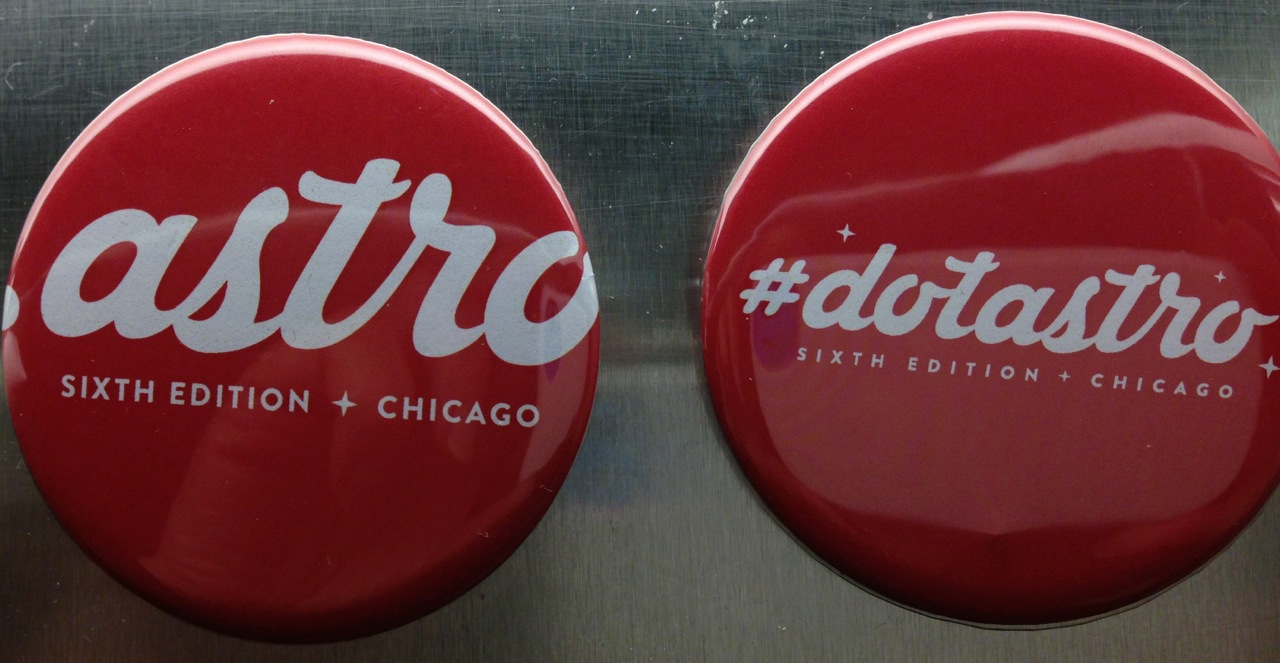
The ASCL is at .Astronomy ("dot astronomy"), which officially starts tomorrow morning. Three days of unconference, discussion, sessions, hacking, ideas, collaborating, fun, cool buttons, and, rumor has it, Belgian chocolate, in the magnificent city of Chicago. Follow along on Twitter, hashtag #dotastro!
-
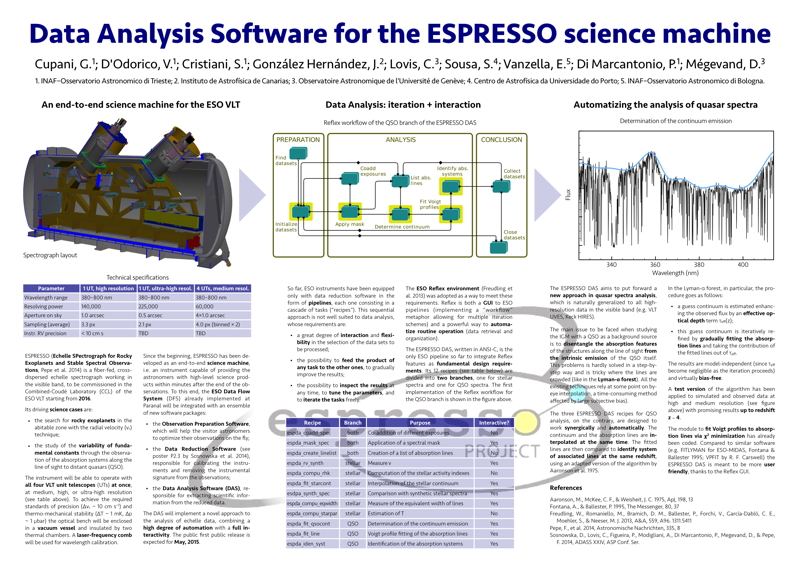
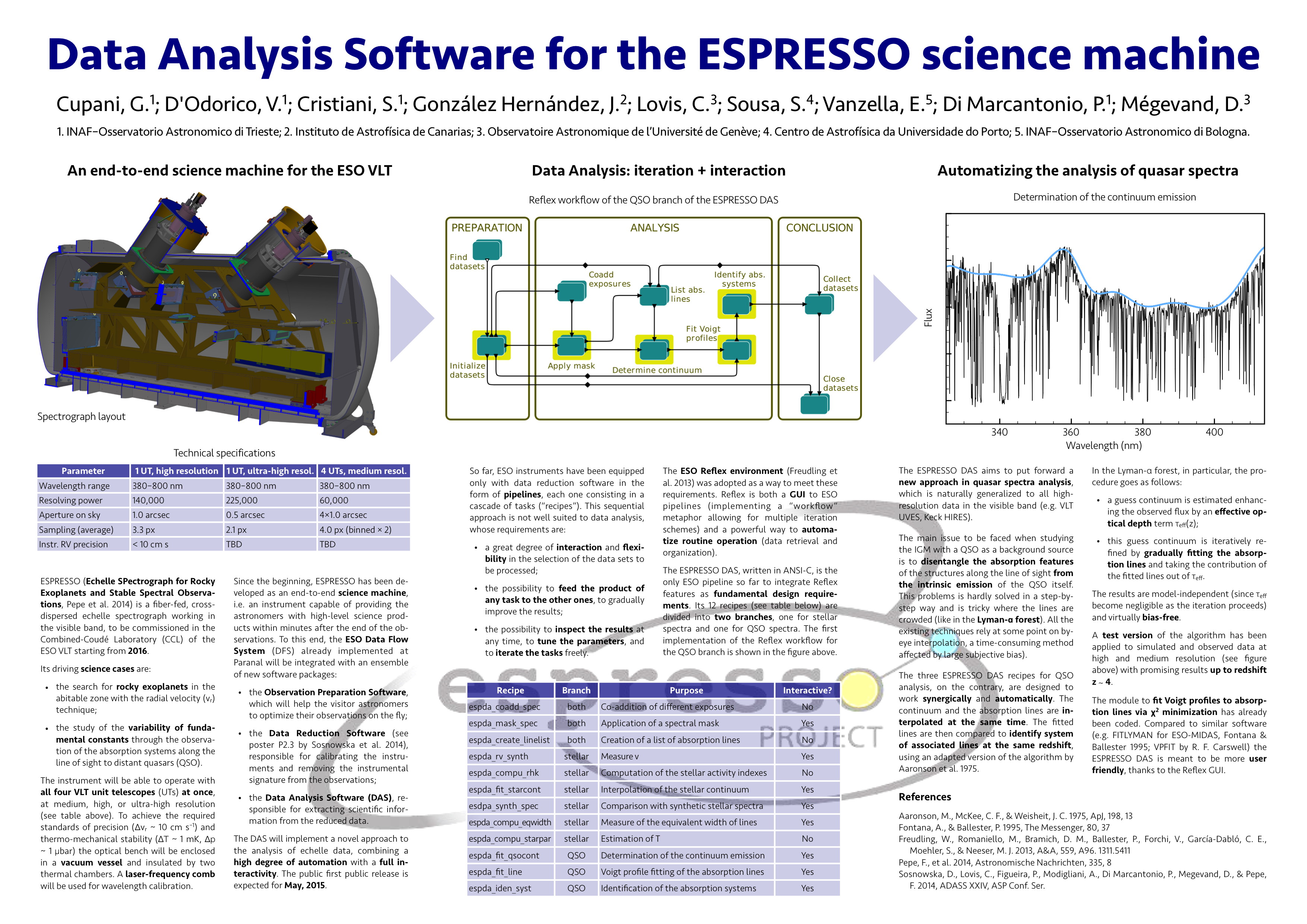
Abstract: The Echelle SPectrograph for Rocky Exoplanets and Stable Spectral Observations (ESPRESSO) is an extremely stable high-resolution spectrograph which is currently being developed for the ESO VLT Combined Coudé Laboratory by an international consortium of four nations and ESO. With its groundbreaking characteristics (resolution up to ~200,000; wavelength range from 380 to 780 nm; centimeter-per-second accuracy in wavelength calibration; possibility to use all 4 unit telescope at once) ESPRESSO is aimed to be a "science machine" – i.e., an instrument whose subsystems are fully-integrated way to directly extract science information from the observations. In particular, ESPRESSO will be the first ESO instrument to be equipped with a dedicated tool for the analysis of data, the Data Analysis Software (DAS), consisting in a number of recipes to analyse both stellar and quasar spectra. In this talk, I will present my work on the quasar branch of the DAS. I will describe the details of the pipeline and of its GUI, ESO Reflex, which is aimed to get over the shortcomings of the existing software providing multiple iteration modes and full interactivity with the data. I will also discuss some new algorithms implemented in the code, which will allow to determine the continuum level of emission in quasar spectra, to fit the spectral lines, and to identify the absorption systems in a coherent scheme. The scientific importance of a carefully-designed, physically-motivated approach to data analysis will be highlighted throughout.
Authors: Guido Cupani (INAF-Osservatorio Astronomico di Trieste)
Valentina D'Odorico (INAF-Osservatorio Astronomico di Trieste)
Stefano Cristiani (INAF-Osservatorio Astronomico di Trieste)
Jonay Gonzalez-Hernandez (Instituto de Astrofísica de Canarias)
Christophe Lovis (Université de Genève)
Sérgio Sousa (Universidade do Porto)
Eros Vanzella (INAF-Osservatorio Astronomico di Bologna)
Paolo Di Marcantonio (INAF-Osservatorio Astronomico di Trieste)
Denis Mégevand (Université de Genève) -
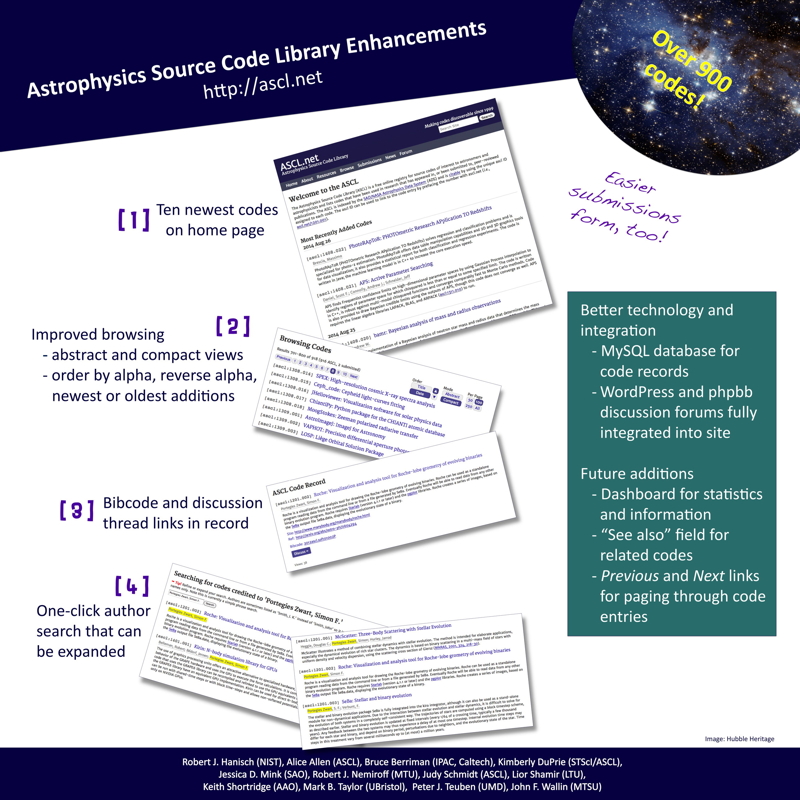
Abstract: The Astrophysics Source Code Library (ASCL) is a free online registry of codes used in astronomy research; it currently contains over 900 codes and is indexed by ADS. The ASCL has recently moved a new infrastructure into production. The new site provides a true database for the code entries and integrates the WordPress news and information pages and the discussion forum into one site. Previous capabilities are retained and permalinks to ascl.net continue to work. The site offers more functionality and flexibility than the previous site, is easier to maintain, and offers new possibilities for collaboration. This presentation covers these recent changes to the ASCL.
Authors: Robert Hanisch (National Institute of Standards and Technology)
Alice Allen (Astrophysics Source Code Library)
Bruce Berriman (Infrared Processing and Analysis Center, California Institute of Technology)
Kimberly Duprie (Space Telescope Science Institute)
Jessica Mink (Harvard-Smithsonian Center for Astrophysics)
Robert Nemiroff (Michigan Technological University)
Lior Shamir (Lawrence Technological University)
Keith Shortridge (Australian Astronomical Observatory)
Mark Taylor (University of Bristol)
Peter Teuben (University of Maryland)
John Wallin (Middle Tennessee State University) -
The 24th Astronomical Data Analysis Software and Systems (ADASS) meeting starts this evening at the Westin Hotel in Calgary, Canada. Talks start tomorrow afternoon; the opening sessions are focused on Big Data Challenges, which is such a big topic it has to be continued on Monday morning.
Though the ASCL editors are not attending ADASS this year, most of the Advisory Committee is (Peter Teuben, Bruce Berriman, Bob Hanisch, Jessica Mink, Keith Shortridge, and Mark Taylor) and Bob Hanisch has a poster on the ASCL's recent changes to hang.
You can follow ADASS on Twitter
@astroADASS, and tomorrow, we'll post the ASCL poster here.