ASCL News
-
The ASCL, along with the AAS’s Working Group on Astronomical Software (WGAS), is coordinating a Special Session at the January 2014 AAS meeting. This session is scheduled for 2:00 PM on January 7, and will feature case studies on code release for AstroPy, Montage, and Cloudy in addition to talks on the state of code sharing and funding agencies’ policies.
The session will be moderated by Peter Teuben and Robert Hanisch; the speakers for this session are:
G. Bruce Berriman, NExScI, PAC, Caltech
Gary J. Ferland, University of Kentucky
David W. Hogg, New York University
Daniel S. Katz, National Science Foundation
Erik J. Tollerud, Yale University
Benjamin J. Weiner, University of ArizonaAfter the presentations, the floor will be opened for discussion on ways to encourage code sharing to improve the transparency and efficiency of research and mitigate the negative aspects of releasing code.
-
Twenty codes were added to the ASCL in July, and eighteen in August.
July:
AstroTaverna: Tool for Scientific Workflows in Astronomy
cosmoxi2d: Two-point galaxy correlation function calculation
CTI Correction Code
DustEM: Dust extinction and emission modelling
ETC++: Advanced Exposure-Time CalculationsFieldInf: Field Inflation exact integration routines
im2shape: Bayesian Galaxy Shape Estimation
ITERA: IDL Tool for Emission-line Ratio Analysis
K3Match: Point matching in 3D space
LENSVIEW: Resolved gravitational lens images modelingMAH: Minimum Atmospheric Height
Monte Python: Monte Carlo code for CLASS in Python
NEST: Noble Element Simulation Technique
Obit: Radio Astronomy Data Handling
orbfit: Orbit fitting softwarephoSim: Photon Simulator
PURIFY: Tools for radio-interferometric imaging
Shapelets: Image Modelling
SIMX: Event simulator
SOPT: Sparse OPTimisationAugust:
APPSPACK: Asynchronous Parallel Pattern Search
BASIN: Beowulf Analysis Symbolic INterface
Ceph_code: Cepheid light-curves fitting
ChiantiPy: Python package for the CHIANTI atomic database
CReSyPS: Stellar population synthesis codeCRUSH: Comprehensive Reduction Utility for SHARC-2 (and more...)
GYRE: Stellar oscillation code
JHelioviewer: Visualization software for solar physics data
LensEnt2: Maximum-entropy weak lens reconstruction
LOSSCONE: Capture rates of stars by a supermassive black holeMapCurvature: Map Projections
MoogStokes: Zeeman polarized radiative transfer
RADLite: Raytracer for infrared line spectra
SMILE: Orbital analysis and Schwarzschild modeling of triaxial stellar systems
SPEX: High-resolution cosmic X-ray spectra analysisSYN++: Standalone SN spectrum synthesis
SYNAPPS: Forward-modeling of supernova spectroscopy data sets
THELI GUI: Optical, near- & mid-infrared imaging data reductionAlso in August, we added one very cool web resource, the NASA Exoplanet Archive.
-
The AAS's Working Group on Astronomical Software (WGAS) and the ASCL are coordinating a Special Session on software at the January 2014 AAS meeting. It will feature several case studies by code authors in addition to broader issues in the development, use, and sharing of software. Watch this space for more information!
-
Sixteen codes were added to the ASCL in June:
BEHR: Bayesian Estimation of Hardness Ratios
Bessel: Fast Bessel Function Jn(z) Routine for Large n,z
grmonty: Relativistic radiative transport Monte Carlo code
Harmony: Synchrotron Emission Coefficients
LRG DR7 Likelihood SoftwareMADCOW: Microwave Anisotropy Dataset Computational softWare
MAPPINGS III: Modelling And Prediction in PhotoIonized Nebulae and Gasdynamical Shocks
Pico: Parameters for the Impatient Cosmologist
PROM4: 1D isothermal and isobaric modeler for solar prominences
PROS: Multi-mission X-ray analysis software systemSAC: Sheffield Advanced Code
STF: Structure Finder
Tapir: A web interface for transit/eclipse observability
VHD: Viscous pseudo-Newtonian accretion
Yaxx: Yet another X-ray extractor -
I'm behind and am glad my next weekend starts on Thursday and runs for four days; perhaps I'll get caught up! Eight codes added in June are now available and more are coming. Watch
-

Photo credit: Peter Teuben On May 20 and 21, the Library of Congress's Digital Preservation program held Preserving.exe: Toward a National Strategy for Preserving Software, which focused on preserving software as digital artifacts of life in the late 20th-early 21st century. Robert Hanisch, Peter Teuben, and Alice Allen attended, and Peter, chair of our Advisory Committee, presented a talk on the ASCL. The slides from Peter's talk are now available online.
-
ExoVis, the winner of the 2013 Open Exoplanet Catalogue visualization contest, is an exosystem visualizer programmed by Tom Hands, a PdD student at the University of Leicester. It's quite elegant. ExoVis has been added to our list of Web Resources and Tools.
Streams Going Notts: The tidal debris finder comparison project popped up on arXiv recently. This paper, which has been added to our thread for papers of possible interest, discusses testing four codes, S-Tracker, VELOCIraptor (formerly known as the STructure Finder, STF), ROCKSTAR, and HOT6D, to determine how well they find tidal debris in a fully cosmological Milky Way type simulation. The paper compares the algorithms used by the codes and quantifies the findings.
-
Twenty-one codes were added to the ASCL in April:
Astropy: Community Python library for astronomy
Copter: Cosmological perturbation theory
CosmicEmuLog: Cosmological Power Spectra Emulator
CosmoRec: Cosmological Recombination code
DESPOTIC: Derive the Energetics and SPectra of Optically Thick Interstellar CloudsDiffusion.f: Diffusion of elements in stars
GALSVM: Automated Morphology Classification
IFrIT: Ionization FRont Interactive Tool
MPgrafic: A parallel MPI version of Grafic-1
ORIGAMI: Structure-finding routine in N-body simulationPEC: Period Error Calculator
pyCloudy: Tools to manage astronomical Cloudy photoionization code
PyNeb: Analysis of emission lines
Qhull: Quickhull algorithm for computing the convex hull
Sérsic: Exact deprojection of Sérsic surface brightness profilesSFH: Star Formation History
SZpack: Computation of Sunyaev-Zeldovich (SZ) signals
TPZ: Trees for Photo-Z
TVD: Total Variation Diminishing code
VOBOZ/ZOBOV: Halo-finding and Void-finding algorithms -
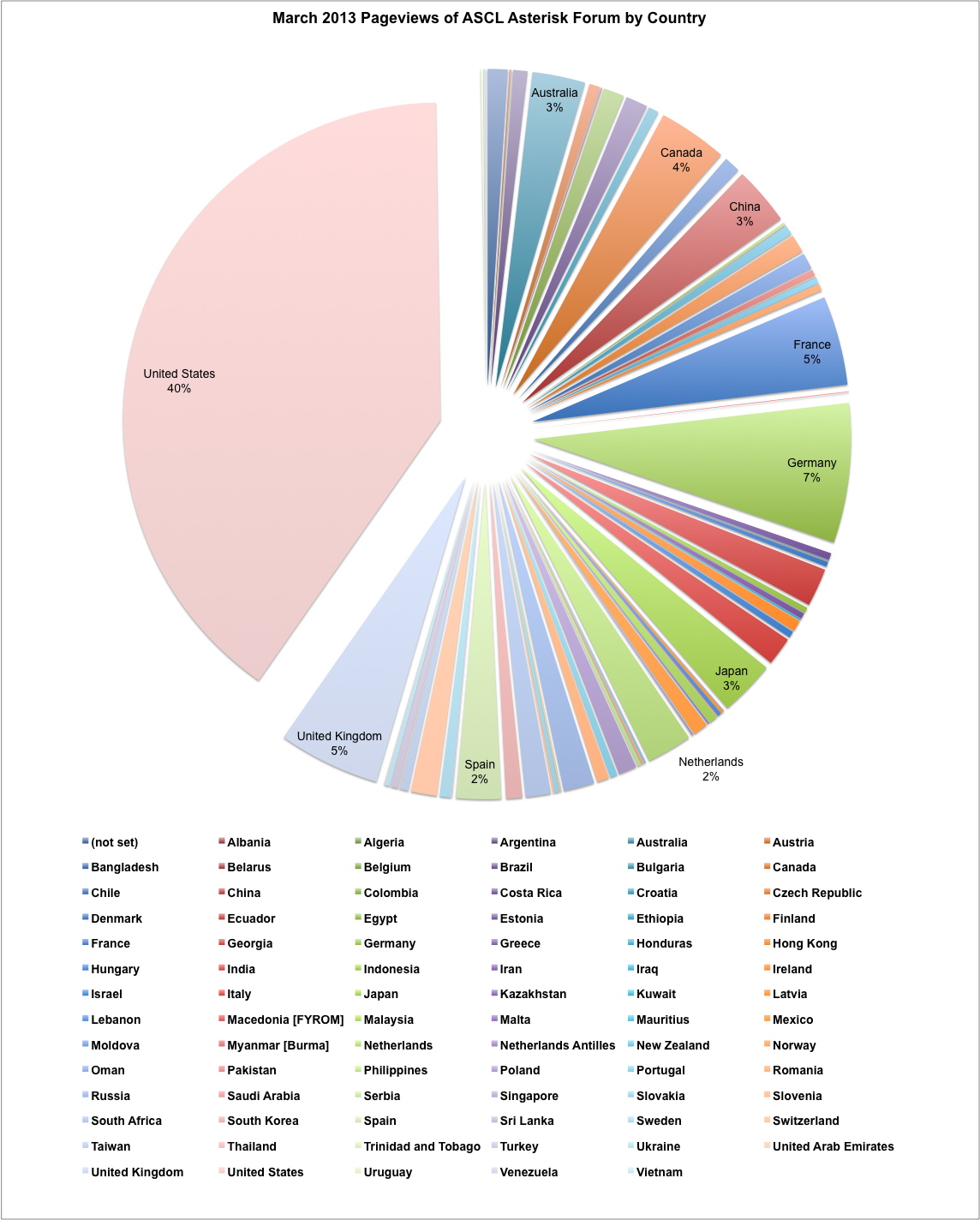
Idly browsing through Google Analytics statistics on the ASCL, I pulled out pageviews by country, these just of the ASCL forum on Asterisk for this month so far. Of the 4,843 pageviews, 1,939 (40%) are from the US, which means of course that 60% are not. People from eighty-three countries have accessed the code entries forum; I've tagged the pie slices below of the ten countries with at least 2% of the total pageviews. Click on the pie to see the chart at full size.
-
Yay!
That is all.