ASCL News
-
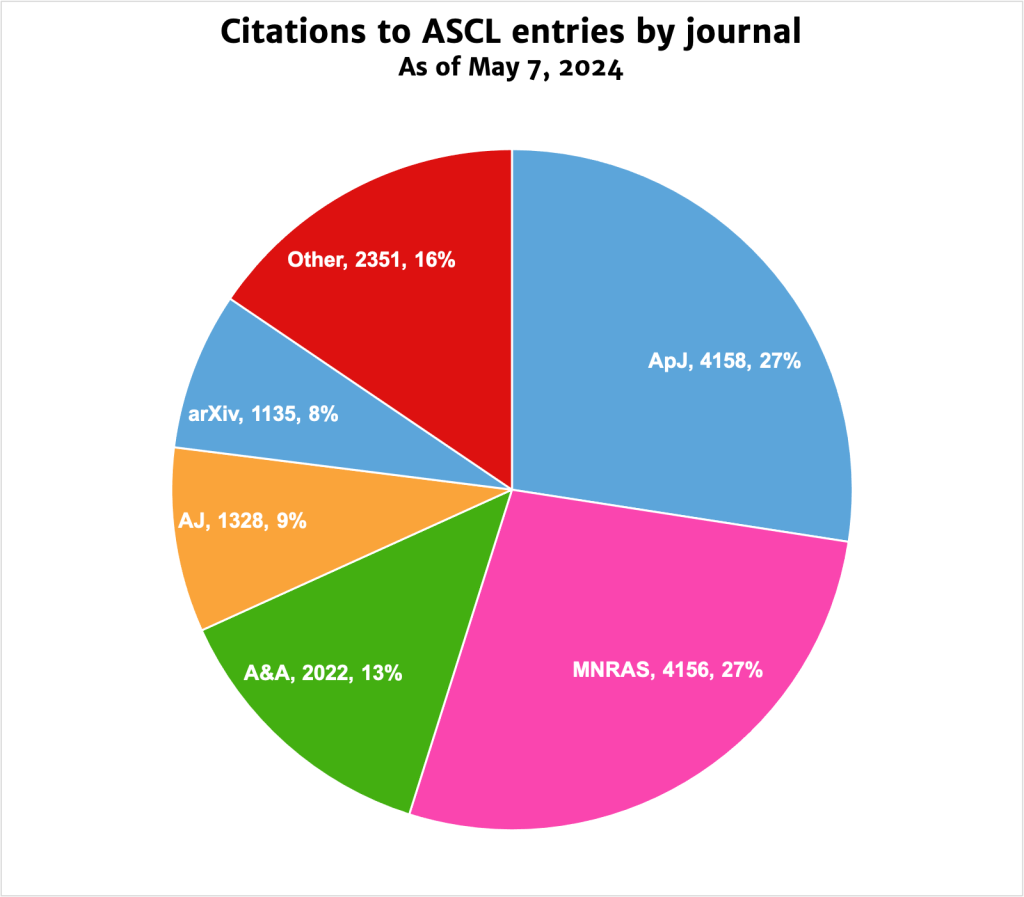
In looking at the ASCL dashboard yesterday, I realized that the Astrophysical Journal (ApJ) now has the most citations to ASCL entries, having overtaken (by a hair) Monthly Notices of the Royal Astronomical Society (MNRAS), which has held the top spot since at least 2015. MNRAS's early (and enduring) lead in software citations was initially the result of one editor, Dr. Keith T. Smith (now a senior editor at Science), who strongly encouraged article authors to cite the software they had used to generate their results. (Though I obviously saw the effect of his work in MNRAS, I had no idea one person was responsible for it until I saw a post in the Astronomers Facebook group and later queried Keith, who was unknown to me at the time.)
AAS Journals, which publishes ApJ, has three data editors, Greg Schwarz, August Muench, and Katie Merrell, who, though primarily consumed with data work, also encourage software citation, obviously to good effect. And so it grows!
-
Entries added over the weekend, including eight recent submissions by software authors, pushed the number of records in the ASCL over the 3000 mark. Thanks for all the codes!
3K! Yay!

-
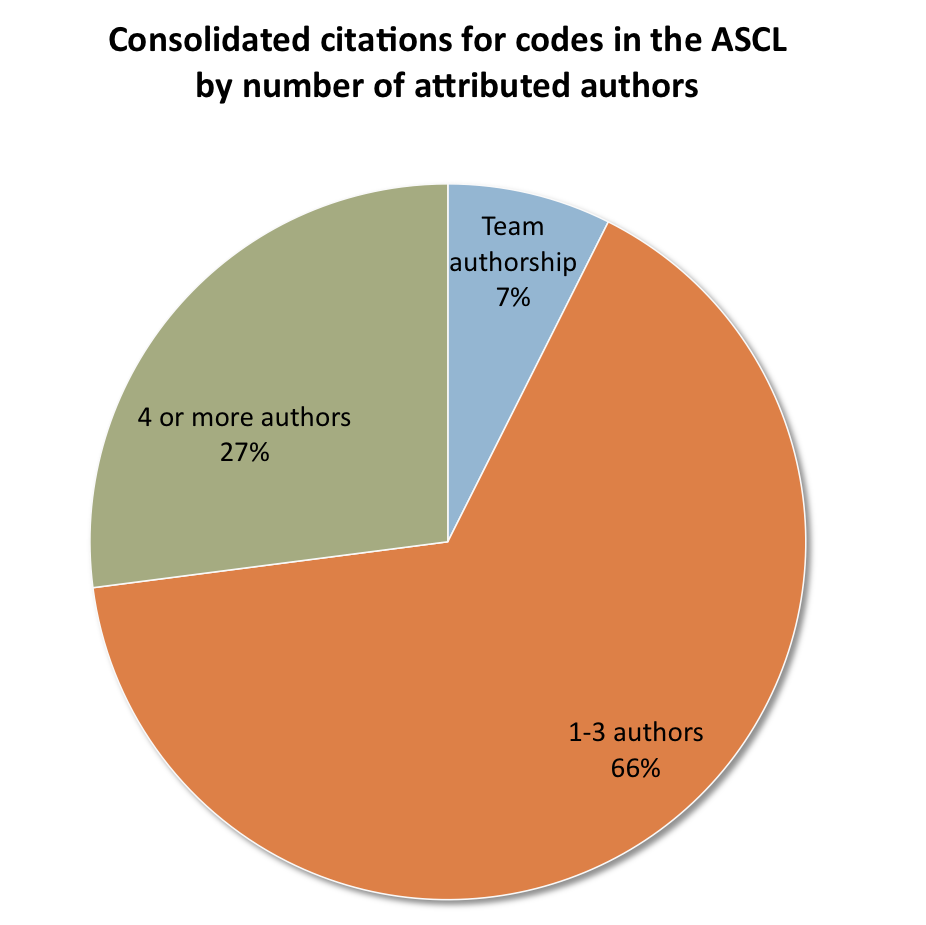 We were asked recently how many of our entries were attributed to one, two, or three authors. Would you guess that over a third of the codes in the ASCL -- 35% -- have only one author? Codes with 1-3 authors attributed, what we dubbed "short author list" codes, account for 68% of our entries. We ended up writing a short paper, published by Research Notes of the AAS (RNAAS), about authorship and citation numbers for team and short author list codes. It was a quick look and we hope to look more deeply into this; if you'd like to do the same, you can download our public data in JSON and find the code that we used for consolidating citations on GitHub.
 -
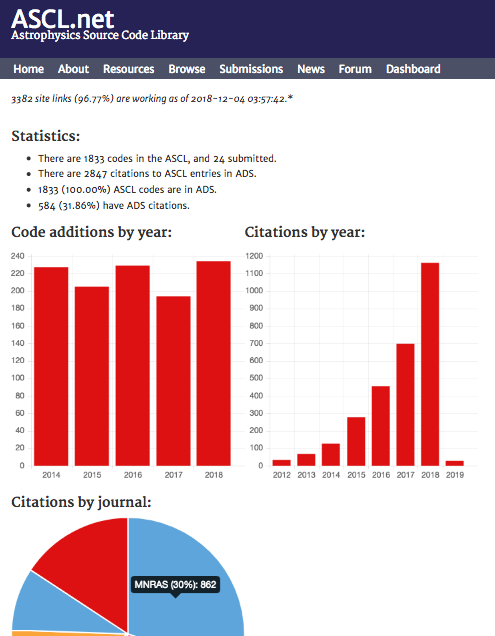
The ASCL makes it easy to cite the software astro research depends on. Every astronomy journal and many others such as Science and Nature accept ASCL references; ADS shows citations to ASCL entries from nearly 90 journals. Citations to ASCL entries are tracked by ADS, Web of Science, and other indices.
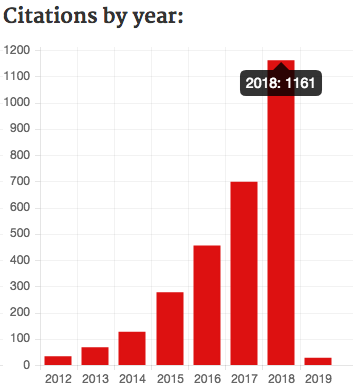
Citations to ASCL entries from ADS as of 12/05/2018ADS makes it easy to search for software in its holdings through the use of the "software" doctype.
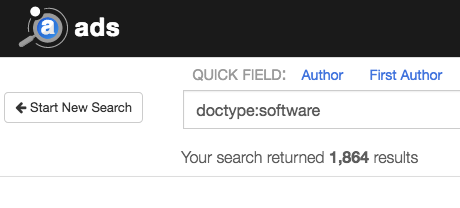
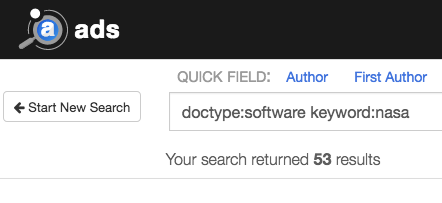
ASCL has started tagging NASA software among its entries, allowing you to search ASCL and ADS for this software.
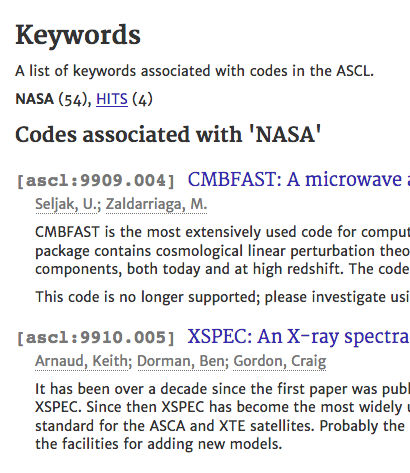
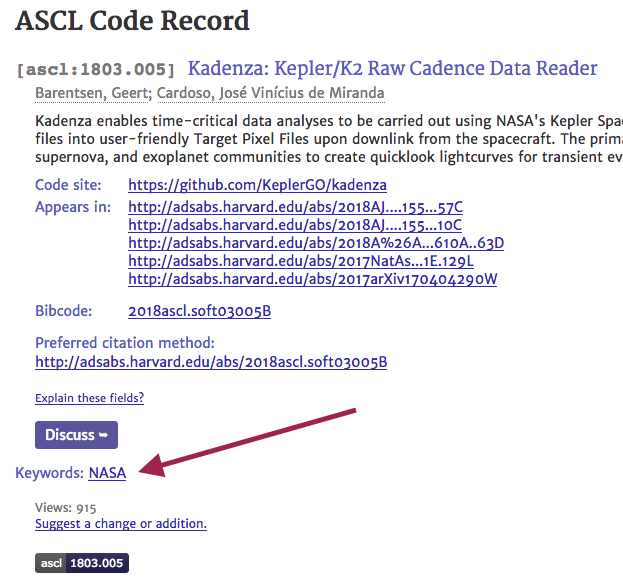
You can find the tags on an entry below the "Discuss" button.
Citation information and other statistics, such as the number of site links we most recently checked, when we checked them, and how many are healthy, appear on our dashboard, which is updated on Tuesdays and Fridays.
If you have any questions about citing ASCL entries, we're happy to help! Email editor@ascl.net or tweet to @asclnet. -
How much have things changed? The previous "big 4" journals that had citations to ASCL entries have been joined by AJ and the percentage of citations from MNRAS has dropped a bit, but overall, the wedges of these two piecharts, one from October, 2015 and the second from today, look remarkably similar.
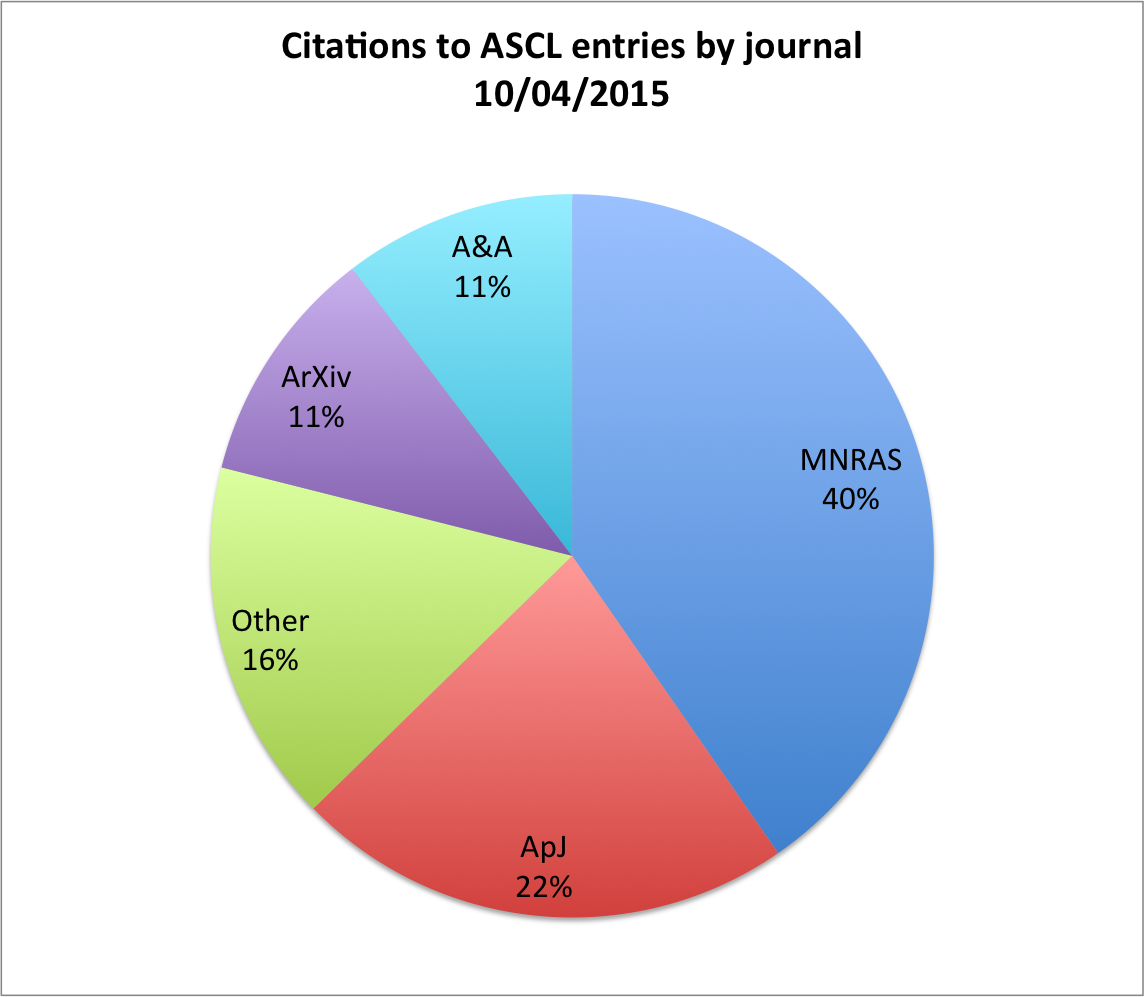
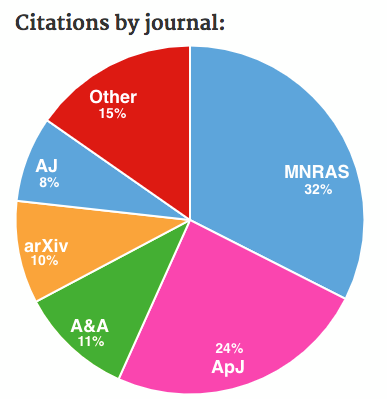
At the time the 2015 piechart was created, ASCL entries had been cited 465 times; today, ADS shows 2093 citations to ASCL entries. Seventeen percent of ASCL entries had been cited in October 2015, and as of today, over 29% of ASCL entries have citations.
Of course there are other ways to cite software, and the ASCL supports all citable methods and ASCL entries include preferred citation information where possible.
Do we list how your software should be cited? If not, please let us know your preferred method and we will add it to the entry!
-
... and which journals have the most?
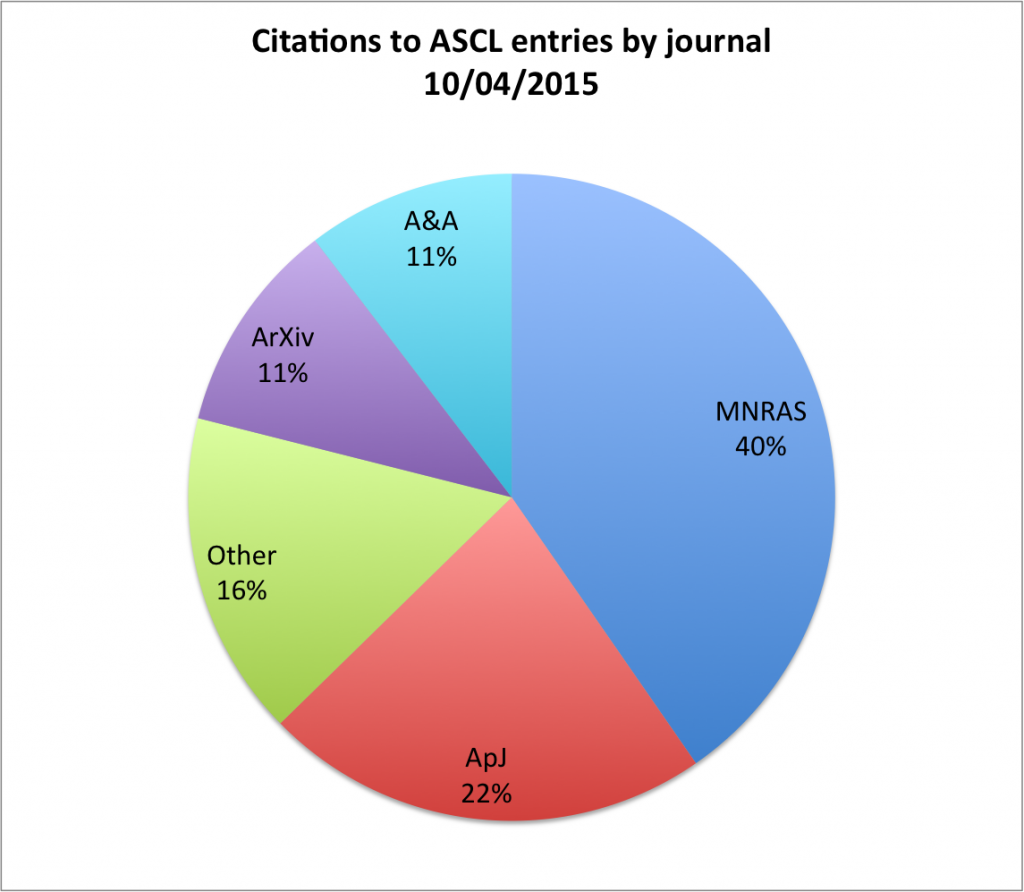 I had software citations on my mind all last week, as the 3rd Workshop on Sustainable Software for Science: Practice and Experiences (WSSSPE3) was held last Monday and Tuesday in Boulder, CO, and I spent a good bit of my time there in the work group for Hacking the credit and citation ecosystem (making it work, or work better, for software). This made me curious as to which journals have citations to ASCL entries, and which have the most citations to ASCL entries. I was pretty sure I knew the answer to the latter, but it's always good to test what one knows. So I went looking, and this what I found...
These three journals and arXiv hold 84% of citations to ASCL entries:
Monthly Notices of the Royal Astronomical Society
The Astrophysical Journal
ArXiv e-prints
Astronomy and AstrophysicsOther publications with citations to the ASCL include:
The Astronomical Journal
Astronomy and Computing
The Astrophysical Journal Supplement Series
Computational Astrophysics and Cosmology
Computer Physics Communications
Galaxies
Icarus
Journal of Cosmology and Astro-Particle Physics
Journal of Physics Conference SeriesJournal of Physics G Nuclear Physics
The Messenger
Physical Review C
Physical Review D
Physical Review Letters
Physics Uspekhi
Publications of the Astronomical Society of Japan
Publications of the Astronomical Society of the Pacific
Revista Mexicana de Astronomia y AstrofisicaProceedings, too, including:
18th European White Dwarf Workshop
19th European Workshop on White Dwarfs
Astronomical Society of India Conference Series
Asymmetrical Planetary Nebulae VI ConferenceEAS Publications Series
IAU Symposium
SF2A-2014: Proceedings of the Annual meeting of the French Society of Astronomy and Astrophysics
Society of Photo-Optical Instrumentation Engineers (SPIE) Conference SeriesI appreciate ADS all over again for making it possible to compile this information so quickly.
-
... maybe not like topsy, but steadily nonetheless. In looking at the ASCL's growth over the past year, I see that on June 15 of last year, ADS held 818 ASCL entries with 168 cumulative citations. 78 different codes had been cited by their ASCL ID, or 9.5% of codes in the ASCL.
Today, there are 1079 ASCL records in ADS with a total of 334 citations, nearly double last year, and the number of codes cited by ASCL ID has just more than doubled; that number now stands at 158, which is 14.6% of codes in the ASCL cited using the ASCL record.
So if my figuring is correct (no guarantees...), the ASCL has grown 32% in the past year (by 261 codes, from 818 to 1079), while codes in the ASCL cited by these entries is up 100%.
We are very interested in code citation, however that happens; we want software authors to gain exposure and credit for their work! A number of excellent ways to cite codes exist, and so long as codes do get cited, we don't care how. We track citations to ASCL entries because this is one way to determine whether the ASCL is being used; page views are another measure we employ.
And yes, it's being used. Yay! Thank you!
-
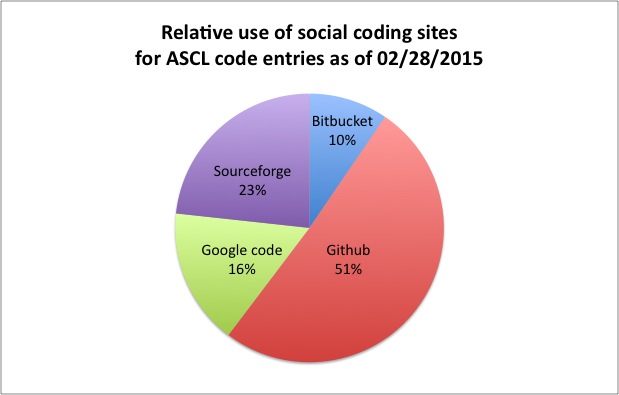
The pie below shows what percentage of codes in the ASCL have social coding links in their entries, and the Starlink caveat still holds: all the Starlink codes are in one Github repo, so that repo is represented only once in the pie below. These numbers are somewhat low, as some codes offer a webpage/site to which the ASCL links, with that webpage then directing people to a repostitory. If someone does a better analysis, please send it over; I'd love to include it!
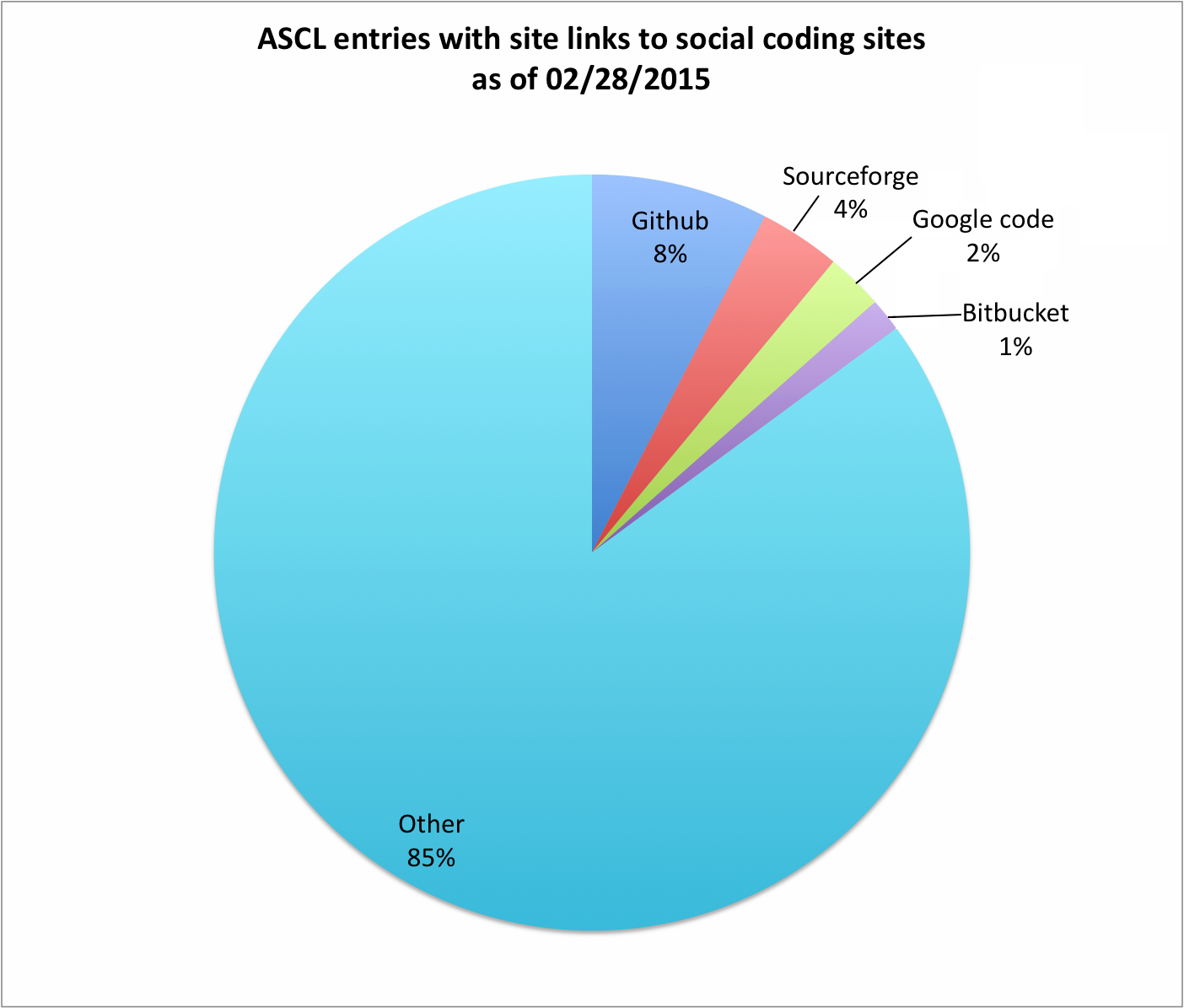
As before, the data are here.
Related posts:
Data play: Social coding sites
More data play: Common domains -
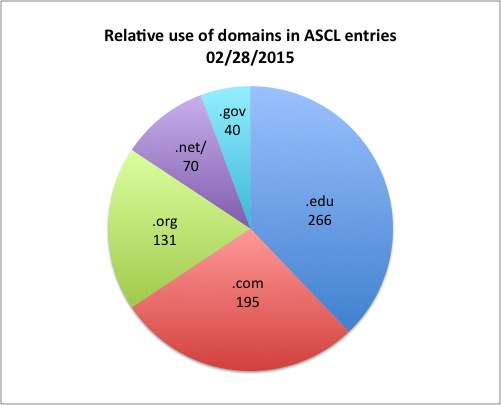
Here's a quick look at the most common domains from the ASCL site links, with the actual counts included in the data labels.
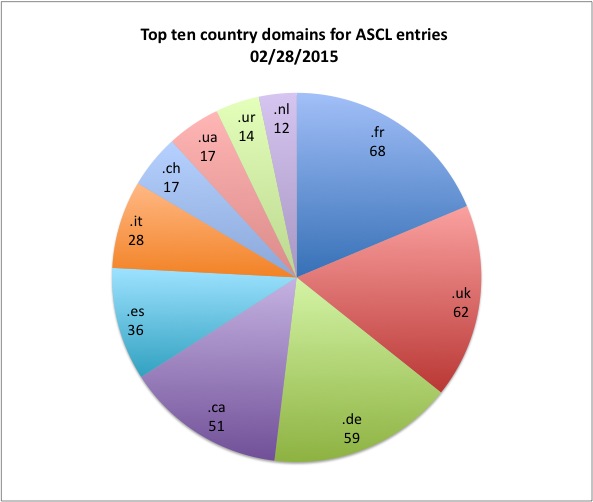
And this shows the top ten country domains among the entries, also with the actual counts shown:
-
I've posted before about where the codes are; here's a pie that shows the relative use of Github, Google Code, Bitbucket, and Sourceforge. Please note that because all the Starlink codes are in one Github repo, that repo is represented only once in the pie below. Want to do your own analysis? The site links (1080 of them at the moment, as some codes have more than one) are available here.