ASCL News
-
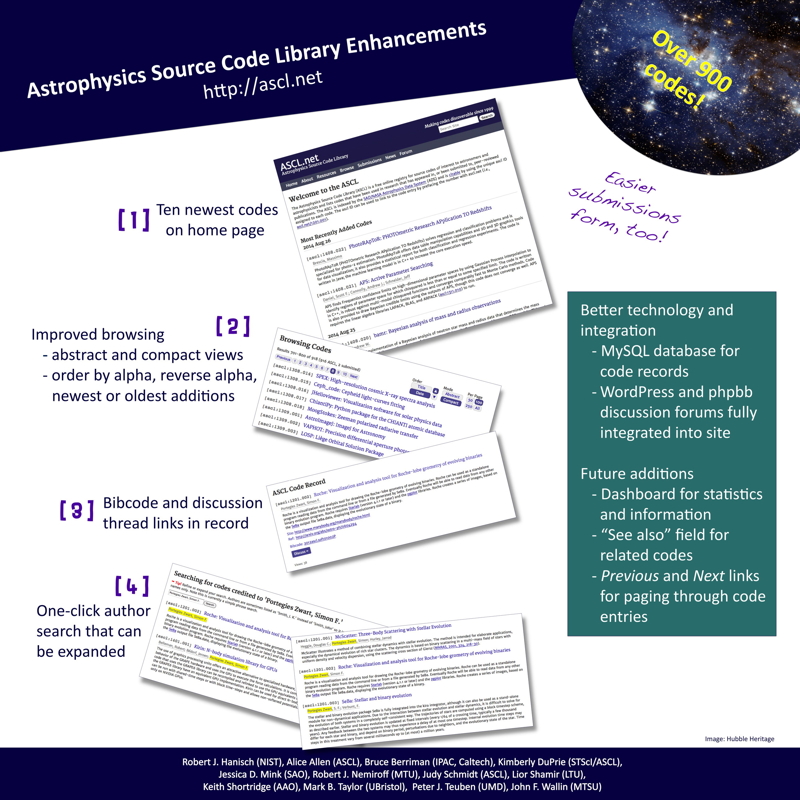
Abstract: The Astrophysics Source Code Library (ASCL) is a free online registry of codes used in astronomy research; it currently contains over 900 codes and is indexed by ADS. The ASCL has recently moved a new infrastructure into production. The new site provides a true database for the code entries and integrates the WordPress news and information pages and the discussion forum into one site. Previous capabilities are retained and permalinks to ascl.net continue to work. The site offers more functionality and flexibility than the previous site, is easier to maintain, and offers new possibilities for collaboration. This presentation covers these recent changes to the ASCL.
Authors: Robert Hanisch (National Institute of Standards and Technology)
Alice Allen (Astrophysics Source Code Library)
Bruce Berriman (Infrared Processing and Analysis Center, California Institute of Technology)
Kimberly Duprie (Space Telescope Science Institute)
Jessica Mink (Harvard-Smithsonian Center for Astrophysics)
Robert Nemiroff (Michigan Technological University)
Lior Shamir (Lawrence Technological University)
Keith Shortridge (Australian Astronomical Observatory)
Mark Taylor (University of Bristol)
Peter Teuben (University of Maryland)
John Wallin (Middle Tennessee State University) -
The 24th Astronomical Data Analysis Software and Systems (ADASS) meeting starts this evening at the Westin Hotel in Calgary, Canada. Talks start tomorrow afternoon; the opening sessions are focused on Big Data Challenges, which is such a big topic it has to be continued on Monday morning.
Though the ASCL editors are not attending ADASS this year, most of the Advisory Committee is (Peter Teuben, Bruce Berriman, Bob Hanisch, Jessica Mink, Keith Shortridge, and Mark Taylor) and Bob Hanisch has a poster on the ASCL's recent changes to hang.
You can follow ADASS on Twitter
@astroADASS, and tomorrow, we'll post the ASCL poster here. -
Thirteen codes were added to the ASCL in September:
CHLOE: A tool for automatic detection of peculiar galaxies
CosmoSIS: Cosmological parameter estimation
IM3SHAPE: Maximum likelihood galaxy shear measurement code for cosmic gravitational lensing
IFSFIT: Spectral Fitting for Integral Field Spectrographs
IFSRED: Data Reduction for Integral Field SpectrographsiSpec: Stellar atmospheric parameters and chemical abundances
LANL*: Radiation belt drift shell modeling
mixT: single-temperature fit for a multi-component thermal plasma
Nahoon: Time-dependent gas-phase chemical model
ORBS: A reduction software for SITELLE and SpiOMM datarmfit: Forward-folding spectral analysis software
Slim: Numerical data compression for scientific data sets
Tsyganenko Geomagnetic Field Models -
The 2nd Working towards Sustainable Software for Science: Practice and Experiences workshop (WSSSPE) will be held in New Orleans on Sunday, November 16. The community was invited to submit short actionable papers for use in designing the workshop.
Getting a community to adopt better practices doesn't usually happen overnight. The ASCL has looked at previous efforts to create code libraries or registries to try to find common barriers that may have inhibited widespread use of these services; the ASCL also has looked to specific management techniques adapted from business practice to encourage change. These findings and change management strategies are discussed in our #WSSSPE 2 paper.
The WSSSPE site lists all of the freely downloadable accepted papers.
-
The cover feature this month of the IEEE's flagship journal Computer is Computing in Astronomy. Its "Applications and Examples" includes a short article (behind a paywall) describing the ASCL.
-
The ASCL will have a poster at the upcoming ADASS meeting in Calgary on the recent enhancements to the site.
-
Twenty-three codes were added to the ASCL in August:
APS: Active Parameter Searching
bamr: Bayesian analysis of mass and radius observations
CosmoPhotoz: Photometric redshift estimation using generalized linear models
GALAPAGOS-C: Galaxy Analysis over Large Areas
GALIC: Galaxy initial conditions constructionHEAsoft: Unified Release of FTOOLS and XANADU
IIPImage: Large-image visualization
Imfit: A Fast, Flexible Program for Astronomical Image Fitting
LIA: LWS Interactive Analysis
LightcurveMC: An extensible lightcurve simulation programNumCosmo: Numerical Cosmology
O2scl: Object-oriented scientific computing library
PhotoRApToR: PHOTOmetric Research APplication TO Redshifts
PIA: ISOPHOT Interactive Analysis
pieflag: CASA task to efficiently flag bad dataPOET: Planetary Orbital Evolution due to Tides
RDGEN: Routines for data handling, display, and adjusting
Skycorr: Sky emission subtraction for observations without plain sky information
SPAM: Source Peeling and Atmospheric Modeling
VisiOmatic: Celestial image viewerVPFIT: Voigt profile fitting program
vpguess: Fitting multiple Voigt profiles to spectroscopic data
WSClean: Widefield interferometric imager -
Twenty codes were added to the ASCL in July:
AstroML: Machine learning and data mining in astronomy
ASTRORAY: General relativistic polarized radiative transfer code
BayesFlare: Bayesian method for detecting stellar flares
Brut: Automatic bubble classifier
CLE: Coronal line synthesise-MERLIN data reduction pipeline
Exopop: Exoplanet population inference
EZ_Ages: Stellar population age calculator
Halogen: Multimass spherical structure models for N-body simulations
kungifu: Calibration and reduction of fiber-fed IFU astronomical spectroscopyMATLAB package for astronomy and astrophysics
MCMAC: Monte Carlo Merger Analysis Code
Period04: Statistical analysis of large astronomical time series
PINGSoft2: Integral Field Spectroscopy Software
SAMI: Sydney-AAO Multi-object Integral field spectrograph pipelineSPECDRE: Spectroscopy Data Reduction
The Starfish Diagram: Statistical visualization tool
TWODSPEC: Long-slit and optical fiber array spectra extensions for FIGARO
VIDE: The Void IDentification and Examination toolkit
VStar: Variable star data visualization and analysis tool -
On Thursday, July 10, the ASCL's new site, designed and developed by Judy Schmidt, was moved into production. Code entries are in a new, more flexible database; as a result, browsing is much more flexible, and back-end processing is greatly improved. We have retained WordPress for related content management and this blog, and the phpbb — the discussion forum — for announcements and discussion of individual codes.
I've embedded a presentation that highlights the major changes to the ASCL, but hope you will explore the site and click through it rather than click through the slides! Regardless of which you do, I hope you will click Leave a reply below to post your feedback and questions; please let us know what you think!
Thanks!
-
Twenty codes were added to the ASCL in June:
ASTROM: Basic astrometry program
ASURV: Astronomical SURVival Statistics
Autoastrom: Autoastrometry for Mosaics
CGS4DR: Automated reduction of data from CGS4
COCO: Conversion of Celestial CoordinatesCoREAS: CORSIKA-based Radio Emission from Air Showers simulator
FROG: Time-series analysis
GAUSSCLUMPS: Gaussian-shaped clumping from a spectral map
IRAS90: IRAS Data Processing
IRCAMDR: IRCAM3 Data Reduction SoftwareIUEDR: IUE Data Reduction package
JCMTDR: Applications for reducing JCMT continuum data in GSD format
MATCH: A program for matching star lists
PAMELA: Optimal extraction code for long-slit CCD spectroscopy
PERIOD: Time-series analysis packagePOLMAP: Interactive data analysis package for linear spectropolarimetry
RV: Radial Components of Observer's Velocity
STARMAN: Stellar photometry and image/table handling
TSP: Time-Series/Polarimetry Package
VADER: Viscous Accretion Disk Evolution Resource