ASCL News
-
Twenty-six codes were added to the ASCL in February 2022:
ASPIRED: Automated SpectroPhotometric Image REDuction
Citlalicue: Create and manipulate stellar light curves
Contaminante: Identify blended targets in Kepler, TESS, and K2 data
distance-omnibus: Distance estimation method for molecular cloud clumps in the Milky WayEDIV: Exoplanet Detection Identifier Vetter
EDIVU: Exoplanet Detection Identifier Vetter Unplugged
fiducial_flare: Spectra and lightcurves of a standardized far ultraviolet flare
Find_Orb: Orbit determination from observationsFIRE Studio: Movie making utilities for the FIRE simulations
GA Galaxy: Interacting galaxies model fitter
GALLUMI: GALaxy LUMInosity function pipeline
INSANE: INflationary potential Simulator and ANalysis EngineNWelch: Spectral analysis of time series with nonuniform observing cadence
palettable: Color palettes for Python
popsynth: Observed surveys from latent population models
PSLS: PLATO Solar-like Light-curve SimulatorRFEP: Residual Feature Extraction Pipeline
SciCatalog: Tools for scientific data catalogs
Sculptor: Interactive modeling of astronomical spectra
SPARTAN: SPectroscopic And photometRic fiTting tool for Astronomical aNalysisStarduster: Radiative transfer and deep learning multi-wavelength SED model
SunnyNet: Neural network framework for solving 3D NLTE radiative transfer in stellar atmospheres
SUPPNet: Neural network for stellar spectrum normalization
TERRA: Transit detection codetopoaccel: Topological acceleration scripts
Zwindstroom: Cosmological growth factors from fluid calculations -
Fourteen codes were added to the ASCL in January 2022:
AllStarFit: R package for source detection, PSF and multi-component galaxy fitting
AltaiPony: Flare finder for Kepler, K2, and TESS light curves
AstroToolBox: Java tools for identifying and classifying astronomical objects
BLOSMapping: Determine line-of-sight magnetic fields of molecular clouds
COWS: Cosmic web filament finderdark-photons-perturbations: Dark photon conversions in our inhomogeneous Universe
disnht: Absorption spectrum solver
EzTao: Easier CARMA Modeling
fermi-gce-flows: Infer the Galactic Center gamma-ray excess
FitsMap: Interactive astronomical image and catalog data visualizerMAGRATHEA: Planet interior structure code
nProFit: n-Profile Fitting Tool
statmorph: Non-parametric morphological diagnostics of galaxy images
tellrv: Radial velocities for low-resolution NIR spectra -
Twenty-seven codes were added to the ASCL in December 2021:
AsteroGaP: Asteroid Gaussian Processes
BayesicFitting: Model fitting and Bayesian evidence calculation package
DarkARC: Dark Matter-induced Atomic Response Code
deeplenstronomy: Pipeline for versatile strong lens sample simulations
Defringe: Fringe artifact correctionDiracVsMajorana: Statistical discrimination of sub-GeV Majorana and Dirac dark matter
FTP: Fast Template Periodogram
GRIT: Gravitational Rigid-body InTegrators for simulating coupled dynamics
hankl: Python implementation of the FFTLog algorithm for cosmology
HoloSim-ML: Analyzing radio holography measurements of complex optical systemsInterferopy: Analyzing datacubes from radio-to-submm observations
JexoSim 2.0: JWST Exoplanet Observation Simulator
l1p: Python implementation of the l1 periodogram
MISTTBORN: MCMC Interface for Synthesis of Transits, Tomography, Binaries, and Others of a Relevant Nature
NeutrinoFog: Neutrino fog and floor for direct dark matter searchesO'TRAIN: Optical TRAnsient Identification NEtwork
Optab: Ideal-gas opacity tables generator
pycelp: Python package for Coronal Emission Line Polarization
QUESTFIT: Fitter for mid-infrared galaxy spectra
Qwind: Non-hydrodynamical model for AGN line-drive windsQwind3: Modeling UV line-driven winds originating from accretion discs
SAPHIRES: Stellar Analysis in Python for HIgh REsolution Spectroscopy
SCORPIO: Sky COllector of galaxy Pairs and Image Output
STDPipe: Simple Transient Detection Pipeline
TESSreduce: Transient focused reduction for TESS dataWIMpy_NREFT: Dark Matter direct detection rates detector
wpca: Weighted Principal Component Analysis in Python -
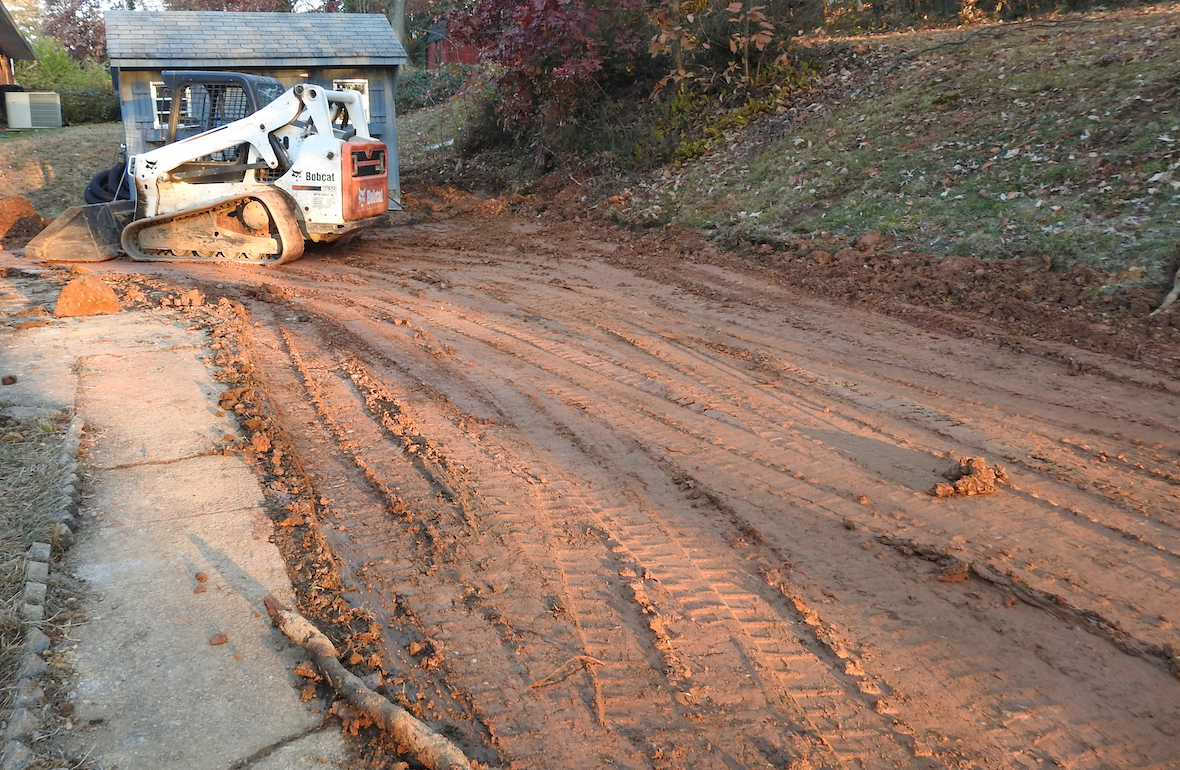
It was a loud week at ASCL Central, what with a backhoe and a couple of Bobcats working outside, so I decamped to my office at UMD for a couple of days to get away from the noise and, especially, the diesel exhaust. It was also a productive week, with eighteen entries added to the ASCL, two records curated, and notification emails sent out. I submitted my proceedings paper for ADASS. A paper submitted in September came back from review, and we've started a series of writing sprints to address the reviewers' concerns; the paper will be resubmitted before the end of the year. I also did some organizing work to prepare for this coming week's FORCE2021 Hackathons; the SciCodes consortium hopes to make progress on several items during this event, which will be held on Monday and Friday. Come join us!
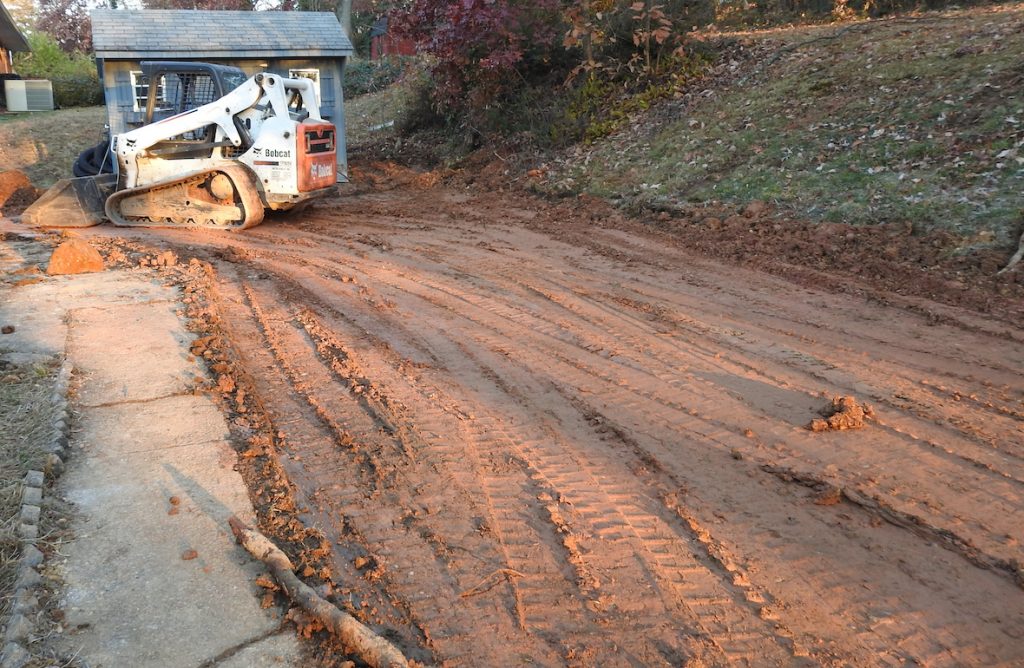
In the dawn's early light, a lot of mud. -
Eighteen codes were added to the ASCL in November:
astroDDPM: Realistic galaxy simulation via score-based generative models
Astrosat: Satellite transit calculator
CEvNS: Calculate Coherent Elastic Neutrino-Nucleus Scattering cross sections and recoil spectra
COCOPLOT: COlor COllapsed PLOTting software
CoLoRe: Cosmological Lofty Realization
flatstar: Make 2d intensity maps of limb-darkened starsgCMCRT: 3D Monte Carlo Radiative Transfer for exoplanet atmospheres using GPUs
GWToolbox: Gravitational wave observation simulator
JAX: Autograd and XLA
LEGWORK: LISA Evolution and Gravitational Wave ORbit Kit
Nii: Multidimensional posterior distributions framework
NLopt: Nonlinear optimization libraryp-winds: Python implementation of Parker wind models for planetary atmospheres
prose: FITS images processing pipeline
PSwarm: Global optimization solver for bound and linear constrained problems
pySYD: Measuring global asteroseismic parameters
SteParSyn: Stellar atmospheric parameters using the spectral synthesis method
UniMAP: Unicorn Multi-window Anomaly Detection Pipeline -
I did an experiment last year to see whether I could influence software authors to add either CITATION.cff or codemeta.json files to their repos to make clear how the software should be cited. It mostly didn't work, but was still a useful exercise. I've written a short paper about it that will appear on arXiv tonight (ETA: here) and is available now at the link below.
Abstract: Software citation has accelerated in astrophysics in the past decade, resulting in the field now having multiple trackable ways to cite computational methods. Yet most software authors do not specify how they would like their code to be cited, while others specify a citation method that is not easily tracked (or tracked at all) by most indexers. Two metadata file formats, codemeta.json and CITATION.cff, developed in 2016 and 2017 respectively, are useful for specifying how software should be cited. In 2020, the Astrophysics Source Code Library (ASCL, ascl.net) undertook a year-long effort to generate and send these software metadata files, specific to each computational method, to code authors for editing and inclusion on their code sites. We wanted to answer the question, “Would sending these files to software authors increase adoption of one, the other, or both of these metadata files?” The answer in this case was no. Furthermore, only 41% of the 135 code sites examined for use of these files had citation information in any form available. The lack of such information creates an obstacle for article authors to provide credit to software creators, thus hindering citation of and recognition for computational contributions to research and the scientists who develop and maintain software.
-
A busy week, but more on the organizing and writing side than actual work on the ASCL itself. One of the organizational tasks was for a Deep Dive webinar on software citation for FORCE2021; this is a dedicated session presented by the FORCE11 Software Citation Implementation Working Group (SCIWG), and will be held on Tuesday, December 7 at 17:00 UTC. Several lightning talks will be presented on the work of the SCIWG, what challenges still exist, and work that is planned in the future, and then the floor will be opened for discussion among presenters and attendees. I wrote a first draft (which I expect is pretty close to the final draft) of a proceedings paper for last month's ADASS meeting, this for the poster I presented. By "wrote," I mean "mostly fought with LaTeX," since that struggle took the majority of the time spent on the paper. On the ASCL itself, seven entries were curated and three new entries were staged.
-
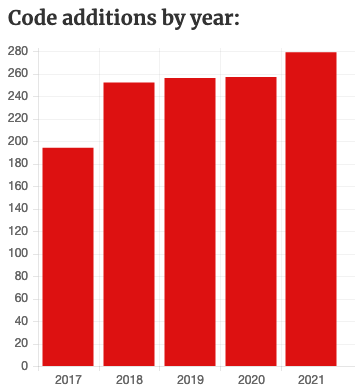
This past week, fourteen new code entries were put into production, fourteen entries were curated, and three entries were staged. We also sent numerous emails to code authors. We've been working on increasing the number of codes added every month, and that effort is paying off, as you can see in the graph (from our dashboard) below. In 2017-2020, we averaged 21 codes/month; this year so far, we're averaging almost 28 new entries/month.
We currently provide all of our public data in JSON and individual entries in both CITATION.cff and codemeta.json. This past week, we had some discussion with one of our developers about making all of our public data available in codemeta.json. We don't have a date for doing this yet, but perhaps will make this change in time for the January AAS meeting.
-
Twenty-two codes were added to the ASCL in October:
ArtPop: Artificial Stellar Populations generator
BASTA: BAyesian STellar Algorithm
BCES: Linear regression for data with measurement errors and intrinsic scatter
exodetbox: Finding planet-star projected separation extrema and difference in magnitude extrema
FEniCS: Computing platform for solving partial differential equationsFlux: Julia machine learning library
GGCHEMPY: Gas-Grain CHEMical code for interstellar medium in Python3
GRASS: GRanulation and Spectrum Simulator
JWSTSim: Geometric-Focused JWST Deep Field Image Simulation
Nauyaca: N-body approach for determining planetary masses and orbital elementsParSNIP: Parametrization of SuperNova Intrinsic Properties
PISCOLA: Python for Intelligent Supernova-COsmology Light-curve Analysis
PSRDADA: Distributed Acquisition and Data Analysis for Radio Astronomy
PT-REX: Point-to-point TRend EXtractor
pyro: Deep universal probabilistic programming with Python and PyTorchQuokka: Two-moment AMR radiation hydrodynamics on GPUs for astrophysics
SELCIE: Screening Equations Linearly Constructed and Iteratively Evaluated
swordfish: Information yield of counting experiments
TauRunner: Code to propagate tau neutrinos at very high energies
ThERESA: 3D Exoplanet CartographyTULIPS: Tool for Understanding the Lives, Interiors, and Physics of Stars
XookSuut: Model circular and noncircular flows on 2D velocity maps -
The ADASS conference took place this week. The ASCL presented a poster about SciCodes at the conference. Though ADASS took up most of my time, eight new code entries, three of them submitted by their authors, were assigned ASCL IDs and moved into production. I also wrote and submitted an abstract for an iPoster presentation at the AAS's January 2022 meeting.