ASCL News
-
 Our science depends on public digital resources, including data archives, software repositories, computational infrastructures, and catalogs. Recent actions by non-scientists have led to the loss of important digital resources in other fields, and even astrophysics assets may face uncertain futures. This poster invites astronomers to reflect on how dependent our research is on shared resources and which of these may be vulnerable to loss. It also asks what actions we can take to safeguard these resources to ensure they remain secure for the future.
Download (PDF)
-
This morning, I gave a short presentation on the ASCL, sharing some tips and tricks for using it (and ADS), as part of this month's Virtual Astronomy Software Talks (VAST) seminar. The slides from it are linked below and contain hotlinks that demonstrate some of the tips and resources available.
Slides (PDF)
-
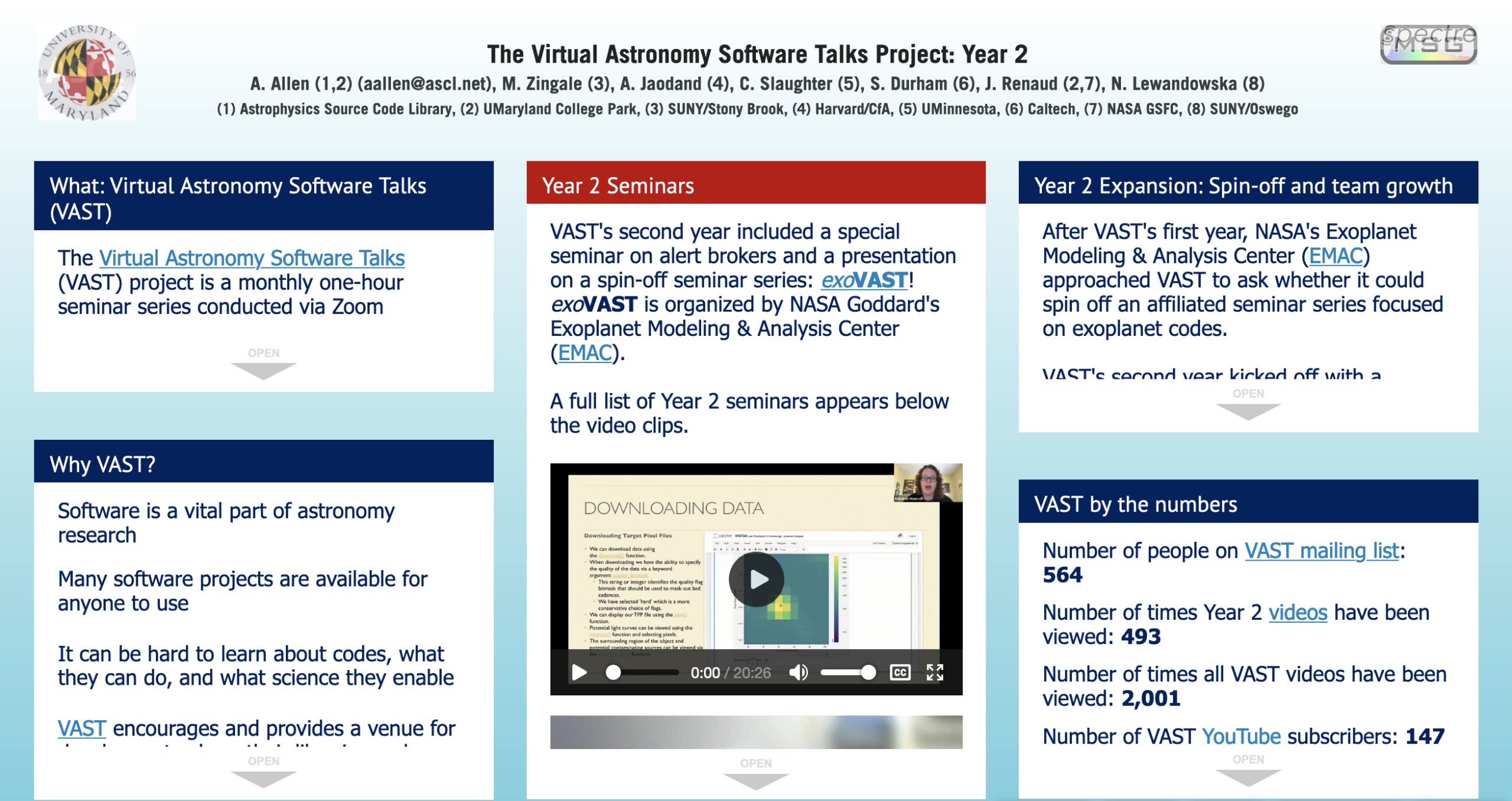
Screenshot of iPoster Software is a vital part of astronomy research, and many software projects are available for anyone to use. The Virtual Astronomy Software Talks (VAST) seminar series provides a way for developers to share information about their software with the community. Using Zoom, one-hour VAST seminars are presented monthly and typically feature two software projects and include a discussion period to foster meaningful communication within the community. Other topics focused on software also also offered; past presentations have covered topics such as teaching computational astrophysics, building a coding community, and publishing software. Presentations are recorded and posted to the VAST YouTube channel, which now features over 20 previous seminars. This presentation covers how VAST is run, its growth in its second year, and its ExoVAST spinoff, and includes information on how to access VAST seminars and propose future talks.
-

The SciCodes Consortium (https://scicodes.net/) recognizes the need for editors and maintainers of research software registries and repositories to share knowledge of best practices and create standards. Our 37 members represent science organizations, institutions, and multidisciplinary research communities that span the institutions across disciplines including biological, medical, mathematical and physical sciences and engineering. These repositories play a pivotal role in strengthening research by enhancing the discoverability of software, thereby supporting transparency, reproducibility, and fostering efficiency through software reuse. Hence, through their stewardship of software, our members pursue common goals including the recognition of software as a first-class citizen in research and establishing metadata standards to enable searching across multiple software registries.SciCodes grew from the Best Practices for Registries Task Force as part of the FORCE11 Software Citation Implementation Working Group. These best practices (Garijo et al., 2022) are:
- Provide a public scope statement
- Provide guidance for users
- Provide guidance to software contributors
- Establish an authorship policy
- Share your metadata schema
- Stipulate conditions of use
- State a privacy policy
- Provide a retention policy
- Disclose your end-of-life policy
The group regularly self assesses for compliance. Examples of how these best practices are implemented in practice are linked to from our website.
We invite the community to join our monthly discussions to:
-
- Discuss challenges and share solutions to common issues that arise in managing our resources
- Strengthen resources through implementation of identified best practices
- Keep up with and share advances through monthly presentations
- Speed adoption of CodeMeta and CFF standards to improve software citation and discoverability
References
Garijo, D. et al., 2022. Nine best practices for research software registries and repositories. PeerJ Computer Science 8:e1023 https://doi.org/10.7717/peerj-cs.1023Download (PDF; working links)
-
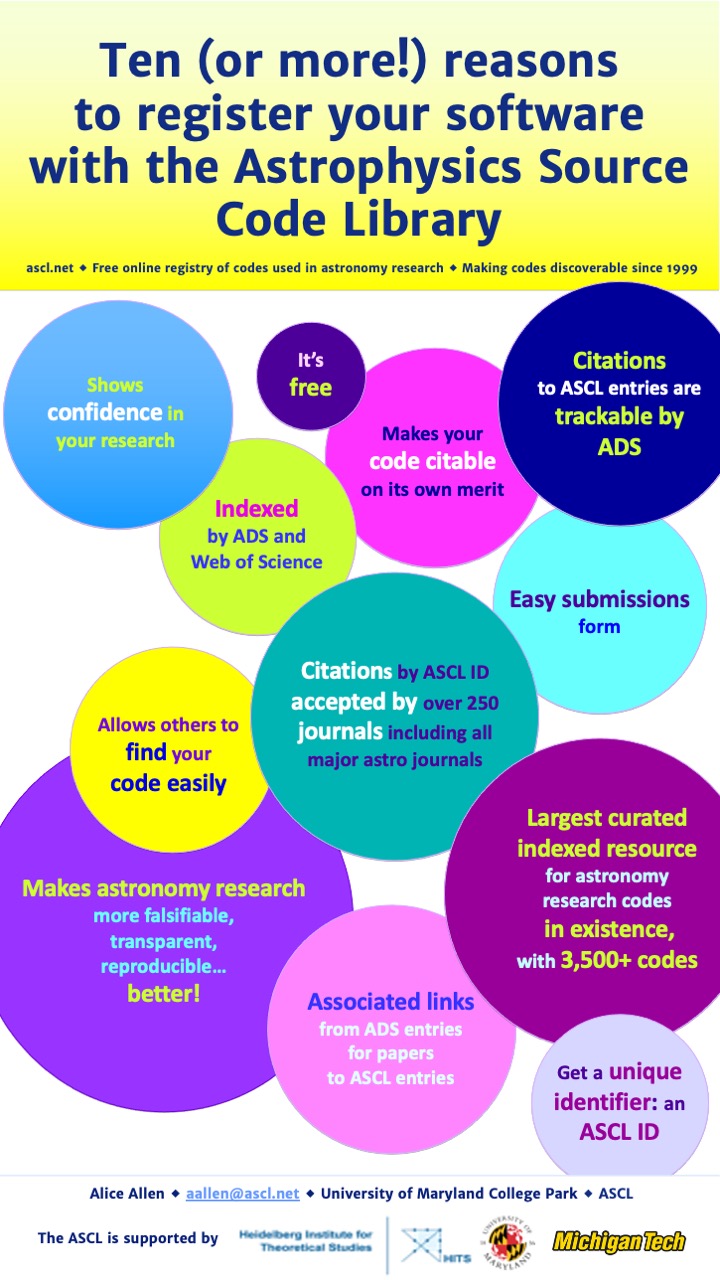
This presentation covers the benefits of registering astronomy research software with the Astrophysics Source Code Library (ASCL, ascl.net), a free online registry for software used in astronomy research. Indexed by ADS and Clarivate’s Web of Science, the ASCL currently contains over 3500 codes, and its entries have been cited over 17,000 times. Registering your code with the ASCL is easy with our online submissions system. Making your software available for examination shows confidence in your research and makes your research more transparent, reproducible, and falsifiable. ASCL registration allows your software to be cited on its own merits and provides a citation that is trackable and accepted by all astronomy journals and journals such as Science and Nature. Adding your code to the ASCL also allows others to find your code more easily, as it can then be found not only in the ASCL itself, but also in ADS, Web of Science, and Google Scholar. -
![Poster title: How Important is Software to Astronomy? Poster text: Software is the most used instrument in astronomy All astronomers use software Robust research requires reproducibility and transparency Computational methods are methods, and should be easily discoverable and open to examination Releasing source code demonstrates confidence in your results and improves efficiency in the discipline Astrophysics Source Code Library (ASCL, ascl.net) • Is a free curated online registry and repository for astro research source codes • Has over 3400 entries • Is indexed by ADS and Web of Science • Includes all major codes that have enabled astro research • Makes it easy to find this software • Advocates for open source and FAIR practices • Is citable and citations to its entries are tracked by major indexers • Adds new and old codes monthly ASCL entries have been cited more than 16,000 times in over 240 journals How to use the ASCL Register your code with the ASCL to make it easier for others to find and to get an ASCL ID to use for citing the software Search for useful downloadable software Find preferred citation information for software you’ve used in research Introduce students to variety of methods available for solving common astronomical problems e community Provides a curated resource for software methods Links research articles with the software that enables that research; links are passed to ADS, so also appear in that resource Allows for citation to software on its own merits without the need to write a separate article for it References [1] Momcheva, I. & Tollerud, E., 2015. Software Use in Astronomy: an Informal Survey, doi:10.48550/arXiv.1507.03989 [2] ASCL dashboard, https://ascl.net/dashboard, retrieved 16 July 2024](https://ascl.net/wordpress/wp-content/uploads/2024/08/IAU2024ASCL_A1poster.jpg) Software is by far the most used instrument in astronomy, and as robust research requires reproducibility and transparency, computational methods should be easily discoverable and open to examination. The Astrophysics Source Code Library (ASCL, ascl.net) makes the software that drives our discipline discoverable. The ASCL is a free online registry and repository for astrophysics research software. Containing over 3300 entries, it not only includes all the major codes that have enabled astro science, thus making it easy to find this software, it also advocates for open source and FAIR practices, and enables trackable formal software citation. Its entries have been cited more than 16,000 times in over 200 journals, and are indexed by ADS and Web of Science. This presentation covers how to use the ASCL and how it benefits the community.
Software is by far the most used instrument in astronomy, and as robust research requires reproducibility and transparency, computational methods should be easily discoverable and open to examination. The Astrophysics Source Code Library (ASCL, ascl.net) makes the software that drives our discipline discoverable. The ASCL is a free online registry and repository for astrophysics research software. Containing over 3300 entries, it not only includes all the major codes that have enabled astro science, thus making it easy to find this software, it also advocates for open source and FAIR practices, and enables trackable formal software citation. Its entries have been cited more than 16,000 times in over 200 journals, and are indexed by ADS and Web of Science. This presentation covers how to use the ASCL and how it benefits the community.Alice Allen, Astrophysics Source Code Library/University of Maryland, MD, USA/Michigan Technological University, MI, USA
-
The ASCL is at the 243rd meeting of the American Astronomical Society (AAS), which is taking place in the major food destination New Orleans. In addition to tracking down beignets and bread pudding, ASCL team members have shared the stage with others in a Special Session and have presented iPosters. The Special Session was held on Monday afternoon; iPosters were presented on Monday and Tuesday evenings.
~~~~~
Special Session: Into the Future: Building on 25 Years of Community Organization in Astro Software DevelopmentAbstract: Over the past 25 years, astronomy has seen many changes involving research software development. These include improved transparency, improved software availability, and changes in journal policies. Formal recognition of community-based software development has increased through targeted funding, the establishment of new journals specifically focused on software, and code citation.
Changes in astro software development include the rise of open social coding sites such as GitHub and GitLab, the establishment and growth of conferences devoted to or including research software (such as ADASS, FORCE11, and the Research Data Alliance), and community-based training in software development (for example, The Carpentries and SciCoder) and exploration (for example, .dotastro and hack days) events.
This Special Session will look back at the community-driven work that has enabled some of these changes and look forward to future horizons for the software community in astronomy. Leaders of some of these community efforts will serve on an expert panel and will share their perspectives, after which the floor will be open for discussion with participants.
Speakers
Peter Teuben, University of Maryland, College Park: Introduction and Overview
Demitri Muna, Chief Science Data Office, NASA HQ: Software Training for Research Scientists: SciCoder and Other Efforts
Aarya Patil, Max Planck Institute for Astronomy: Building the AstroPy Community
Robert Nemiroff, Michigan Technological University: How and Why the Astrophysics Source Code Library Was Formed
Kimberly DuPrie, Space Telescope Science Institute: Lessons from Industry~~~~~
iPoster: Using the Astrophysics Source Code Library in the classroom
Alice Allen, Astrophysics Source Code Library; Kimberly DuPrie, Space Telescope Science Institute; Peter Teuben, University of Maryland, College Park; Robert Nemiroff, Michigan Technological UniversityAbstract: The Astrophysics Source Code Library (ASCL, ascl.net) is an online registry of source codes used in refereed astrophysics research. It currently lists over 3,300 codes and covers all aspects of computational astrophysics, and all of its public metadata about software can be downloaded. This presentation covers possible ways the ASCL can be used by educators and their graduate students. The ASCL serves as a discovery tool for codes that can be used for one’s own research. Graduate students can also investigate existing codes to see how common astronomical problems are approached numerically in practice, and use these codes as benchmarks for their own solutions to these problems. Further, they can deepen their knowledge of software practices and techniques through examination of others’ codes, and can use the ASCL’s data set for research on computational methods in astrophysics.
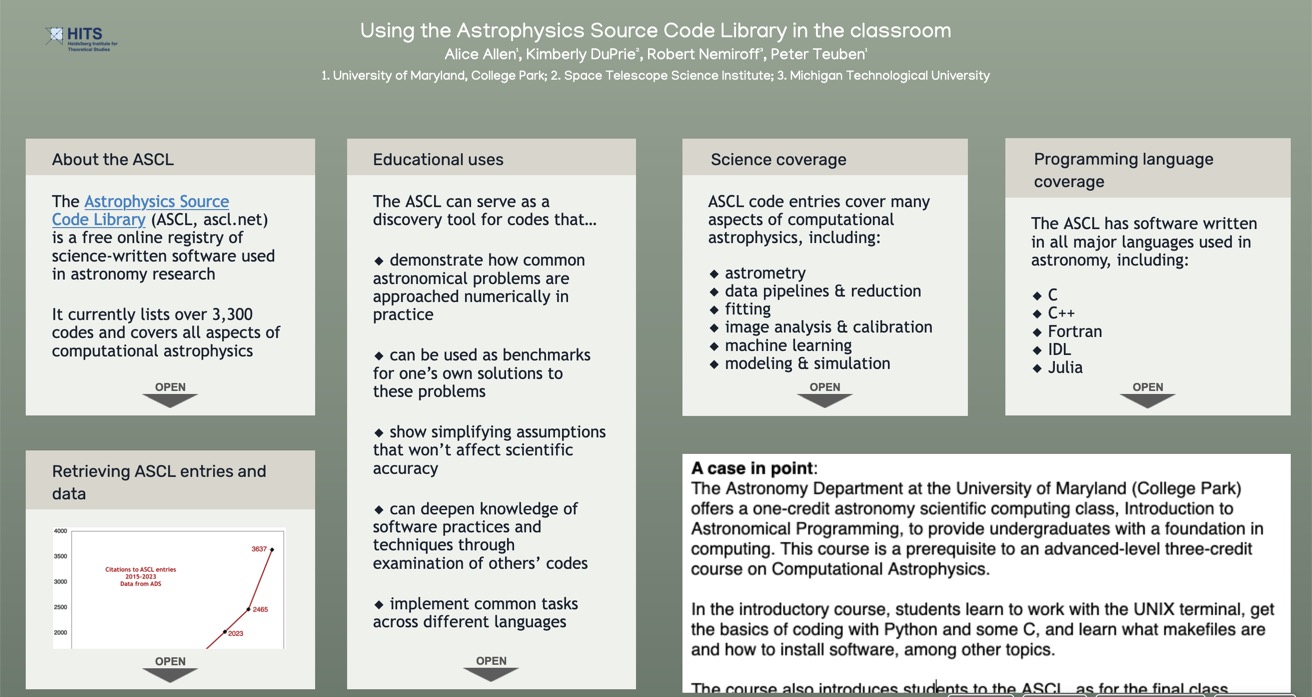
Screenshot of Using the Astrophysics Source Code Library in the Classroom iPoster ~~~~~
iPoster: ASCL, ADS, and EMAC: Improving the visibility and citability of exoplanet research software
Alice Allen, Astrophysics Source Code Library; Alberto Accomazzi, Center for Astrophysics | Harvard & Smithsonian; Joe Renaud, UMD College Park / NASA Goddard.Abstract: The Astrophysics Source Code Library (ASCL, ascl.net) is a free online registry for source codes of interest to astronomers, astrophysicists, and planetary scientists. It lists, and in some cases houses, software used in research that has appeared in, or been submitted to, peer-reviewed publications. It now has over 3300 software entries and is indexed by ADS and Clarivate’s Web of Science. In 2020, NASA created the Exoplanet Modeling and Analysis Center (EMAC, emac.gsfc.nasa.gov). Housed at the Goddard Space Flight Center, EMAC serves, in part, as a catalog and repository for exoplanet research resources. EMAC currently has 223 entries, 77% of which are for downloadable software. This presentation will cover the collaborative work the ASCL is doing with EMAC and with NASA’s Astrophysics Data System (ADS) to increase the discoverability and citability of EMAC’s software entries and to strengthen the ASCL's and ADS's ability to serve the planetary science community.
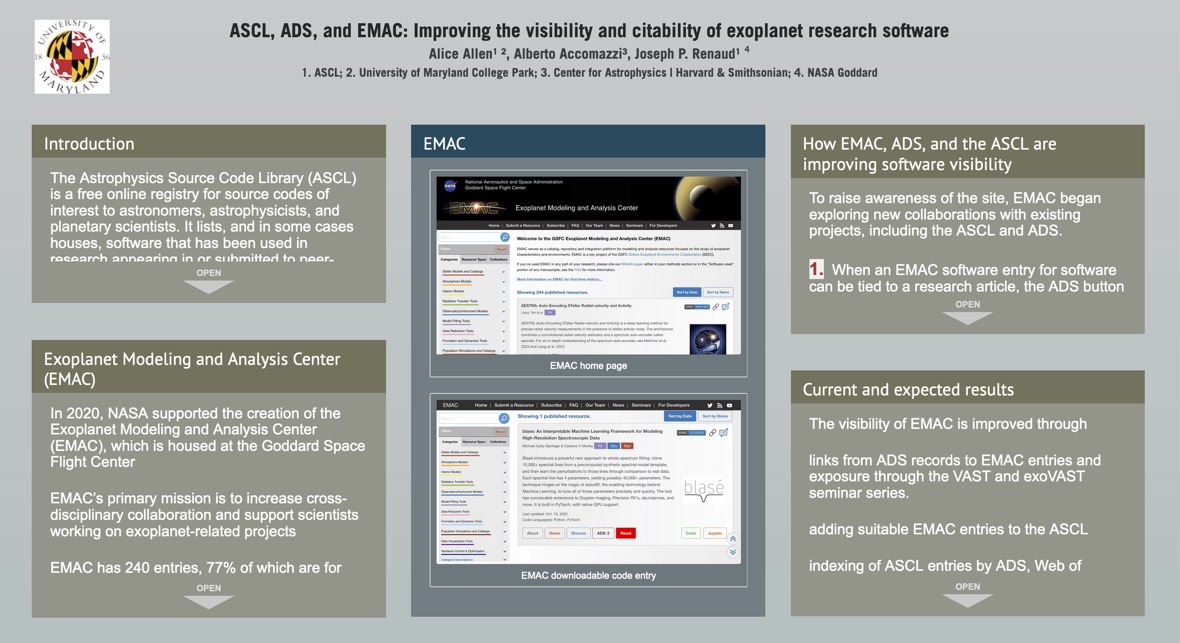
Screenshot of ASCL, ADS and EMAC: Improving the visibility and citability of exoplanet research software iPoster -
ADASS is my favorite conference; it's so favored that... well, you'll see ...
ADASS was in Tucson this year. I decided to drive from Maryland to Tucson, figuring that was likely my best way to avoid getting/bringing COVID to the conference. It's too long a drive to do in one day, so I stayed at a campsite outside Claremore, Oklahoma one night. It was lovely! Almost deserted, lots of birds, view of the lake... perfect! But alas, when making my coffee the next morning, I tripped and fell, breaking my right arm and nose and bashing up a few other body parts. I got patched up at a local hospital (excellent care!) and had surgery two days later (more excellent care!). I couldn't drive, of course, so what to do, what to do? A friend offered to fly to Tulsa and drive me wherever I wanted to go, suggesting "back home" would be best. Where did I want to go? Tucson, of course! I did not want to miss ADASS!! So off to Tucson we went. Once I was deposited in a hotel there, she flew back to her home. (Now that's a friend!! I'm forever grateful!!)
I gave an oral presentation at ADASS on "Improving the visibility and citability of exoplanet research software," this about the work the ASCL is doing with NASA's Exoplanet Modeling and Analysis Center (EMAC) and ADS. Links to my slides and proceedings pre-print are below.
ADASS did not disappoint! I'm so glad I attended it, and also attended the IVOA meeting immediately after. Everyone was helpful and kind, as I knew they would be. I stayed in Tucson until cleared to drive, and then drove myself the 2300 miles home. Not the trip (hahahaha) I was expecting, but it was the trip that was.
-
All posters at the 241st meeting of the American Astronomical Society were iPosters: displayed on a screen instead of printed on paper or fabric. The ASCL's iPoster is available for viewing in the iPoster Gallery; the image below is a static screenshot.
Why others might not be citing your astronomy software
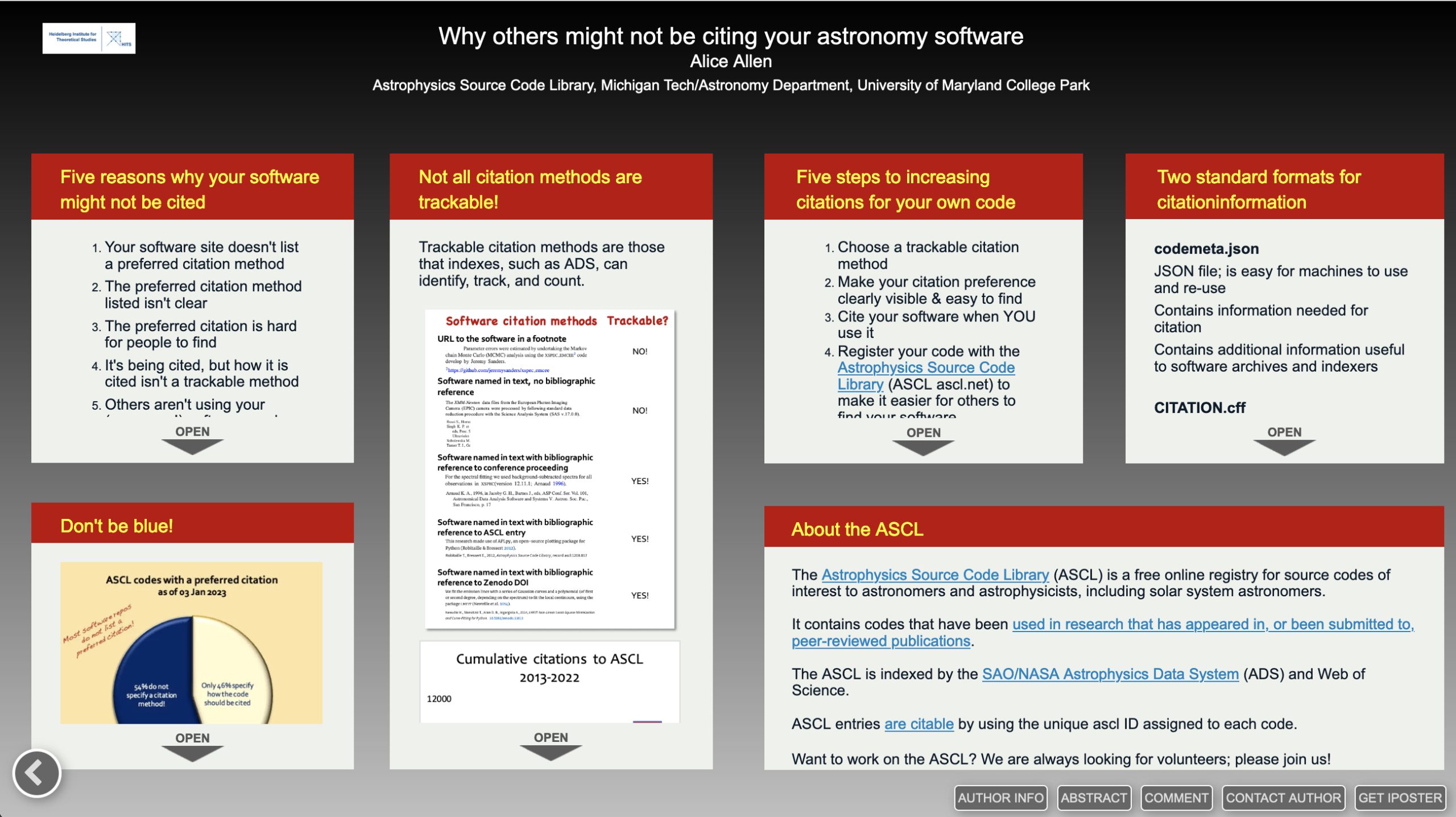
Screenshot of ASCL iPoster at AAS 241 Your codes can themselves be cited, and you can choose your preferred citation method! So why aren't people citing your code? Come find out, and also learn what five steps you can take to improve citation of the software you write.
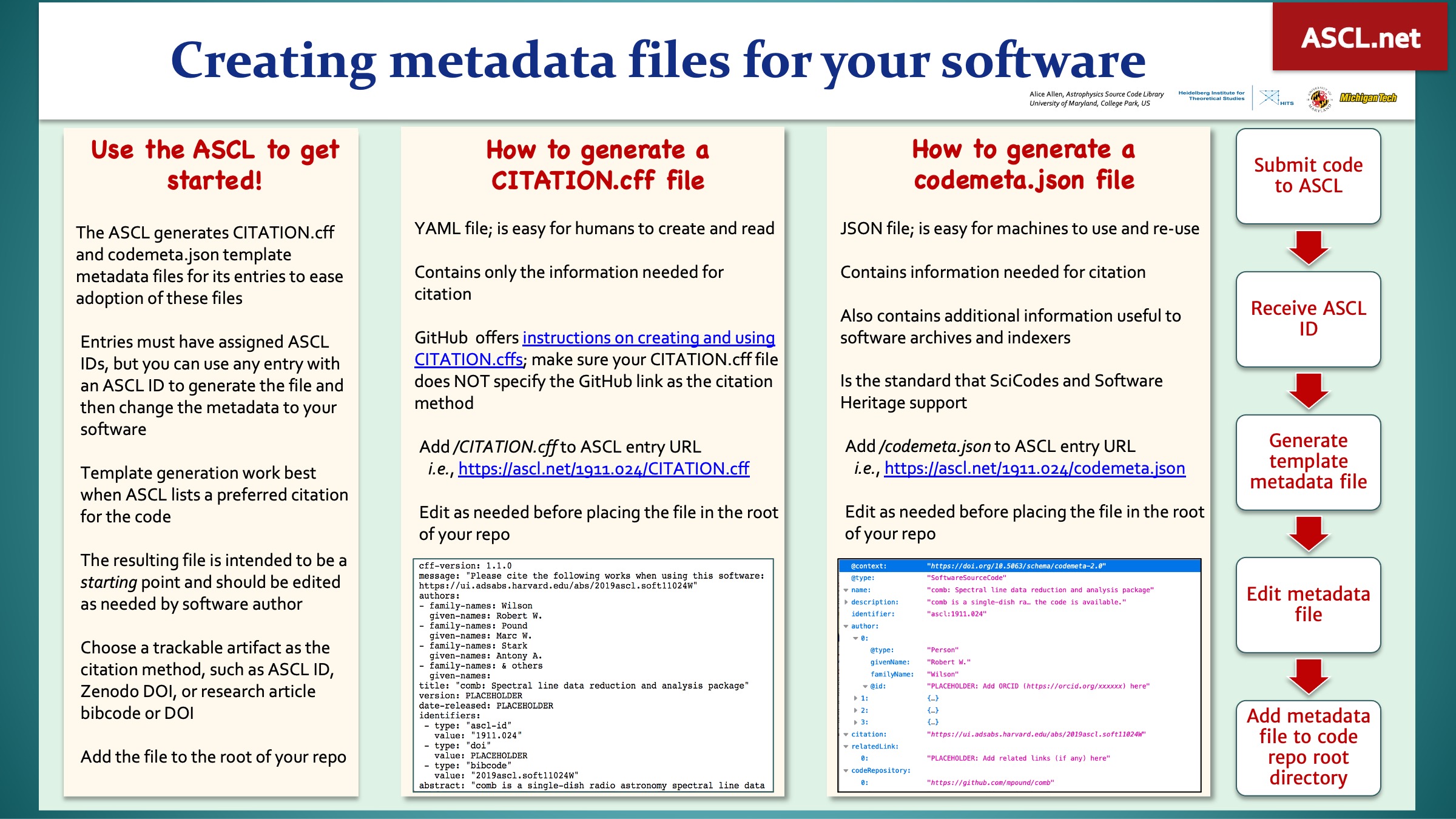
In the past decade, software citation has accelerated in astrophysics, resulting in the field now having multiple ways to cite computational methods. Adding software metadata files, such as a CITATION.cff or a codemeta.json file, to the root directory of a GitHub repo (or other code storage site) lets others know how they should cite that software. Yet most software authors do not specify how they would like their code to be cited, while others specify a citation method that is not easily tracked (or tracked at all) by most indexers. In 2020, the Astrophysics Source Code Library (ASCL, ascl.net) sent authors of 135 codes software metadata files (CITATION.cff and codemeta.json), tailored to each computational method, and suggested that one of these files be edited as needed and included on their code site. In early 2021, we examined the code sites for these 135 entries and found that only 41% of these sites had citation information in any form available. In mid-2021, GitHub announced the integration of CITATION.cff into its service, making it easier to add this metadata file to one’s repo. Even so, as of January, 2023, 54% of the codes registered in the ASCL do not specify how to cite use of the software. The lack of citation information creates an obstacle for article authors to provide credit to software creators, thus hindering citation of and recognition for computational contributions to research and for the scientists who develop and maintain software.
#AAS241
-
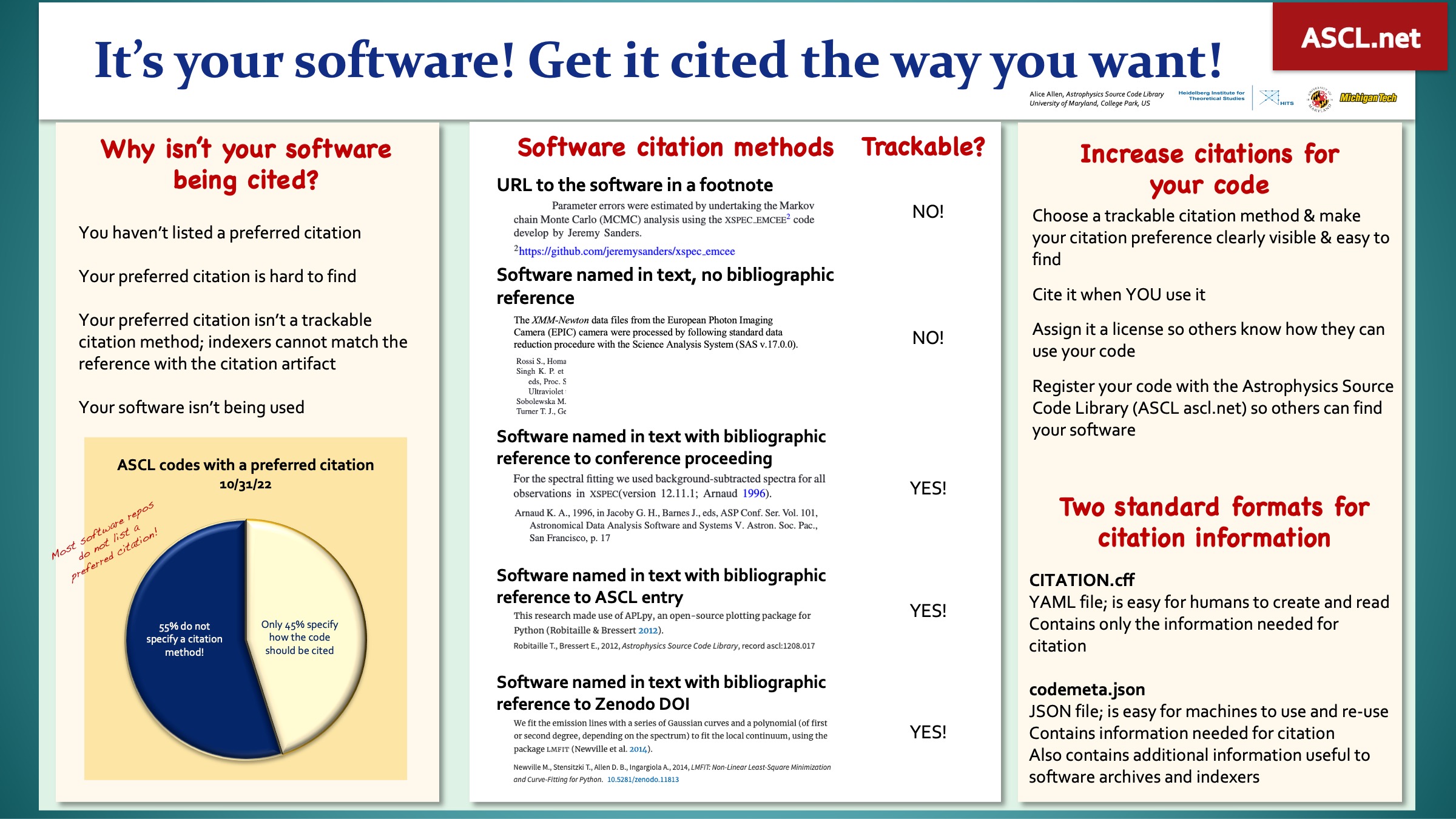
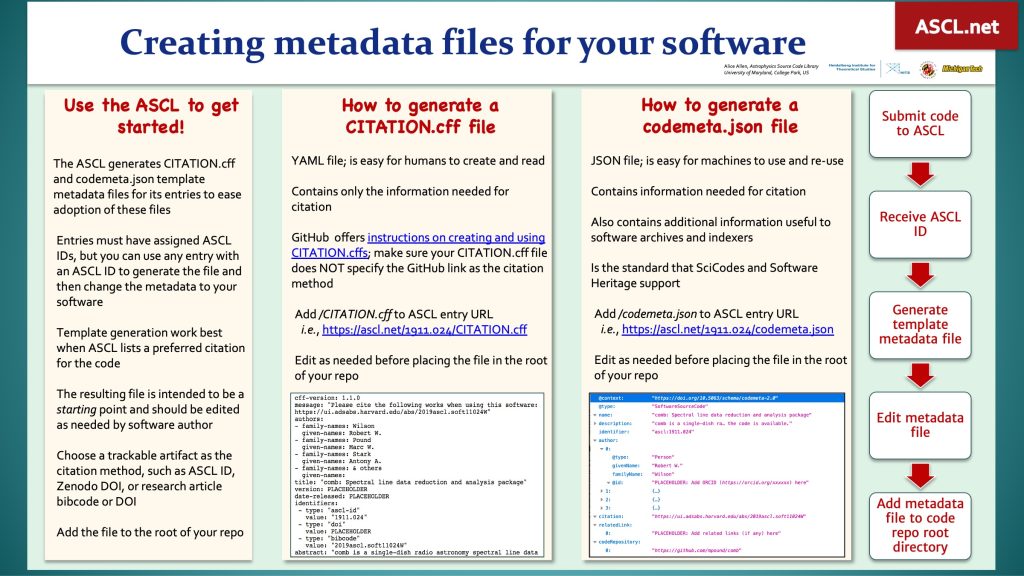
Are others using software you've written in their research and citing it as you want it to be cited? If not, this poster will help! Software can be cited in different ways, some good, and some not good at all for tracking and counting citations in indexers such as ADS and Google Scholar. Generally, indexers need to match citations to resources, such as journal articles, they ingest. There are several reasons why your code might not be cited well (in a trackable/countable way). One common reason is the lack of clear and explicit instructions on a code's download site. Most astro code sites don't list a preferred citation method! Make it easy for people to cite your software by listing a (good! trackable!) preferred citation method where others can easily find it. Creating a standard software metadata file, such as a CITATION.cff or codemeta.json, and adding it to the root of your code repo is easy to do with the ASCL's metadata file creation overlay (see handout below), and will help out anyone wanting to give you credit for your computational method, whether it's a huge carefully-written and tested package, or a short quick-and-dirty-but-oh-so-useful code.#ADASSXXXI