ASCL News
-
This week, we saw another example of the importance of software in astronomy research. We are pleased to announce the establishment of an annual software prize from the UMD Astronomy Department for research software written by a registered undergraduate or graduate student while the student was at University of Maryland, College Park. The source code of the software must be open and assigned an acceptable open source license.
The prize consists of a certificate and a cash award, which will be presented at the Astronomy Department annual award ceremony. We reserve the right to withhold the prize if the criteria are not sufficiently met.
More details will be available later; if you would like additional information, please contact us.
Peter Teuben, teuben@astro.umd.edu
Alice Allen, aallen@ascl.net -
Twelve codes were added to the ASCL in February, 2019:
dyPolyChord: Super fast dynamic nested sampling with PolyChord
ExPRES: Exoplanetary and Planetary Radio Emissions Simulator
GraviDy: Gravitational Dynamics
LiveData: Data reduction pipelineLPNN: Limited Post-Newtonian N-body code for collisionless self-gravitating systems
PINT: High-precision pulsar timing analysis package
PyMF: Matched filtering techniques for astronomical images
Radynversion: Solar atmospheric properties during a solar flareRPFITS: Routines for reading and writing RPFITS files
SNTD: Supernova Time Delays
Specutils: Spectroscopic analysis and reduction
SpecViz: 1D Spectral Visualization ToolAnd sixteen codes were added to the ASCL in March, 2019:
allesfitter: Flexible star and exoplanet inference from photometry and radial velocity
AsPy: Aspherical fluctuations on the spherical collapse background
brutifus: A Python module to post-process datacubes from integral field spectrographs
DAVE: Discovery And Vetting of K2 ExoplanetsGalIMF: Galaxy-wide Initial Mass Function
Galmag: Computing realistic galactic magnetic fields
HelioPy: Heliospheric and planetary physics library
ICSF: Intensity Conserving Spectral FittingNFWdist: Density, distribution function, quantile function and random generation for the 3D NFW profile
NIFTy5: Numerical Information Field Theory v5
PLATON: PLanetary Atmospheric Transmission for Observer Noobs
PRF: Probabilistic Random ForestSimSpin: Kinematic analysis of galaxy simulations
SIXTE: Simulation of X-ray Telescopes
SPICE: Observation Geometry System for Space Science Missions
SpiceyPy: Python wrapper for the NAIF C SPICE Toolkit -
The ASCL is participating in the Research Data Alliance (RDA) meeting currently underway in Philadelphia, PA. The Plenary 13 meeting motto is "With Data Comes Responsibility." Indeed! Among the sessions of special interest for software folks was yesterday's Interest Group meeting on Software Source Code and today's first meeting of a new Working Group on Software Source Code Identification. The Working Group is led by Roberto Di Cosmo, who is a founder of Software Heritage, Martin Fenner from DataCite, and Daniel Katz from the University of Illinois. This initial meeting is titled "Identifying, referencing and citing the source code of research software: a state of the art." The ASCL is doing a short presentation that focuses on a few of our practices, how we do them, and the rationale for them; this includes what we do when we process a submission, what metadata for software we do and don't have and why, and some of our curation practices. Our slides for this presentation are available below.

Photo courtesy of @StephvandeSandt Our attendance at this meeting was made possible with support from Software Heritage; our thanks to that organization!
-
This is a continuation of a previous post, and was written by Brian Thomas, Alice Allen, Marc W. Pound, and Peter Teuben.
Lessons Learned
As this was the first such event of this type for ADASS we were unsure of the outcome, as it was somewhat of an experiment. We share some lessons learned for future events.- Provide a list of interesting problems and related clean data. Doing so helps to bootstrap project ideas, as not all participants will have enough domain background to start quickly. Because the event was so short, it was helpful to provide microservices and point to datasets that were more or less cleaned and ‘ready to go’ for projects directed at these problem areas.
- Develop a marketing plan. We could have done a better job to garner interest in the event. We posted to a community BBS, a UMD subreddit, posted paper flyers in campus science and engineering buildings, and contacted student groups and faculty to help spread the word. However, we did not have a coordinated campaign that included social media and messaging targeted for specific dates and groups (e.g., “Save The Date” emails), nor was the hackathon mentioned in the ADASS registration form. A competing, large, all-women hackathon (https://gotechnica.org/) held the same weekend on campus also affected our enrollment.
- Venue (location and time) is important. The university was a good choice because of easy access to rooms, wifi, and food choices. Holding the hackathon at a large academic institution ensured that it would be easy for younger participants (undergrads) to attend, as did holding the event over a weekend to avoid conflicting with classes.
- Have an assessment tool/strategy. An exit survey or ending discussion with participants can help improve subsequent hackathons. We failed to take advantage of the opportunity to engage either the participants or the ADASS audience at the session where winning projects were presented about perceived problems and good aspects of our event.
- Narrow the range of participant experience. Future organizers should consider either limiting participation to non-professionals, or group the participants and awards into professional and non-professionals. It is somewhat unfair to have less experienced coders compete against domain specialists and possibly contrary to the avowed desire to use this event to advertise our field of work to outsiders.
- Time management is crucial. Scheduling a conference event right at the end of the hackathon was problematic, and not tightly managing the final presentation time and similar issues became important and detracted from the event. This will be particularly important in other events that have larger participation.
Conclusions
A community lives and dies by how well it nurtures the next generation. Folks enter the ADASS community by a number of means but typically by being either scientists who become attracted to the technical challenges of writing the software or as computer engineers and programmers who find the science use cases particularly interesting. We are not aware of any organized means to train the next generation of ADASS workers; there are no formal degree programs in “Astronomy Software.” As such, our community has taken a somewhat laissez-faire approach to training the next generation and this may lead to a future deficit in skilled professionals willing to work in our field. More and more our community’s skills are being found useful in application elsewhere; for example, many ADASS attendees can easily become highly sought after Data Scientists.Hackathons are a step towards being more proactive in our outreach and provide an ideal means to encourage and interest a younger group of programmers in the complex and interesting challenges that our community tackles. We found a number of lessons in hosting this event but no showstoppers, and a good deal of goodwill was generated. Based on our experience, we heartily recommend that future ADASS events include hackathon events.
Acknowledgments. We would like to thank the City of College Park for providing the prize money, Vigilante Coffee for supplying much needed coffee, ASCL for providing snacks and the University of Maryland Astronomy Department for hosting the hackathon.
-
This post was written by Brian Thomas, Alice Allen, Marc W. Pound, and Peter Teuben, and, with part 2, will appear in the ADASS XXVIII proceedings.
Brian is with the Office of Chief Information Officer, NASA HQ, Washington DC; Marc, Peter, and Alice are in the Astronomy Department at the University of Maryland in College Park, MD.
In this post, we describe the ADASS XXVIII hackathon, the first associated with an ADASS conference, and provide our motivation and the details of the event. A subsequent post discusses the lessons we learned from holding this event and our conclusions about it.
Introduction
A hackathon seeks to draw together a large group of folks for an intense and extended period of creative programming. Hackathons may be held for a variety of purposes including, but not limited to, teaching (Huppenkothen et al. 2018), to draw together a technical community as a social event (Kellogg et al. 2019), and to draw attention to solving particular challenges or themes (as found, for example, on popular sites such as Kaggle). Pa Pa Pe Than et al. (2018) provides a broader overview of hackathon applications and uses.Our motivation for holding a hackathon associated with the ADASS XXVIII meeting was aligned with outreach to interested individuals; we wanted to highlight topical technical problems that the ADASS community might be concerned with and introduce a new generation of rising computer programmers and scientists to the excitement of solving them. We chose the topic area of Time Domain Astronomy (TDA) to focus on for this event as it was also one of the themes for this year’s ADASS meeting and aligned well with the interests of the Department hosting the hackathon. We allowed a loose definition of TDA, dealing with any astronomical data where time was a parameter. Thus projects for this hackathon could involve, for example, variable stars, exoplanets, and bodies in the solar system.
Event Organization
The ADASS hackathon took place the weekend before the ADASS starting on Saturday morning and ending at noon on Sunday with the total event time being 27 hours. We provided a space in the University of Maryland Physical Sciences Complex (PSC) as well as snacks and coffee. The participants were required to attend the introduction and be present for final presentations at 11am on Sunday. Otherwise, they could stay in the PSC building or leave as they desired. A cash award (provided by the City of College Park) was available for the top 3 teams with $500, $350 and $150 being awarded to the first, second and third place teams respectively. The winning team was also provided time to present their hack during the ADASS meeting.We began by having the participants introduce themselves, their backgrounds and interests. We then introduced the participants to the field of TDA, providing some general background and challenges in this area. Presentations were given by Charlotte Ward (UMD graduate student), Gerbs Bauer (UMD Research Professor), and Brian Thomas (NASA). We highlighted some datasets which could be applied to solving aspects of the challenges. This was followed by a freely flowing brainstorming session where people could discuss ideas and questions, and potential hacks could be focused. Ideas were placed on sticky notes on a wall. Participants were then allowed a short period of time to form teams and brainstorm. After another hour or so, each team presented an outline of their hack, potentially allowing members to join another team if skill sets were better suited elsewhere. In our case nobody decided to join another team.
We allowed for a range of project types. Projects could be new analyses or approaches or novel ways of understanding existing solutions or problems. The final product could be a proof-of-concept app, a plugin to existing code, a storyboard design, or really anything that embodies creative hacking around the TDA theme. We did not require that the final project be polished; a good idea that was well fleshed out could also be submitted. A final presentation of a few slides describing the work including the motivation and approach was the only requirement for consideration for a prize.
We used Devpost to help structure the hackathon. This site served as a centralized location from which information could be disseminated including rules of conduct and a discussion board which we used to distribute ideas and answer participant questions. Hackathon rules can be summarized as follows:
- Each participant belongs to one team and one final submission, but is allowed to switch teams. Team makeup is not final until the presentation. The maximum team size was 5.
- Only 1 submission per team.
- A Code of Conduct. We did not tolerate harassment of hackathon participants in any form, including, but not limited to, harassment based on gender identity and expression, age, sexual orientation, disability, physical appearance, body size, race, ethnicity, nationality, religion, political views, previous hackathon attendance, lack of computing experience, or chosen programming language or tech stack. Sexual language and imagery was not appropriate at any point in the hackathon including in software hacks, social media, talks, presentations, or demos.
Hackathon participants violating any of these rules could be sanctioned or expelled
from the hackathon at the discretion of the hackathon organizers.Participants
Our event was set up as a community hackathon and attracted students, professional hackathonners, and ADASS participants who formed teams (see below). Members of the hosting department and the ADASS program organizing committee served as judges. Out of the 34 original registrations, 6 were present but not playing (being part of the organization or just cheerleading), and 9 did not show up.Judges, Organizers, and Teams
The session was organized by Peter Teuben, Brian Thomas, Alice Allen, Marc Pound, and Elizabeth Warner. Our judges were Alice Allen, Gerbs Bauer, Andy Harris, Nuria Lorente, Ada Nebot, and Brian Thomas. The 7 teams that participated are listed in Table 1. We have also noted which teams won which prizes.Team members Project name Sarah Frail and Patrick Shan Morpheus - Near Earth Objects Visualization Marco Lam Drag and drop ensemble (2nd prize) Paul Ross McWhirter and Josh Veitch-Michaelis Auto periodogram selection using MC (3rd prize) Timothy Henderson and Matt Graber Solar Activity Viewer Thomas Boch, Matthieu Baumann, and Siddha Mavuram Music of Light curves (1st prize) Kyle Kaplan, Sankalp Gilda, Hayden Hotham, Steve Gambino, and Abbie Petulante ML on ZTF pipeline Kevin Cai, Kael Lenus, James Zhou, and Justin Otor Fixed and Variable Time Kepler Viewer in WWT Table 1. Hackathon Teams
The winning team “The Music of Light Curves” made their hack, the sonification of variable stars from the Gaia catalogue, available on https://tboch.github.io/music-lightcurves-hack/. Their presentation to the ADASS audience during the TDA session on Wednesday met with resounding applause (and later a mention in the international press).
-
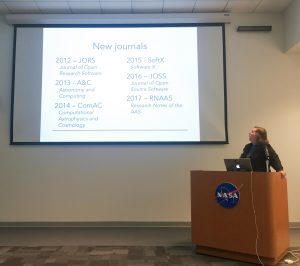
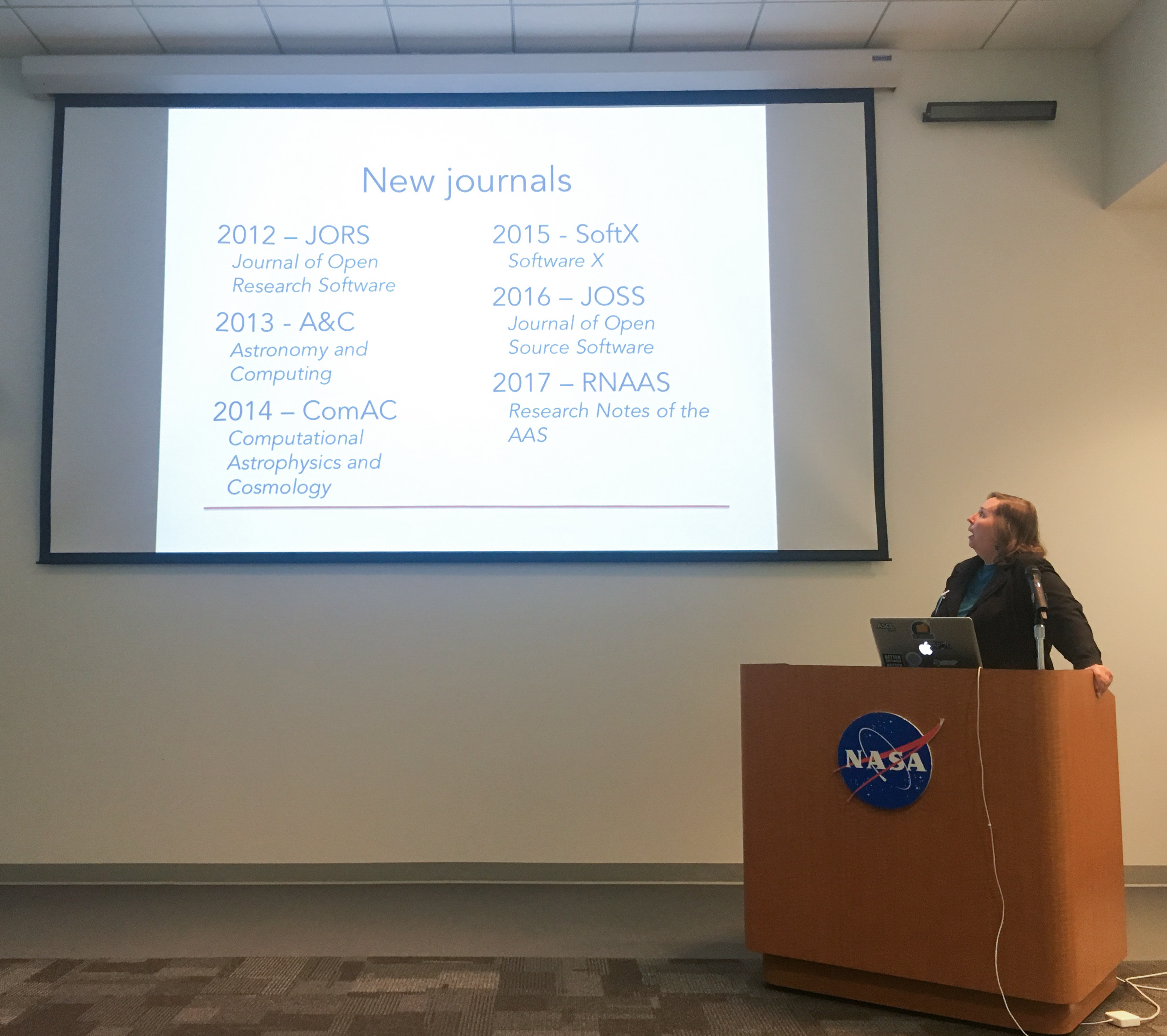
At the podium Although I was born in Washington, DC and have spent most of my life in its Maryland suburbs, yesterday was my first time on the Goddard campus (aside from its Visitor Center, which I've been to many times), this despite having two family members and many friends who used to1 or do work there. I was excited! And I had a great reason for going: I was presenting a talk to the Astrophysics Science Division titled "Make your research software famous! (or at least discoverable)." The talk, broadcast on a NASA UStream channel and recorded for future viewing,2 covered a bit about our research on source code availability in astronomy, and also covered our current project to make NASA astro research software more discoverable, what the Astrophysics Source Code Library is and how it improves research transparency, software citation, and recent changes in publishing with regard to software that, combined with other changes in the community and science in general, make it easier than ever before to make one's astro research software discoverable. The slides I presented are available for download (PDF), and links to different resources, journals, and organizations that I mentioned in the talk are also available.
Kristin Rutkowski, along with Tess Jaffe and Alex Reustle, hosted my visit to GSFC; I had met both Kristin and Tess at last year's ADASS conference in College Park, where we had our first conversation about my visiting the site to talk about the ASCL. Yesterday's audience was great; they were involved and asked a lot of excellent questions, about copyright, code authors not receiving credit for the software they write, how we handle dead links, mutable author lists, NASA policies regarding software release, and how the ASCL is funded. Some of the questions came from people attending remotely and were asked online; Alex made sure these were covered, too. Alex is also involved in making the video of the talk available online, and when it is available, I'll update this post with its link.
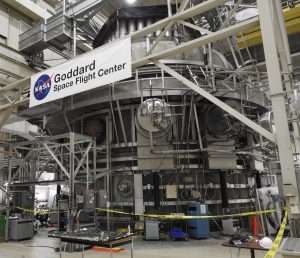
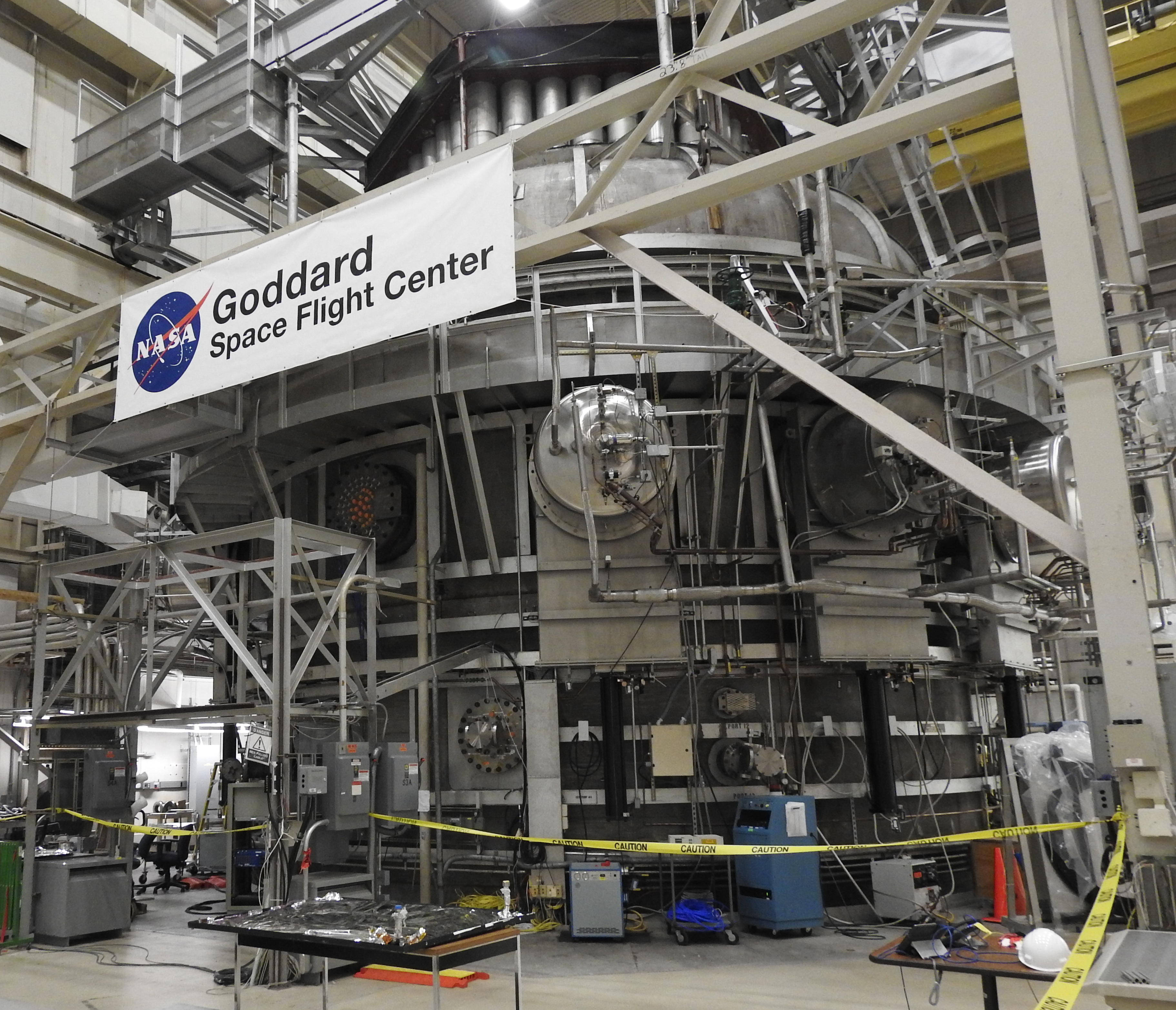
Space Environment Simulator After my presentation, Kristin and Tess took me to see some of the NASA labs and equipment, including the Space Environment Simulator Facility, the JWST/OTIS Vibration Test System, the currently out-of-service High Capacity Centrifuge, and the Acoustic Test Cell. We went through doors marked "Authorized Personnel Only"!! This is one of the perqs of working on the ASCL -- I become "Authorized Personnel" when visiting telescopes and labs and such, which, to me, is very cool and exciting! Sure, it's only for a few minutes and always in the company of others who have far more business being there than I do, but still: very cool and exciting!! After looking at these labs and equipment, Kristin and I said goodbye to Tess, and then drove over to see dinosaur footprints that had been found on the Goddard campus. (Could a visit anywhere be any cooler?!?!)
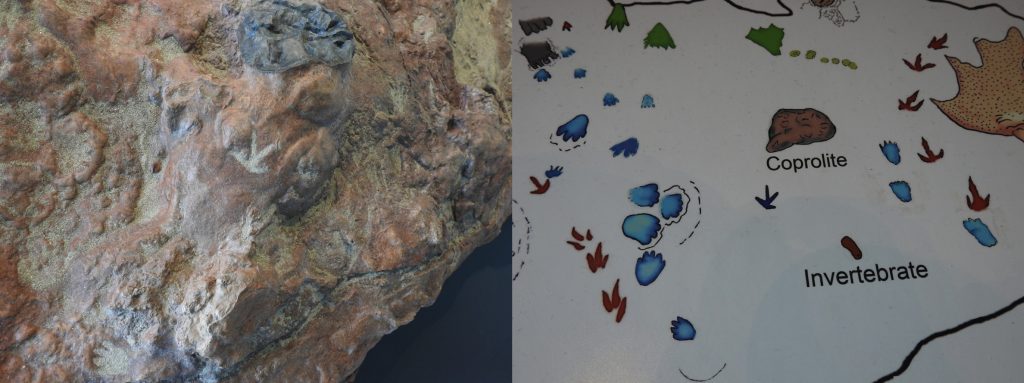
Dinosaur and small mammal tracks Science science everywhere! I had a great time at Goddard, and thank Alex and Tess and especially Kristin for hosting my visit!
1 Happy retirement day, Janie!
2 No, that's not nerve-wracking at all, so long as one doesn't think about it. -
Presentation slides (PDF)
Journals
Journal of Open Source Software (JORS)
Astronomy and Computing (A&C)
Computational Astrophysics and Cosmology (ComAC)
Journal of Open Source Software (JOSS)
Change leaders and guidelines
Force11/Force11 Software Citation Principles
Working toward Sustainable Software for Science: Practice and Experiences (WSSSPE)
Social coding sites and archival services
Other resources
-
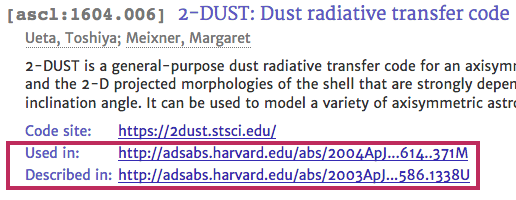
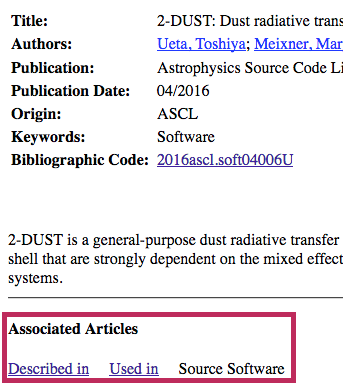
As we mentioned back in June 2018, ASCL editors had been examining the papers listed in the Appears in field and disambiguating these into new Described in and Used in fields, this to better capture the relationship of a mentioned article to the software. Disambiguated links have been appearing in ADS since May 2018, as you can see in this example, with the ASCL entry (as it had been) on the left, and the (classic) ADS screen display on the right:
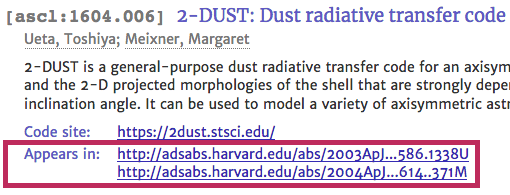
We completed the disambiguation process earlier this month, and now with the completion of that project, our excellent developer/designer Judy Schmidt (@SpaceGeck) has changed the ASCL entry screen slightly; it now displays the Described in and Used in fields rather than the ambiguous Appears in field.
The entry has changed from this:
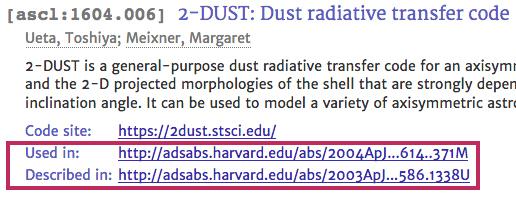
Our reports and data feeds, such as to Web of Science's DCI and the JSON data dump, have also been changed to show the Described in and Used in fields.We have a few more screens and forms to change, such as the Submit form, and when these other changes have taken place, we will let you know in another blog post that will be cleverly titled Changes on the ASCL, #2.
-
Twelve codes were added to the ASCL in January, 2019:
bettermoments: Line-of-sight velocity calculation
Bilby: Bayesian inference library
CCL: Core Cosmology Library
cFE: Core Flight Executiveeddy: Extracting Disk DYnamics
Galaxia_wrap: Galaxia wrapper for generating mock stellar surveys
OCFit: Python package for fitting of O-C diagrams
Photon: Python tool for data plottingSEDobs: Observational spectral energy distribution simulation
ssos: Solar system objects detection pipeline
stellarWakes: Dark matter subhalo searches using stellar kinematic data
unwise_psf: PSF models for unWISE coadds -
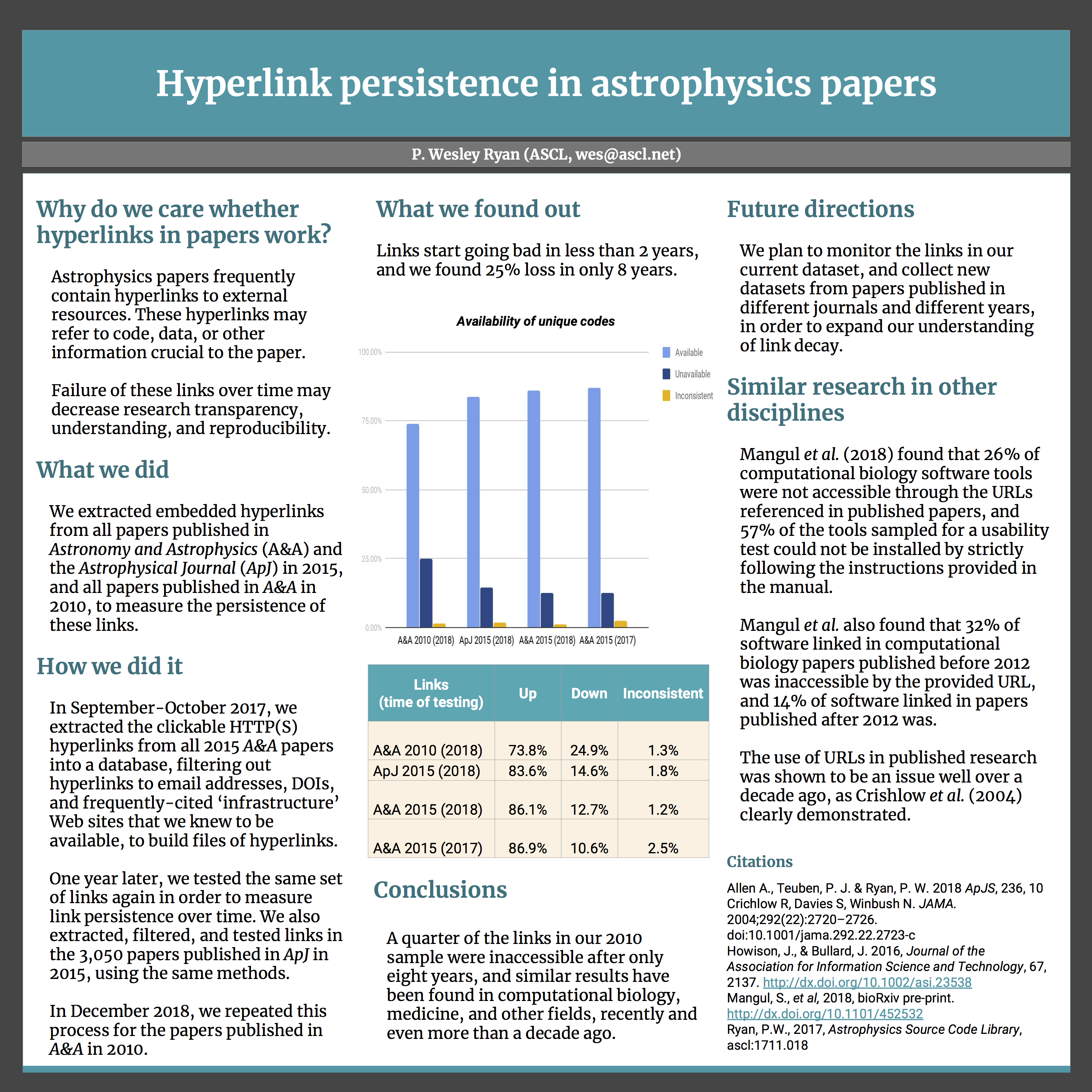 URLs have often been used as proxy citations for software and data. We extracted URLs from one journal’s 2015 research articles, removed those from certain long-term reliable domains, and tested the remainder to determine what percentage of these URLs were accessible in September and October 2017. We repeated this test a year later to determine what percentage of these links were still accessible. We will present what we learned about URL accessibility in astronomy.
P. Wesley Ryan, Astrophysics Source Code Library