ASCL News
-
The European Week of Astronomy and Space Science (EWASS) was held June 26-30 in Prague and attended by over 1,100 people, and the ASCL was there! This post is an overview of the ASCL's participation in the event; a subsequent post (or two) will provide more detailed information and links to slide decks for sessions the ASCL was involved in organizing.
Program page for software talks
Image by Amruta JaodandThis was my first time attending EWASS, which was initially brought to my attention by Keith Smith (Science). It was also my first time in Prague. My activities since the meeting have included submitting proposals (with others) for EWASS 2018, which will be in Liverpool, and pricing short-term apartment rentals in Prague; clearly, I liked both the meeting and the city very much! My thanks to Keith for cluing me in to this fine meeting.
ASCL Advisory Committee member Rein Warmels (ESO) and I partnered with Abigail Stevens (U Amsterdam), Amruta Jaodand (ASTRON), and Matteo Bachetti (INAF-Osservatorio Astronomico di Cagliari) on software-related sessions for EWASS 2017; our collaboration resulted in a day of talks on Wednesday called Developments and Practices in Astronomy Research Software and a Hack Together Day on Thursday, this latter coordinated by Stevens, Jaodand, and Bachetti.
The ASCL was well represented, with ASCL co-founder Robert Nemiroff (MTU) giving a talk on short codes and Warmels and I each moderating 90-minute sessions on software, both with a discussion period; I also gave a presentation on the ASCL and participated in the Hack Together Day.
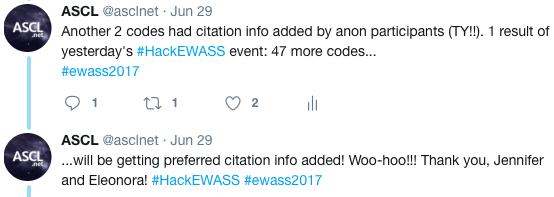
The Hack Together Day had numerous exciting projects; the ASCL's projects were less glamorous than most others but yielded really useful information, some of which has already been added to ASCL entries.
 Our collective efforts went very well, despite a few worrisome moments along the way. The room our Special Session presentations were in had 98 seats; perhaps 90% were filled for these sessions, and there were people also standing in the room. The presenters/presentations were great and the discussions were lively, and more information about these sessions will be posted soon.
There was of course much much more to EWASS than our efforts; notable for those software-inclined were the astrometry, big data, and astroinformatics sessions and associated posters for all of these sessions. In all, an excellent conference!
-
Twelve codes were added to the ASCL in June 2017:
DaMaSCUS: Dark Matter Simulation Code for Underground Scatterings
Dark Sage: Semi-analytic model of galaxy evolution
encube: Large-scale comparative visualization and analysis of sets of multidimensional data
EXOSIMS: Exoplanet Open-Source Imaging Mission Simulator
Exotrending: Fast and easy-to-use light curve detrending software for exoplanetsGenPK: Power spectrum generator
KeplerSolver: Kepler equations solver
LMC: Logarithmantic Monte Carlo
PyPulse: PSRFITS handler
rtpipe: Searching for Fast Radio Transients in Interferometric Datasick: Spectroscopic inference crank
the-wizz: Clustering redshift estimation code -
It's come up in Twitter, so here are CSV files for codes that have and do not have preferred citation information in their ASCL records.
-
Seventeen codes were added to the ASCL in May 2017:
astroABC: Approximate Bayesian Computation Sequential Monte Carlo sampler
COSMOS: Carnegie Observatories System for MultiObject Spectroscopy
DMATIS: Dark Matter ATtenuation Importance Sampling
demc2: Differential evolution Markov chain Monte Carlo parameter estimator
f3: Full Frame Fotometry for Kepler Full Frame Imagesfd3: Spectral disentangling of double-lined spectroscopic binary stars
FDBinary: A tool for spectral disentangling of double-lined spectroscopic binary stars
getimages: Background derivation and image flattening method
LensPop: Galaxy-galaxy strong lensing population simulation
MBProj2: Multi-Band x-ray surface brightness PROJector 2NPTFit: Non-Poissonian Template Fitting
PCAT: Probabilistic Cataloger
PROFILER: 1D galaxy light profile decomposition
PSOAP: Precision Spectroscopic Orbits A-Parametrically
SPTCLASS: SPecTral CLASSificator codesupernovae: Photometric classification of supernovae
WeirdestGalaxies: Outlier Detection Algorithm on Galaxy Spectra -
Fourteen codes were added to the ASCL in April 2017:
A-Track: Detecting Moving Objects in FITS images
Difference-smoothing: Measuring time delay from light curves
Multipoles: Potential gain for binary lens estimation
Photo-z-SQL: Photometric redshift estimation framework
pwkit: Astronomical utilities in PythonPySM: Python Sky Model
Quickclump: Identify clumps within a 3D FITS datacube
Shwirl: Meaningful coloring of spectral cube data with volume rendering
STATCONT: Statistical continuum level determination method for line-rich sources
Transit: Radiative-transfer code for planetary atmospheresUDAT: A multi-purpose data analysis tool
VaST: Variability Search Toolkit
VULCAN: Chemical Kinetics For Exoplanetary Atmospheres
XID+: Next generation XID development -
Fifteen codes were added to the ASCL in March 2017:
Atmospheric Athena: 3D Atmospheric escape model with ionizing radiative transfer
Charm: Cosmic history agnostic reconstruction method
COCOA: Simulating Observations of Star Cluster Simulations
Corrfunc: Blazing fast correlation functions on the CPU
exorings: Exoring Transit PropertiesICICLE: Initial Conditions for Isolated CoLlisionless systEms
Larch: X-ray Analysis for Synchrotron Applications using Python
MC-SPAM: Monte-Carlo Synthetic-Photometry/Atmosphere-Model
PHOTOMETRYPIPELINE: Automated photometry pipeline
PyMVPA: MultiVariate Pattern Analysis in PythonQtClassify: IFS data emission line candidates classifier
sidm-nbody: Monte Carlo N-body Simulation for Self-Interacting Dark Matter
SNRPy: Supernova remnant evolution modeling
starsense_algorithms: Performance evaluation of various star sensors
TransitSOM: Self-Organizing Map for Kepler and K2 transits -
Twelve codes were added to the ASCL in January 2017:
CosmoSlik: Cosmology sampler of likelihoods
Forecaster: Mass and radii of planets predictor
GrayStar: Web-based pedagogical stellar modeling
GrayStarServer: Stellar atmospheric modeling and spectrum synthesis
GWFrames: Manipulate gravitational waveformsKAULAKYS: Inelastic collisions between hydrogen atoms and Rydberg atoms
kcorrect: Calculate K-corrections between observed and desired bandpasses
MSWAVEF: Momentum-Space Wavefunctions
SONG: Second Order Non-Gaussianity
Spectra: Time series power spectrum calculatorThe Joker: A custom Monte Carlo sampler for binary-star and exoplanet radial velocity data
Vizic: Jupyter-based interactive visualization tool for astronomical catalogsAnd twelve codes were added to the ASCL in February 2017:
Chempy: A flexible chemical evolution model for abundance fitting
corner: Corner plots
GalaxyGAN: Generative Adversarial Networks for recovery of galaxy features
GRIM: General Relativistic Implicit Magnetohydrodynamics
HOURS: Simulation and analysis software for the KM3NeTJetCurry: Modeling 3D geometry of AGN jets from 2D images
juwvid: Julia code for time-frequency analysis
KEPLER: General purpose 1D multizone hydrodynamics code
ORBE: Orbital integrator for educational purposes
stream-stream: Stellar and dark-matter streams interactionsstreamgap-pepper: Effects of peppering streams with many small impacts
Validation: Codes to compare simulation data to various observations -

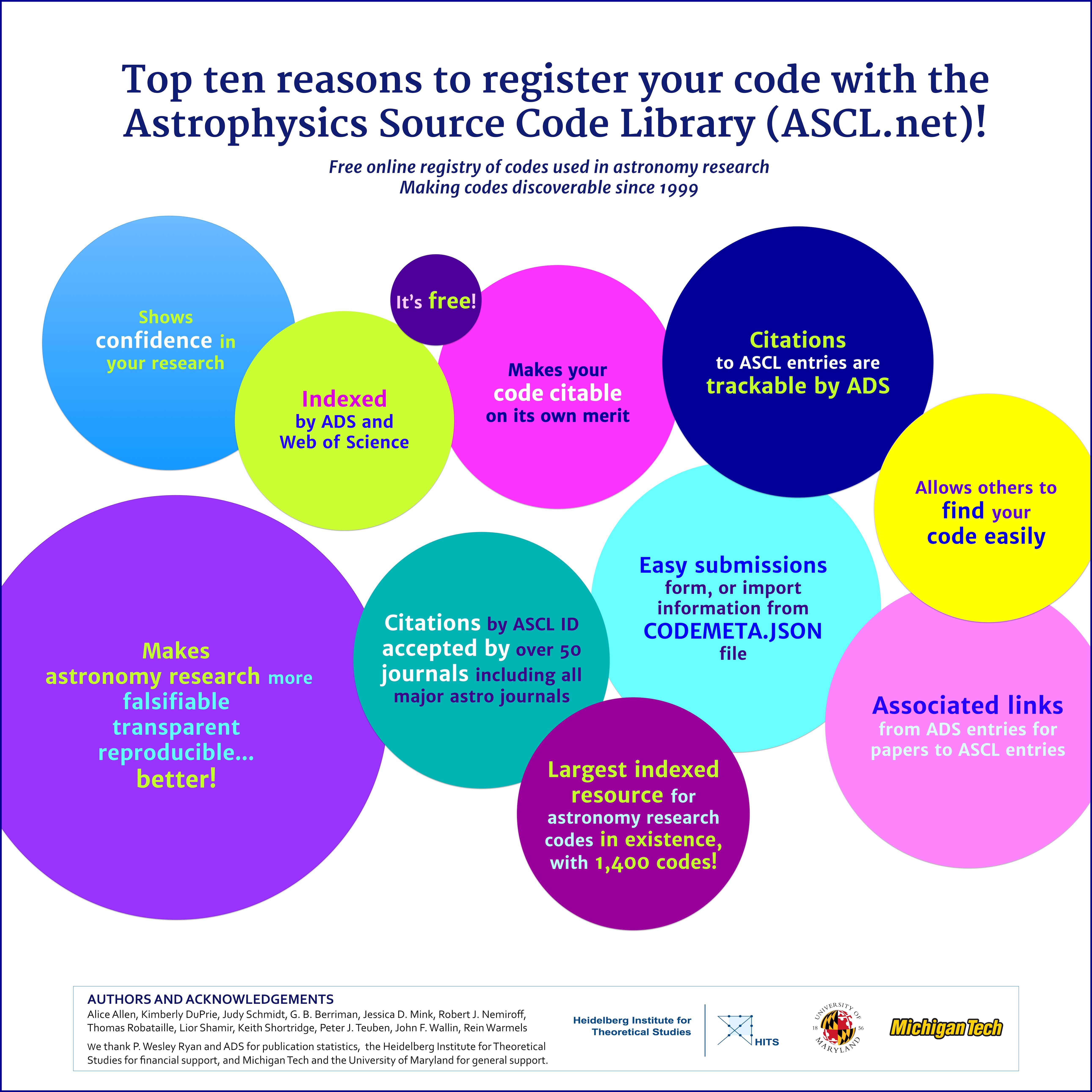
With 1,400 codes, the Astrophysics Source Code Library (ASCL, ascl.net) is the largest indexed resource for codes used in astronomy research in existence. This free online registry was established in 1999, is indexed by Web of Science and ADS, and is citable, with citations to its entries tracked by ADS. Registering your code with the ASCL is easy with our online submissions system. Making your software available for examination shows confidence in your research and makes your research more transparent, reproducible, and falsifiable. ASCL registration allows your software to be cited on its own merits and provides a citation that is trackable and accepted by all astronomy journals and journals such as Science and Nature. Registration also allows others to find your code more easily. This presentation covers the benefits of registering astronomy research software with the ASCL.
Alice Allen, Astrophysics Source Code Library
Kimberly DuPrie, Space Telescope Science Institute
G. Bruce Berriman, IPAC, Caltech
Jessica D. Mink, Smithsonian Astrophysical Observatory
Robert J. Nemiroff, Michigan Technological University
Thomas Robitaille, Freelance
Judy Schmidt, Astrophysics Source Code Library
Lior Shamir, Lawrence Technological University
Keith Shortridge, Knave and Varlet
Peter J. Teuben, University of Maryland
John F. Wallin, Middle Tennessee State University
Rein Warmels, European Southern Observatory -
Twenty-two codes were added to the ASCL in December 2016:
AUTOSTRUCTURE: General program for calculation of atomic and ionic properties
BaTMAn: Bayesian Technique for Multi-image Analysis
CELib: Software library for simulations of chemical evolution
CRETE: Comet RadiativE Transfer and Excitation
dacapo_calibration: Photometric calibration codeEarthshine simulator: Idealized images of the Moon
flexCE: Flexible one-zone chemical evolution code
GAMER: GPU-accelerated Adaptive MEsh Refinement code
Grackle: Chemistry and radiative cooling library for astrophysical simulations
InversionKit: Linear inversions from frequency datalibprofit: Image creation from luminosity profiles
LSDCat: Line Source Detection and Cataloguing Tool
Meso-NH: Non-hydrostatic mesoscale atmospheric model
ProFit: Bayesian galaxy fitting tool
pylightcurve: Exoplanet lightcurve modelPyORBIT: Exoplanet orbital parameters and stellar activity
PyProfit: Wrapper for libprofit
Python-CPL: Python interface for the ESO Common Pipeline Library
QSFit: Quasar Spectral FITting
REPS: REscaled Power Spectra for initial conditions with massive neutrinosSuperplot: Graphical interface for plotting and analyzing data
Trident: Synthetic spectrum generator -
Twenty-two codes were added to the ASCL in November 2016:
AIMS: Asteroseismic Inference on a Massive Scale
Carpet: Adaptive Mesh Refinement for the Cactus Framework
CMCIRSED: Far-infrared spectral energy distribution fitting for galaxies near and far
EarthShadow: Calculator for dark matter particle velocity distribution after Earth-scattering
Exo-Transmit: Radiative transfer code for calculating exoplanet transmission spectraGalPot: Galaxy potential code
GRASP2K: Relativistic Atomic Structure Package
Icarus: Stellar binary light curve synthesis tool
Kapteyn Package: Tools for developing astronomical applications
MPDAF: MUSE Python Data Analysis FrameworkOXAF: Ionizing spectra of Seyfert galaxies for photoionization modeling
phase_space_cosmo_fisher: Fisher matrix 2D contours
Pippi: Parse and plot MCMC chains
PRECESSION: Python toolbox for dynamics of spinning black-hole binaries
proEQUIB: IDL/GDL library for atomic level populations and line emissivities in statistical equilibriumpyGMMis: Mixtures-of-Gaussians density estimation method
RHOCUBE: 3D density distributions modeling code
SlicerAstro: Astronomy (HI) extension for 3D Slicer
SNCosmo: Python library for supernova cosmology
tf_unet: Generic convolutional neural network U-Net implementation in TensorflowTransit Clairvoyance: Predicting multiple-planet systems for TESS
UltraNest: Pythonic Nested Sampling Development Framework and UltraNest