ASCL News
-
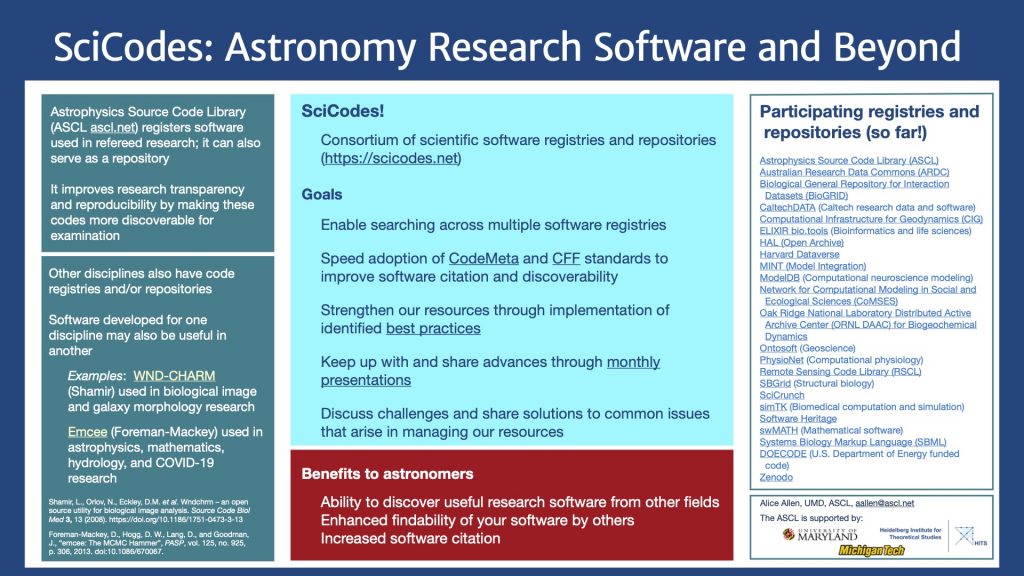
The Astrophysics Source Code Library (ASCL ascl.net), started in 1999, is a free open registry of software used in refereed astronomy research. Over the past few years, it has spearheaded an effort to form a consortium of scientific software registries and repositories. In 2019 and 2020, ASCL contacted editors and maintainers of academic discipline and institutional software registries and repositories in math, biology, neuroscience, geophysics, remote sensing, and other fields to develop a list of best practices for research software registries and repositories. At the completion of that project, performed as a Task Force for a FORCE11 working group, members decided to form SciCodes as an ongoing consortium. This poster will cover the consortium’s work so far, what it is currently working on, what it hopes to achieve for making scientific research software more discoverable across disciplines, and how the consortium can benefit astronomers.
Download poster (PDF)
#ADASSXXXI
-
This was the week before ADASS! The meeting this year is a hybrid meeting, with some attendees in Cape Town, and the others scattered all over the world. As much as I would love to be in Cape Town, I am attending virtually because of the pandemic. My poster this year involves but isn't about the ASCL; instead, I'm presenting a poster about SciCodes.
Speaking of SciCodes, this week was our monthly meetings, so I spent time on them, but also had time for working on the ASCL. Random code of the day posts were scheduled through the end of the month and twenty entries were updated. Six new codes were staged, and two were submitted. This coming week, numerous ASCL-involved folks will be at ADASS, and I look forward to seeing them there!
-
Writing and organizing seemed to be this week's theme. Melissa Harrison and I wrote and submitted a proposal for a dedicated working group session at FORCE2021 on behalf of the FORCE11 Software Citation Implementation Working Group and secured a number of speakers for lightning talks. I got a rejection notice on Wednesday for a paper I'd submitted in early September; based on feedback from the reviewers and the to-do list I'd started after submitting it, I edited the paper, intending to post it to arXiv. A couple of people encouraged me to submit it to another journal, however, so I did. I also worked on my ADASS poster and paper. Actual work on the ASCL itself included curating seven entries, processing one submission and assigning the code an ASCL ID, and staging three new entries.
-
As previously mentioned, curating records in the ASCL is done a number of ways. We ensure that every record gets looked at periodically by querying our database as to which records have not been updated since current year – 3, which this year means January 1, 2018. We've been busy looking at records and can now say that every record in the ASCL has been examined for health and/or curated in some way (or added) since January 1, 2018.
 With that done, we will now start checking entries that haven't been updated since January 1, 2019, because curation never ends.
This week, we also sent emails to authors of codes added in September and staged three new entries. I attended the FORCE11 Software Citation Implementation Working Group meeting on Tuesday, and later in the week, talked with several people about possible poster presentations at upcoming conferences.
One sad note: On September 27, ASCL Central became catless, alas. RIP, handsome little cat; it was a lovely 15 years.
-
Thirty codes were added to the ASCL this week, seven of which had been submitted by authors. Nineteen codes were curated, mostly through our work in creating the daily random code social media posts; we scheduled twenty-three posts. This coming week, we'll be sending out registration notices for the new entries along with other usual correspondence, and I'll be attending a FORCE11 Software Citation Implementation Working Group meeting on Tuesday.
-
Thirty codes were added to the ASCL in September:
alpconv: Calculating alp-photon conversion
BHJet: Semi-analytical black hole jet model
BiPoS1: Dynamical processing of the initial binary star population
DviSukta: Spherically Averaged Bispectrum calculator
eMCP: e-MERLIN CASA pipelineFrankenstein: Flux reconstructor
gammaALPs: Conversion probability between photons and axions/axionlike particles
GLoBES: General Long Baseline Experiment Simulator
gphist: Cosmological expansion history inference using Gaussian processes
Healpix.jl: Julia-only port of the HEALPix libraryHSS: The Hough Stream Spotter
HTOF: Astrometric solutions for Hipparcos and Gaia intermediate data
Menura: Multi-GPU numerical model for space plasma simulation
OSPREI: Sun-to-Earth (or satellite) CME simulator
pyFFTW: python wrapper around FFTWpyia: Python package for working with Gaia data
Rubble: Simulating dust size distributions in protoplanetary disks
ShapeMeasurementFisherFormalism: Fisher Formalism for Weak Lensing
SkyCalc_ipy: SkyCalc wrapper for interactive Python
SkyPy: Simulating the astrophysical skySNEWPY: Supernova Neutrino Early Warning Models for Python
Snowball: Generalizable atmospheric mass loss calculator
SNOwGLoBES: SuperNova Observatories with GLoBES
SoFiA 2: An automated, parallel HI source finding pipeline
STAR-MELT: STellar AccrRtion Mapping with Emission Line Tomographyunpopular: Using CPM detrending to obtain TESS light curves
Varstar Detect: Variable star detection in TESS data
VOLKS2: VLBI Observation for transient Localization Keen Searcher
WeakLensingDeblending: Weak lensing fast simulations and analysis of blended objects
WimPyDD: WIMP direct–detection rates predictor
-
What a difference a week makes! Our paper has been reconsidered and is now with the journal for peer-review. Productivity on the ASCL was lower than usual this week as I took a few days off, but still, nine code records were edited, daily random code posts were made to Facebook and Twitter, and three new entries were written and staged for consideration. I also made note of minor changes to make on another paper that is undergoing peer review. This coming week will be all code entry work, vetting, writing, and curating.
-
The main events this past week were finishing up and submitting an article, this for the special issue of PeerJ Computer Science, which I've previously mentioned, and prepping for and holding the monthly SciCodes meetings. Unfortunately, our paper was desk-rejected for being out of scope for the journal (yet in scope for the call for papers). This happened very quickly, which gave the author team some time to determine what our options might be and how we would approach considering them before the week was out. The SciCodes meetings went well and I had a great chat with a possible new participant in the consortium; it was a very fruitful conversation. As is common, the week included curation, new entries, social media post scheduling, and correspondence. Sixteen records were curated, some of them the result of scheduling of seven daily code posts, and three new entries were staged. All in all, a busy week, with elation, disappointment, determination, and some whining from the ASCL Central cat, who, poor thing, is going to the kitty dentist on Monday for evaluation before his dental surgery later this month.
-
Meetings and writing, writing and meetings. Sure, Monday was officially a holiday, but I spent the day mostly on writing tasks; later in the week, the SciCodes team working on a paper met twice for writing sprints and discussion, and I attended the monthly Force11 Software Citation Implementation Working Group meeting. I also met with ASCL founder Robert Nemiroff and ASCL editors Kimberly DuPrie and Catherine Gosmeyer. Peter Teuben, chair of the ASCL's Advisory Committee, usually attends the editor meetings as well but had a prior commitment. Most of the meeting was spent discussing updates to our procedures and communications; we also talked about upcoming conferences and got caught up on what (and how) we're all doing. Still, we curated records and sent correspondence, usual tasks most weeks, and Peter submitted the final report for our NASA ADAP project.

-
August is over, and so is our hiatus from weekly posting. This past week, we added 21 new entries, curated 21 entries, and have so far sent 22 registration notices. Of the 25 codes added to the ASCL in August, seven had been submitted by their authors. We also staged "Today's random code" social media posts through September 14, and shared a blog post, cross-posted on several other sites including Better Scientific Software, on best practices for entities such as the ASCL. I spent a lot of time this week on a paper that expands on the best practices, this written collaboratively with some of the SciCodes participants, and we expect to submit this paper soon to a special issue of PeerJ Computer Science. I also wrote a final report for our NASA ADAP project that will be submitted this coming week.

