ASCL News
-
FRIDAY, 6 JANUARY 2017
Special Session: Perspectives in Research Software: Education, Funding, Reproducibility, Citation, and Impact
10:00 am – 11:30 am
Grapevine 2The Moore-Sloan Data Science Environment at NYU and the ASCL have organized a Special Session at January's AAS. The session, Perspectives in Research Software: Education, Funding, Reproducibility, Citation, and Impact, will be moderated by Bruce Berriman (IPAC, Caltech/Astronomy Computing Today). The session will feature short presentations and will include a discussion period with the floor open for questions and comments, and maybe even a few answers, too. The topics and presenters are :
Tracy Teal (Data Carpentry), Software not as a service
Michael Hucka (Caltech), Finding the right wheel when you don’t want to reinvent it
Lior Shamir (LTU), Reproducibility and reusability of scientific software
Ivelina Momcheva (STScI), Funding research software development
Heather Piwowar (ImpactStory), Capturing the impact of software
David W. Hogg (NYU), The relationships between software publications and software systems
Alice Allen (ASCL), Update on research software citation effortsThat last speaker looks a wee bit dodgy, but the moderator and other panelists are aces! And you, software authors and users, are as always important participants in the discussion. I hope to see you there!
-
And here it is: the Big List o' Software Stuff at next month's AAS meeting. If I missed anything, please let me know in the comments below; thanks!
TUESDAY, 3 JANUARY 2017
Workshops
Introduction to Software Carpentry, 8:00 am ‐ 5:30 pm, Appaloosa 1
Using Python for Astronomical Data Analysis, 8:30 am ‐ 5:00 pm, Texas C
WEDNESDAY, 4 JANUARY 2017
Splinter meeting: Flexible Multi‐dimensional Modeling of Complex Data in Astronomy, 9:30 am ‐ 11:30 am, Grapevine 4Poster presentations
146.04 Gemini Planet Imager Calibrations, Pipeline Updates, and Campaign Data Process
146.07 Reprocessing of Archival Direct Imaging Data of Herbig Ae/Be Stars
146.13 Finding Planets in K2: A New Method of Cleaning the Data
146.17. Searching for Wide, Planetary-Mass Companions in Archival Spitzer/IRAC Data
154.25 Automated Detection of Dwarf Galaxies and Star Clusters in SMASH through the NOAO Data Lab
154.27 On the Quantification of Incertitude in Astrophysical Simulation Codes
155.13 Spectro-spatial reconstruction of Wide Field Imaging Interferometry Testbed (WIIT) dataOral presentations
Testing SMBH scaling relations using cosmological simulations and optical/near-IR imaging data, 10:00 am - 10:20 am, Grapevine C
An Empirical Examination of the NEOWISE Results and Data analysis, 10:50 am - 11:00 am, Texas 4
Data Simulation for 21 cm Cosmology Experiments, 2:40 pm - 2:50 pm, Grapevine C
THURSDAY, 5 JANUARY 2017
Poster presentations
Session 236: Computation, Data Handling, Image Analysis & Light Pollution (21 posters)239.03, The era of synoptic galactic archeology: using HST and Chandra observations to constrain the evolution of elliptical galaxies through the spatial distribution of globular clusters and X-ray binaries
244.05, Three-Dimensional Simulations of the Convective Urca Process in Pre-Supernova White DwarfsOral presentations
Mind the Gap when Data Mining the Ritter-Kolb Cataclysmic Variable Catalogue, 10:00 am - 10:10 am, Fort Worth 6
What drives the kinematic evolution of star-forming galaxies? 10:20 am - 10:30 am, Grapevine 2
Simulating Galactic Winds on Supercomputers, 2:50 pm - 3:10 pm, Grapevine A
Photometric Redshifts for High Resolution Radio Galaxies in the SuperCLASS Field, 3:10 pm - 3:20 PM, Grapevine A
FRIDAY, 6 JANUARY 2017
Special Session: Perspectives in Research Software: Education, Funding, Reproducibility, Citation, and Impact, 10:00 am - 11:30 am, Grapevine 2Poster presentations
335.05, When Will It Be …?: U.S. Naval Observatory Religious Calendar Computers Expanded
336.09, Variable Stars as an Introduction to Computational Research
345.03, An ALMA Survey of Planet Forming Disks in Rho Ophiuchus
345.19, Chemistry of protostellar envelopes and disks: computational testing of 2D abundances
348.06, Computing Architecture for the ngVLAOral presentations
K2 red giant asteroseismology using Bayesian Asteroseismology data Modeling (BAM), 10:24 am - 10:36 am, Grapevine B
Upgrades to MINERVA control software, 2:00 pm - 2:10 pm, Texas D
SATURDAY, 7 JANUARY 2017
Special Session: Statistical, Mathematical and Computational Methods for Astronomy (ASTRO): SAMSI 2016-17, 10:00 am - 11:30 am, Grapevine 2Workshop: Hack Together Day, 10:00 am ‐ 7:00 pm, Grapevine 4 (Info and registration)
Also of likely interest is the Special Session on The Value of Astronomical Data and Long Term Preservation that will take place on Thursday, 4 January from 10:00 am - 11:30 am in Texas 3.
-
Though we have a way to go before January's AAS meeting (and ADASS and OpenCon on the ASCL's schedule coming up sooner), a look at the schedule for the AAS meeting already shows multiple options for the computationally-inclined astronomer. I'm very excited about the Special Session we've organized with the Moore-Sloan DSE, called Perspectives in Research Software. Bruce Berriman (IPAC, Caltech/Astronomy Computing Today) will moderate the session. In keeping with previous sessions, the session will include a discussion period with the floor open for questions and comments; we want to hear what you have to say. We have a panel of seven speakers; the presenters and topics are:
Tracy Teal (Data Carpentry), Software not as a service
Michael Hucka (Caltech), Finding the right wheel when you don't want to reinvent it
Lior Shamir (LTU), Reproducibility and reusability of scientific software
Ivelina Momcheva (STScI), Funding research software development
Heather Piwowar (ImpactStory), Capturing the impact of software
David W. Hogg (NYU), The relationships between software publications and software systems
And me, Update on research software citation effortsI hope to see you there!
Other software events that have shown up so far on the AAS schedule are listed below. Good times coming!
Tuesday, 3 January 2017
Workshop: Introduction to Software Carpentry, 8:00 am ‐ 5:30 pm
Workshop: Using Python for Astronomical Data Analysis, 8:00 am ‐ 4:30 pmWednesday, 4 January 2017
Splinter Meeting: Flexible Multi‐dimensional Modeling of Complex Data in Astronomy, 9:30 am ‐ 11:30 amFriday, 6 January 2017
Special Session: Perspectives in Research Software: Education, Funding, Reproducibility, Citation, and Impact, 10:00 am - 11:30 amSaturday, 7 January 2017
Special Session: Statistical, Mathematical and Computational Methods for Astronomy (ASTRO): SAMSI 2016-17, 10:00 am - 11:30 am
Workshop: Hack Together Day, 10:00 am ‐ 7:00 pmAlso of likely interest is the Special Session on The Value of Astronomical Data and Long Term Preservation that will take place on Thursday, 4 January from 10:00 am - 11:30 am.
-
I'll be representing the ASCL at next month's WSSSPE4 meeting in Manchester, and in October, the ASCL will be at ADASS XXVI and will hold an Advisory Committee (AC) meeting while there. Peter Teuben, chair of the ASCL AC, will moderate a Birds of a Feather session at ADASS on Implementing Ideas for Improving Software Citation and Credit; this is a follow-up on the discussion at last year's BoF Improving Software Citation and Credit, with a goal of taking action on some of the ideas generated at last year's BoF. Watch this space in October for more!
For January's American Astronomy Society meeting in Texas, the Moore-Sloan Data Science Environment at NYU and the ASCL have organized another Special Session, Perspectives in Research Software. This will follow the format of previous sessions, with presentations in the first half of the session and discussion open to all for the second half. Bruce Berriman from the Infrared Processing and Analysis Center at Caltech will moderate; the presenters include Ivelina Momcheva (Space Telescope Science Institute), Tracy Teal (Data Carpentry), Lior Shamir (Lawrence Technological University), and Michael Hucka (Caltech). I'm rationally exuberant about this session!
-
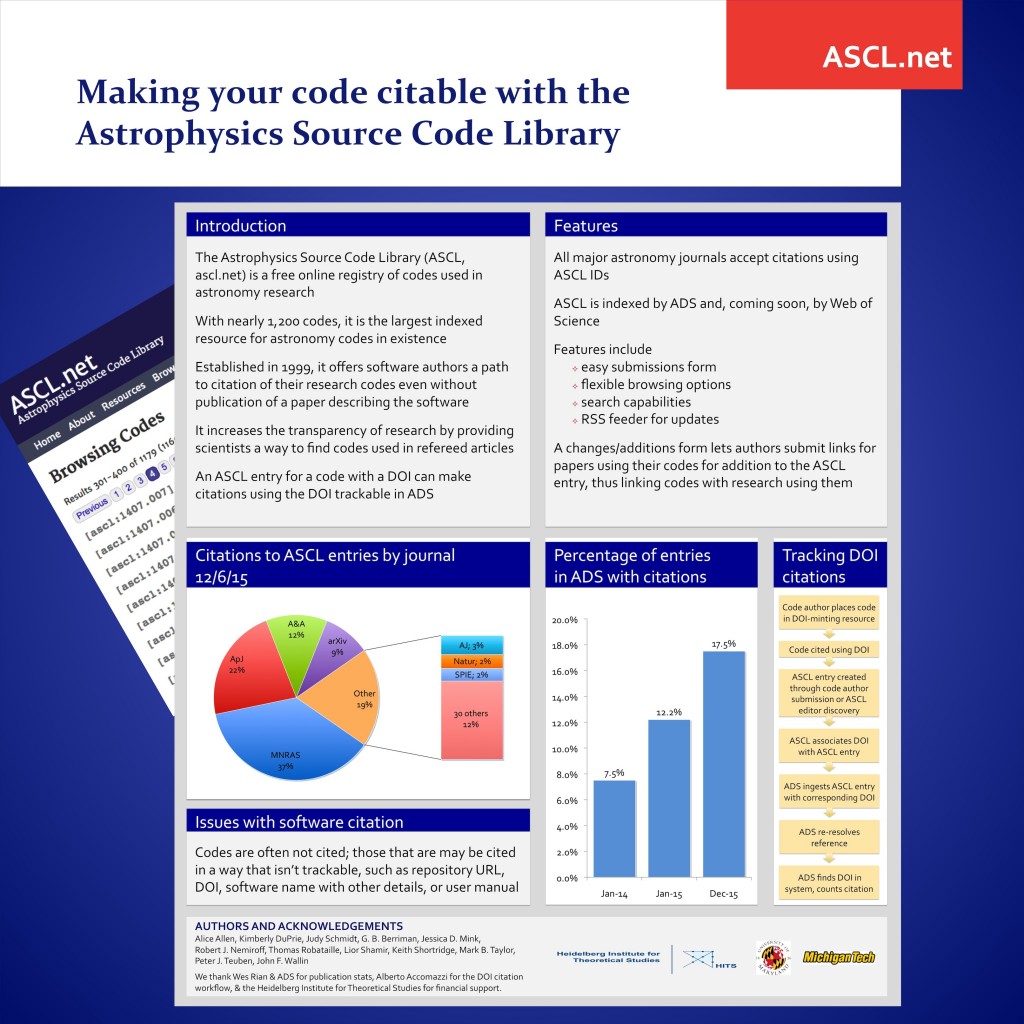
The Astrophysics Source Code Library (ASCL, ascl.net) is a free online registry of codes used in astronomy research. With nearly 1,200 codes, it is the largest indexed resource for astronomy codes in existence. Established in 1999, it offers software authors a path to citation of their research codes even without publication of a paper describing the software, and offers scientists a way to find codes used in refereed publications, thus improving the transparency of the research. Citations using ASCL IDs are accepted by major astronomy journals and if formatted properly are tracked by ADS and other indexing services. The number of citations to ASCL entries increased sharply from 110 citations in January 2014 to 456 citations in September 2015. The percentage of code entries in ASCL that were cited at least once rose from 7.5% in January 2014 to 17.4% in September 2015. The ASCL’s mid-2014 infrastructure upgrade added an easy entry submission form, more flexible browsing, search capabilities, and an RSS feeder for updates. A Changes/Additions form added this past fall lets authors submit links for papers that use their codes for addition to the ASCL entry even if those papers don’t formally cite the codes, thus increasing the transparency of that research and capturing the value of their software to the community.
-
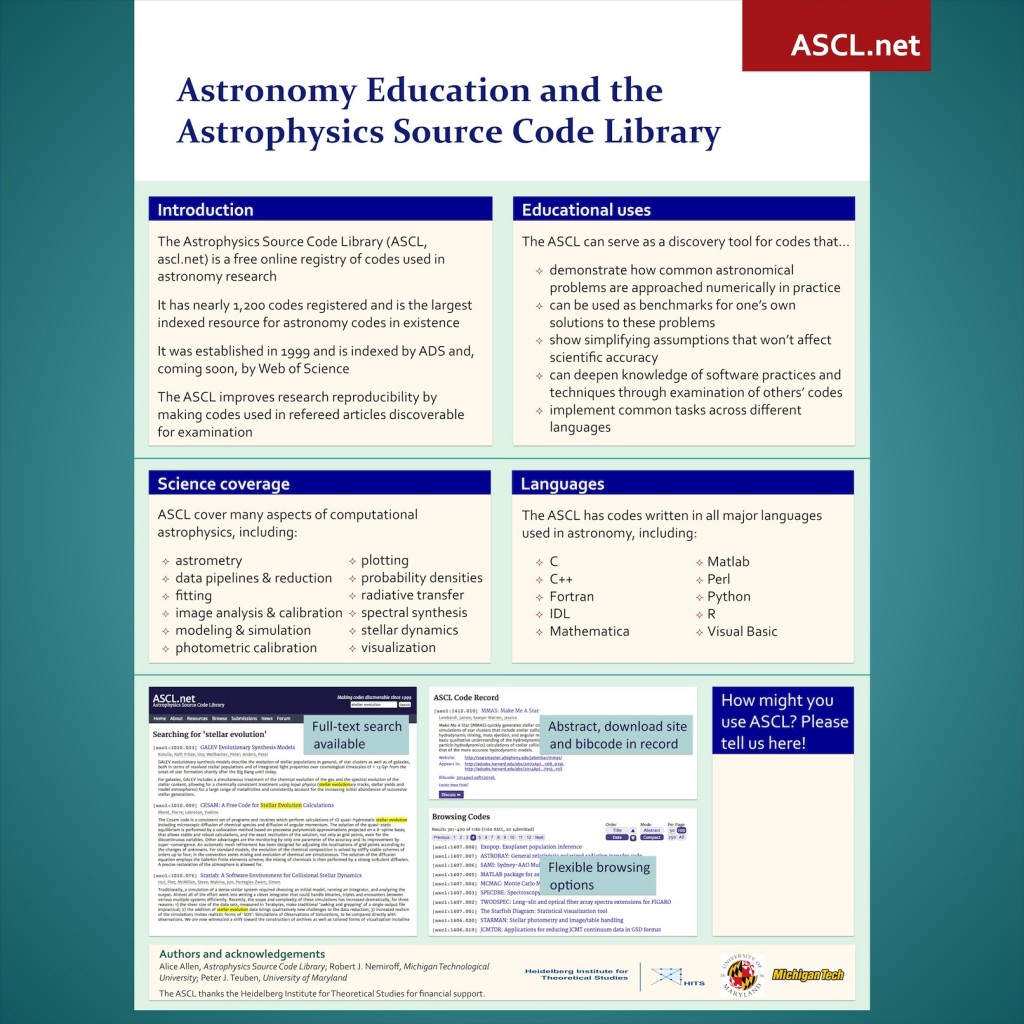
The Astrophysics Source Code Library (ASCL) is an online registry of source codes used in refereed astrophysics research. It currently lists nearly 1,200 codes and covers all aspects of computational astrophysics. How can this resource be of use to educators and to the graduate students they mentor? The ASCL serves as a discovery tool for codes that can be used for one’s own research. Graduate students can also investigate existing codes to see how common astronomical problems are approached numerically in practice, and use these codes as benchmarks for their own solutions to these problems. Further, they can deepen their knowledge of software practices and techniques through examination of others’ codes.
-
Posters! Sessions! Meetings! The upcoming AAS meeting in Kissimmee, Florida is shaping up to be the busiest ever! Here are the formal meeting activities the ASCL is participating in.
Special Session: Tools and Tips for Better Software (aka Pain Reduction for Code Authors)
Tuesday, January 05, 2:00 PM - 3:30 PM; Sanibel
Organizers: Astrophysics Source Code Library (ASCL)/Moore-Sloan Data Science Environment at NYUResearch in astronomy is increasingly dependent on software methods and astronomers are increasingly called upon to write, collaborate on, release, and archive research quality software, but how can these be more easily accomplished? Building on comments and questions from previous AAS special sessions, this session, organized by the Astrophysics Source Code Library (ASCL) and the Moore-Sloan Data Science Environment at NYU, explores methods for improving software by using available tools and best practices to ease the burden and increase the reward of doing so. With version control software such as git and svn and companion online sites such as GitHub and Bitbucket, documentation generators such as Doxygen and Sphinx, and Travis CI, Intern, and Jenkins available to aid in testing software, it is now far easier to write, document and test code. Presentations cover best practices, tools, and tips for managing the life cycle of software, testing software and creating documentation, managing releases, and easing software production and sharing. After the presentations, the floor will be open for discussion and questions.
The topics and panelists are:
Source code management with version control software, Kenza S. Arraki
Software testing, Adrian M. Price-Whelan
The importance of documenting code, and how you might make yourself do it, Erik J. Tollerud
Best practices for code release, G. Bruce Berriman
Community building and its impact on sustainable scientific software, Matthew Turk
What to do with a dead research code, Robert J. Nemiroff
Poster 247.07: Astronomy education and the Astrophysics Source Code Library
Wednesday, January 06, Exhibit Hall AThe Astrophysics Source Code Library (ASCL) is an online registry of source codes used in refereed astrophysics research. It currently lists nearly 1,200 codes and covers all aspects of computational astrophysics. How can this resource be of use to educators and to the graduate students they mentor? The ASCL serves as a discovery tool for codes that can be used for one’s own research. Graduate students can also investigate existing codes to see how common astronomical problems are approached numerically in practice, and use these codes as benchmarks for their own solutions to these problems. Further, they can deepen their knowledge of software practices and techniques through examination of others’ codes.
Poster 348.01: Making your code citable with the Astrophysics Source Code Library
Thursday, January 07, Exhibit Hall AThe Astrophysics Source Code Library (ASCL, ascl.net) is a free online registry of codes used in astronomy research. With nearly 1,200 codes, it is the largest indexed resource for astronomy codes in existence. Established in 1999, it offers software authors a path to citation of their research codes even without publication of a paper describing the software, and offers scientists a way to find codes used in refereed publications, thus improving the transparency of the research. Citations using ASCL IDs are accepted by major astronomy journals and if formatted properly are tracked by ADS and other indexing services. The number of citations to ASCL entries increased sharply from 110 citations in January 2014 to 456 citations in September 2015. The percentage of code entries in ASCL that were cited at least once rose from 7.5% in January 2014 to 17.4% in September 2015. The ASCL’s mid-2014 infrastructure upgrade added an easy entry submission form, more flexible browsing, search capabilities, and an RSS feeder for updates. A Changes/Additions form added this past fall lets authors submit links for papers that use their codes for addition to the ASCL entry even if those papers don’t formally cite the codes, thus increasing the transparency of that research and capturing the value of their software to the community.
-
As promised in a previous post, here is the list of software activities at the upcoming January AAS meeting in Kissimmee; I hope to add a Software Publishing Special Interest Group meeting to the list, but other than that, the list should be complete. If I missed anything that should be here, please (please!) let me know. Thank you, and see you there!
SUNDAY, JANUARY 03, 2016
Introduction to Software Carpentry 2 Day Workshop (day 1 of 2)
Organizer: Software Carpentry
9:00 AM - 5:30 PM; St. George 106 (Gaylord Palms Resort and Convention Center)
MONDAY, JANUARY 04, 2016
Introduction to Software Carpentry 2 Day Workshop (day 2 of 2)
Organizer: Software Carpentry
8:00 AM - 5:30 PM; St. George 106 (Gaylord Palms Resort and Convention Center)Astrostatistics and R
Organizer: Eric D. Feigelson (Penn State University) and two assistants
9:00 AM - 6:00 PM; Emerald 8 (Gaylord Palms Resort and Convention Center)Using Python for Astronomical Data Analysis
Organizer: Perry Greenfield
9:00 AM - 4:30 PM; St. George 114 (Gaylord Palms Resort and Convention Center)SciCoder Presents: Developing Larger Software Projects
Organizer: Demitri Muna
10:00 AM - 6:00 PM; Emerald 6 (Gaylord Palms Resort and Convention Center)Bayesian Methods in Astronomy: Hands-on Statistics
Organizer: Jake VanderPlas (U. Washington) and two assistants
1:00 PM - 6:00 PM; Emerald 2 (Gaylord Palms Resort and Convention Center)
TUESDAY, JANUARY 05, 2016
Tools and Tips for Better Software (aka Pain Reduction for Code Authors)
Organizers: Astrophysics Source Code Library (ASCL)/Moore-Sloan Data Science Environment at NYU
2:00 PM - 3:30 PM; Sanibel (Gaylord Palms Resort and Convention Center)
WEDNESDAY, JANUARY 06, 2016
Lectures in AstroStatistics
10:00 AM - 11:30 AM; Osceola 5 (Gaylord Palms Resort and Convention Center)Extrasolar Planet Atmospheres: BART Atmospheric Modelling Code and Applications
10:00 AM - 10:10 AM; 212.01. A Random Walk on WASP-12b with the Bayesian Atmospheric Radiative Transfer (BART) Code
Presenter: Joseph Harrington10:10 AM - 10:20 AM; 212.02. Bayesian Atmospheric Radiative Transfer (BART) Code and Application to WASP-43b
Presenter: Jasmina BlecicTopics in Astrostatistics
1:30 PM - 3:30 PM; St. George 106 (Gaylord Palms Resort and Convention Center)AGN, QSO, Blazars Poster Session
243.46 Time-dependent Photoionization of Gaseous Nebulae: TD_XSTAR Code
Presenter: Ehab E. Elhoussieny243.37. Bayesian and Profile Likelihood Approaches to Time Delay Estimation for Stochastic Time Series of Gravitationally Lensed Quasars
Presenter: Hyungsuk TakMajors and Graduate Student Education and Professional Development Poster Session
247.07 Astronomy education and the Astrophysics Source Code Library
Presenter: Alice Allen
THURSDAY, JANUARY 07, 2016
Catalogs, Surveys, and Data Viewing
2:00 PM - 2:10 PM; 324.01. Introducing Nightlight: A New, Modern FITS Viewer
Presenter: Demitri Muna
Tampa (Gaylord Palms Resort and Convention Center)2:10 PM - 2:20 PM; 324.02. Synthesizing Understanding from Data with yt
Presenter: Matthew Turk
Tampa (Gaylord Palms Resort and Convention Center)Cosmological Simulations of Galaxies
3:00 PM - 3:10 PM; 316.05. The Non-parametric Concentration of Dark Matter Halos in Cosmological N-body Simulations
Presenter: Meagan Lang
Sun A (Gaylord Palms Resort and Convention Center)3:10 PM - 3:20 PM; 316.06. The Scylla Multi-Code Comparison Project
Presenter: Ariyeh Maller
Sun A (Gaylord Palms Resort and Convention Center)348. Computation, Data Handling, Image Analysis Poster Session
Posters in other sections:
338.17. Simulating magnetospheres with numerical relativity: The GiRaFFE code
Presenter: Maria Babiuc-Hamilton342.05. Machine Learning and Cosmological Simulations
Presenter: Harshil Kamdar342.07. SurveySim: a new MCMC code to explore the evolution of the IR luminosity function
Presenter: Matteo Bonato
FRIDAY, JANUARY 08, 2016
Beyond the Academy: Showcasing Astronomy Alumni in Non-Academic Careers
413.01. Astronomers as Software Developers
Presenter: Rachel A. Pildis
10:00 AM - 10:25 AM; Osceola 4 (Gaylord Palms Resort and Convention Center)Hack Day
Organizer: Kelle Cruz (Hunter College/CUNY and AMNH)
10:00 AM - 5:00 PM; Tallahassee (Gaylord Palms Resort and Convention Center)
To participate in Hack Day, please register at http://www.astrobetter.com/wiki/AASHackDay. -
Already it's shaping up to be a software maven's dream AAS meeting, with workshops and Special Sessions focused on expanding your software skills and a Hack Day to put them to use! We'll have a comprehensive listing closer to the meeting date, but here are the activities already on the schedule, with more to come!
Introduction to Software Carpentry 2 Day Workshop
Astrostatistics and R
Using Python for Astronomical Data Analysis
SciCoder Presents: Developing Larger Software Projects
Bayesian Methods in Astronomy: Hands-on Statistics
Tools and Tips for Better Software (aka Pain Reduction for Code Authors)
Lectures in AstroStatistics
Hack Day -
On Tuesday, January 6, the ASCL, AAS Working Group on Astronomical Software (WGAS), and the Moore-Sloan Data Science Environment at NYU sponsored a special session on software licenses, with support from the AAS. This subject was suggested as a topic of interest in the Astrophysics Code Sharing II: The Sequel session at AAS 223.
Frossie Economou from the LSST and chair of the WGAS opened the session with a few words of welcome and stressed the importance of licensing. I gave a 90-second overview of the ASCL before turning the podium over to Alberto Accomazzi from NASA/Astronomy Data System (ADS), who introduced the panel of speakers and later moderated the open discussion (opening slides), after which Frossie again took the podium for some closing remarks. The panel of six speakers discussed different licenses and shared considerations that arise when choosing a license; they also covered institutional concerns about intellectual property, governmental restrictions on exporting codes, concerns about software beyond licensing, and information on how much software is licensed and characteristics of that software. The floor was then opened for discussion and questions.
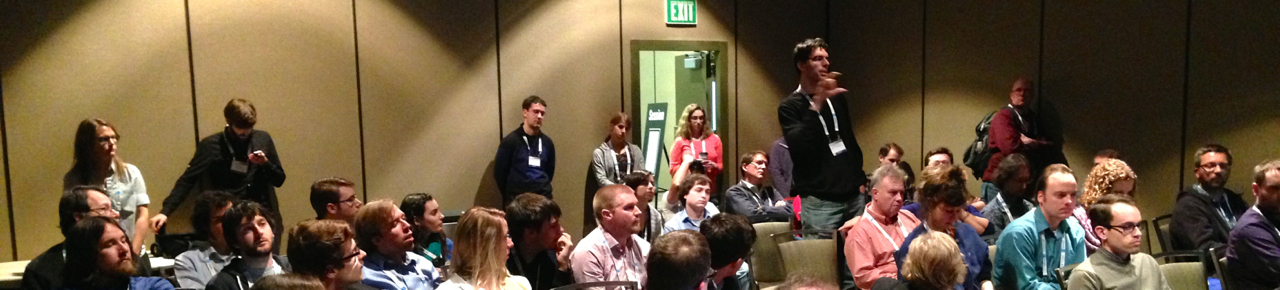
Discussion period moderated by Alberto Accomazzi Presentations
Some of the main points from each presentation are summarized below, with links to the slides used by the presenters.-
- Copy-left and Copy-right, Jacob VanderPlas (eScience institute, University of Washington)
Jake extolled everyone to always license codes, as in the US, copyright law defaults to "all privileges retained" unless otherwise specified. He pointed out that "free software" can refer to the freedoms that are available to users of the software. He covered the major differences between BSD/MIT-style "permissive" licensing and GPL "sticky" licensing while acknowledging that the difference between them can be a contentious issue.
slides (PDF)
- Copy-left and Copy-right, Jacob VanderPlas (eScience institute, University of Washington)
-
- University tech transfer perspective on software licensing, Laura L. Dorsey (Center for Commercialization, University of Washington)
Universities care about software licenses for a variety of reasons, Laura stated, which can include limiting the university's risk, respecting IP rights, complying with funding obligations, and retaining academic and research use rights. She also covered factors software authors may care about, among them receiving attribution, controlling the software, and making money. She reinforced the importance of licensing code and discussed the common components of a software license.
slides (PDF)
- University tech transfer perspective on software licensing, Laura L. Dorsey (Center for Commercialization, University of Washington)
-
- Relicensing the Montage Image Mosaic Engine, G. Bruce Berriman (Infrared Processing and Analysis Center, Caltech)
In last year's Astrophysics Code Sharing session, Bruce had discussed the limitations of the Caltech license under which the code Montage was licensed; since then, Montage has been relicensed to a BSD 3-Clause License. Following on the heels of Laura's discussion and serving as a case study for institutional concerns regarding software, Bruce related the reasons for and concerns about the relicensing, and discussed working with the appropriate office at Caltech to bring about this change.
slides (PDF)
- Relicensing the Montage Image Mosaic Engine, G. Bruce Berriman (Infrared Processing and Analysis Center, Caltech)
-
- Export Controls on Astrophysical Simulation Codes, Daniel Whalen (Institute for Theoretical Astrophysics, University of Heidelberg)
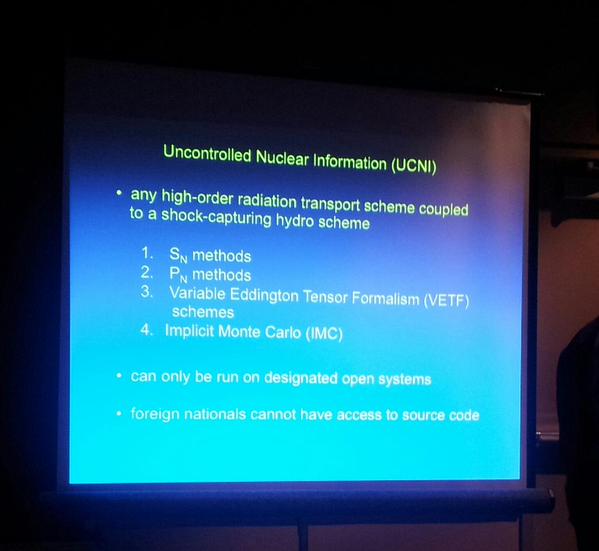
Restricted algorithms; image by Adam M. Jacobs Dan's presentation covered some of the government issues that arise from research codes, including why certain codes fall under export controls; a primary reason is to prevent the development of nuclear weapons.Dan also brought up how foreign intelligence agencies collect information and what specific simulations are restricted, and stated that Federal rules are changing, but slowly.
slides (PDF)
- Export Controls on Astrophysical Simulation Codes, Daniel Whalen (Institute for Theoretical Astrophysics, University of Heidelberg)
-
- Why licensing is just the first step, Arfon M. Smith (GitHub Inc.)
Arfon went beyond licensing in his presentation to discuss open source and open collaborations, and how GitHub delivers on a "theoretical promise of open source." He shared statistics on the growth of collaborative coding using GitHub, and demonstrated how a collaborative coding process can work and pointed out that through this exposed process, community knowledge is increased and shared. He challenged the audience to contemplate the many reasons for releasing a project and to ask themselves what kind of project they want to create.
slides (PDF)
- Why licensing is just the first step, Arfon M. Smith (GitHub Inc.)
-
- Licenses in the wild, Daniel Foreman-Mackey (New York University)
First, I have to note that Dan made it through 41 slides in just over the six minutes allotted for his talk, covering about seven slides/minute; I don't know whether to be more impressed with his presentation skills or the audience's information-intake abilities!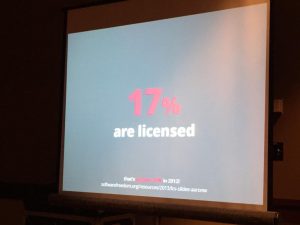
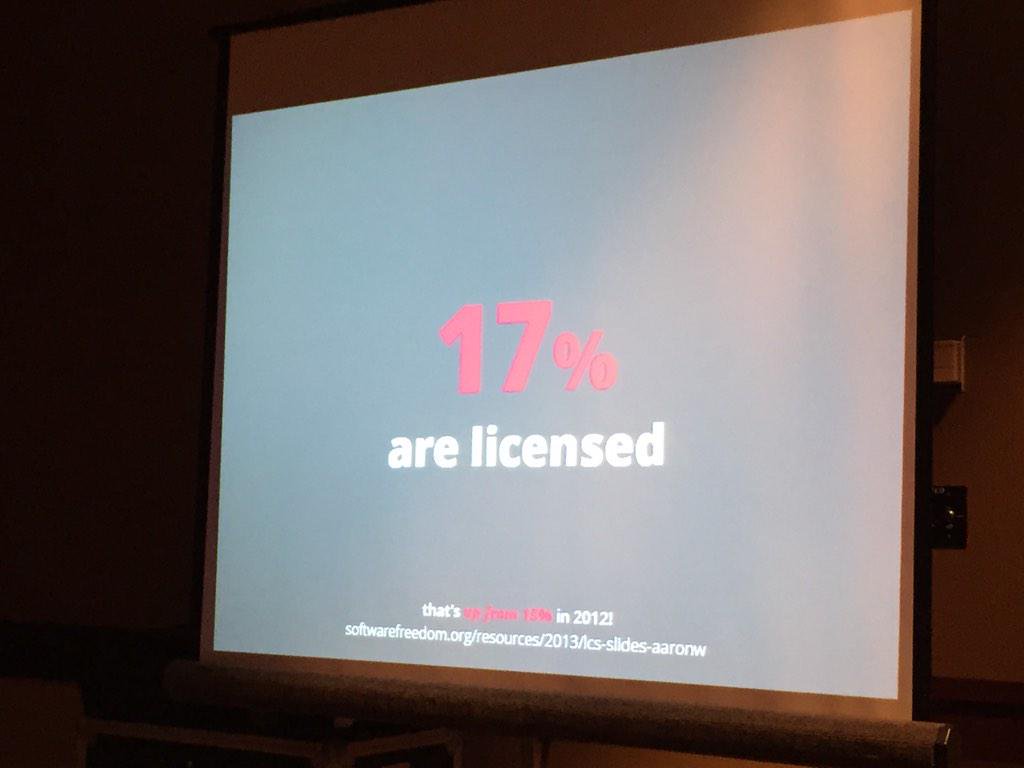
Percentage of licensed GitHub repos; image by Arfon Smith After declaring that he knows nothing about licensing, Dan showed us, and how, that he knows plenty about mining data and extracting information from it. From his "random" selection of 1.6 million GitHub repositories, he noted with some glee that 63 languages are more popular on GitHub than IDL is, the number of repositories with licenses have increased since 2012 to 17%, and that only 28,972 of the 1.6 million mentioned the license in the README file. Dan also determined the popularity of various licenses overall and by language and shared that information as well.
slides (PDF)
- Licenses in the wild, Daniel Foreman-Mackey (New York University)
Open Discussion
After Dan's presentation, Alberto Accomazzi opened the floor for discussion. Takeaway points included:- Discuss licensing with your institution; it's likely there is an office/personnel devoted to deal with these issues
- This office is likely very familiar with issues you bring to it, including who to refer you to when the issues are outside their purview
- "Friends don't let friends write their own licenses." IOW, select an existing license rather than writing your own
- License your code
- Let others know how you want your code cited/acknowledged
My thanks to David W. Hogg, Kelle Cruz, Matt Turk, and Peter Teuben for work -- which started last March! -- on developing the session, to Alberto for his excellent moderating and to Frossie for opening and closing it. My thanks also to the wonderful Jake, Laura, Bruce, Dan W, Arfon, and Dan F-M for presenting at this session, and to the Moore-Sloan Data Science Environment at NYU and AAS for their sponsorship.
Resources
Many resources on licensing, including excellent posts by Jake and Bruce, can be found here. -