ASCL News
-
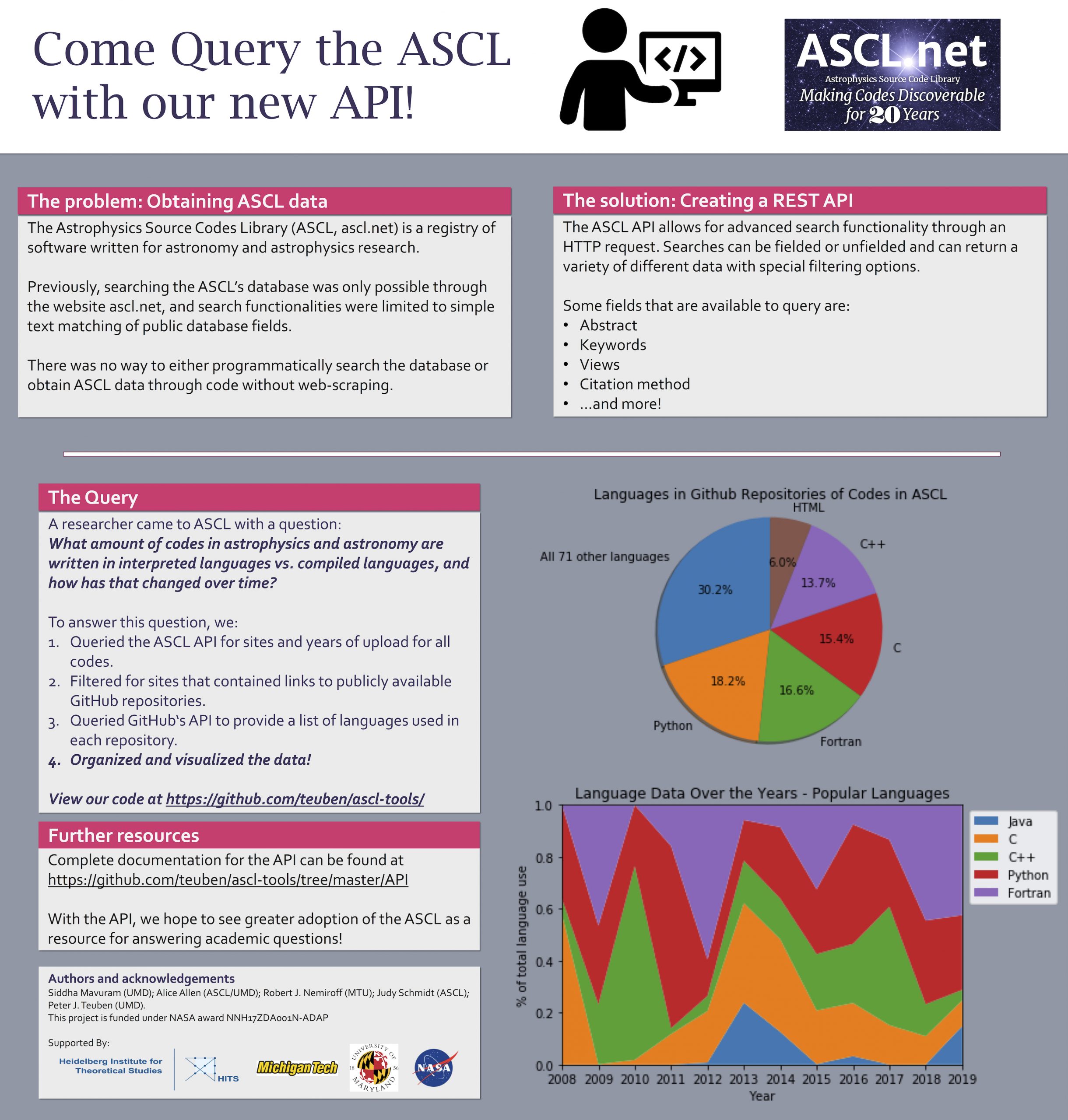
We have developed an API for the Astrophysics Source Code Library (ASCL) that enhances the ability of users to conduct complex and automated queries on ASCL indexed codes. The API is public and allows anyone to programmatically search and filter the ASCL software database via an HTTP request. For example, the search https://ascl.net/api/search/?q=%22supernova%22&fl=credit returns a list of authors with ASCL-indexed codes involving supernovae in JSON format. We will demonstrate the API and show its use in answering a researcher’s questions regarding the growth and usage of both interpreted and compiled languages in the database, gaining a more nuanced understanding of trends in astrophysics software development. Our findings confirmed a piece of conventional wisdom: that Python is growing in market share, while low level programming languages like C and C++ remain very popular. Further documentation for the API is available at https://github.com/teuben/ascl-tools/tree/master/API.Siddha Mavuram (UMD), Alice Allen (ASCL/UMD), Robert J. Nemiroff (MTU), Judy Schmidt (ASCL), Peter J. Teuben (UMD)
-
Astronomical Data Analysis Software and Systems (ADASS), which was to have been in Granada, Spain this year, kicked off the fully online ADASS X
 XX meeting yesterday with four tutorials, as is usually done, though not quite like it was done this year. The Programming Organizing Committee and especially the Local Organizing Committee had to convert a conference that had been two years in the planning to a virtual meeting. This offered numerous challenges and learning opportunities! One challenge is that the conference is international; scheduling sessions for access to all participants couldn't have been easy, but with the technology stack they chose, which includes the conference website, Zoom, YouTube, and Discord, and hard work, all of ADASS's resources are available to all participants. One might have to get up early or stay up late to hear all of the talks live -- the sleep-deprived author of this post awoke at 12:15 AM today to catch the opening sessions -- but there are asynchronous options available, so groggy stumbling as one makes her way to the computer is a choice, not a requirement.
The ASCL has several presentations and activities this year. ASCL Chair Peter Teuben, ASCL Advisory Committee member Bruce Berriman, and I organized a Birds of a Feather (BoF) session on How to better describe software for discovery and citation today. We have organized BoFs focused on some aspect of software in the past, and, as in the past, this BoF offered a number of very short presentations and then open discussion.
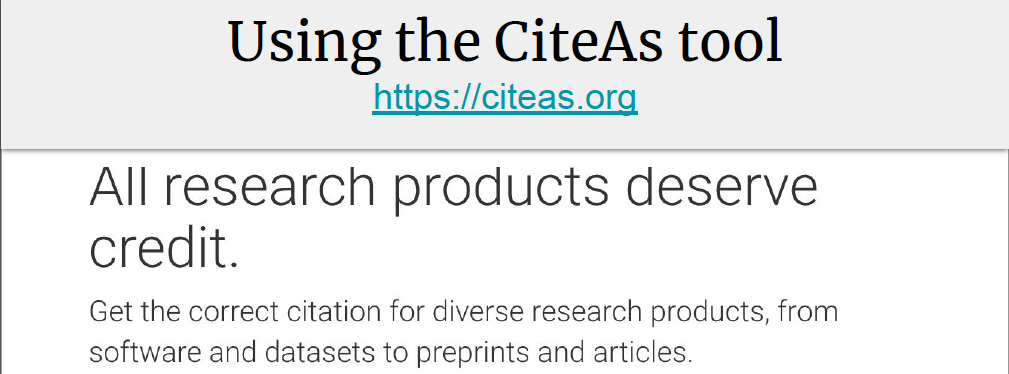
The BoF session focused on software metadata, to improve how software is described and can be discovered and cited. After Teuben opened the session, Berriman presented his experience with using CiteAs to see how it suggested his software Montage be cited.
 CiteAs uses numerous ways to find a code's citation method, including looking for metadata files -- specific files that contain metadata for the software -- on the code's website and/or GitHub repository. Montage does not currently have a metadata file on its sites, so the citation method CiteAs suggested was not as robust as it could have been. The results of the search and its provenance are shown in the BoF's slides, which can be downloaded at a link below.
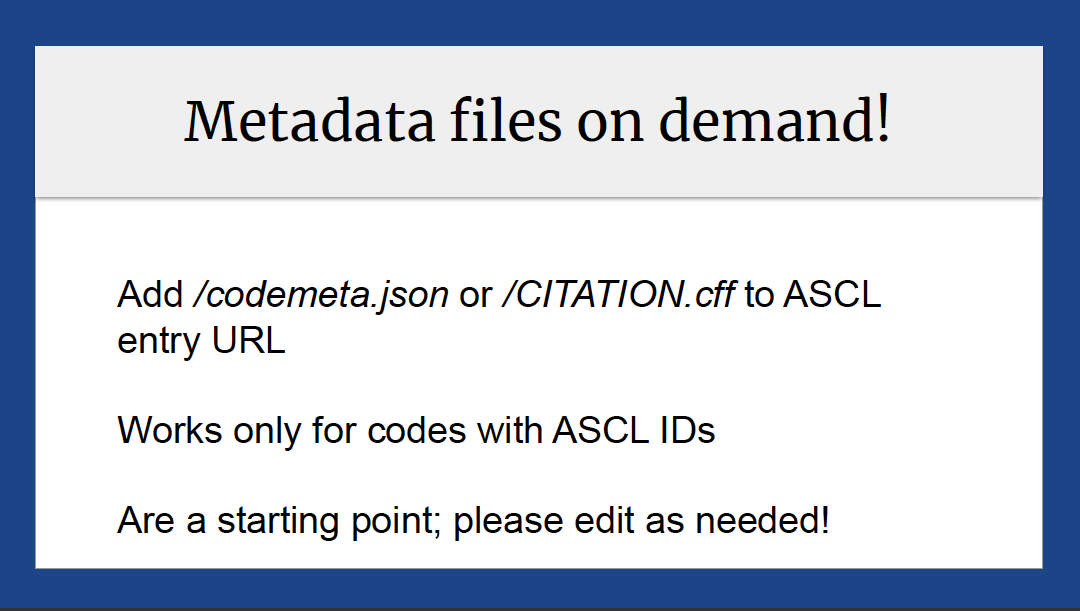
This led nicely into my short talk on metadata files and how the ASCL can create a metadata file from an ASCL entry.
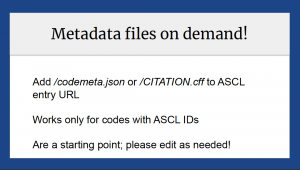 The files the ASCL creates programmatically, codemeta.json and CITATION.cff, are intended to be starting points and contain placeholders for data the ASCL does not capture, but which we feel should be included in the metadata file; we encourage software authors to edit these files before they are placed on one's code site.
Yan Grange, who had organized an earlier BoF on Best licensing practices, presented a summary of the session and the results of two of the several polls taken during that BoF.
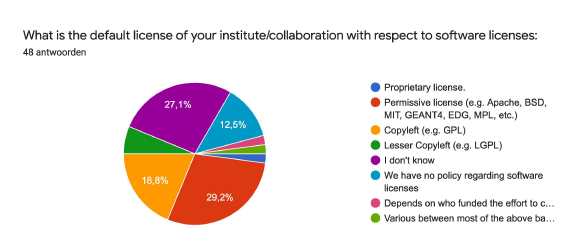 Providing a license for your software is vitally important, as it lets others know what they can and cannot do with your software. Resources and other information from the earlier BoF are available online, and Grange's summary slides for our software metadata BoF are included in the slides file below.
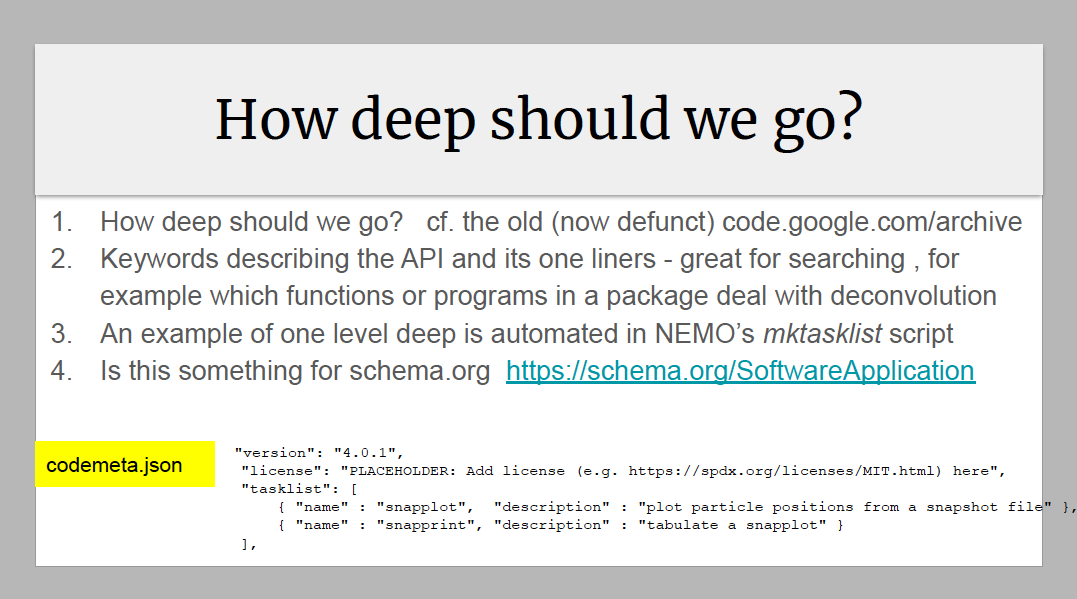
Teuben presented on several related topics: expanding or deepening a codemeta file with “API” information, the Unified Astronomy Thesaurus (UAT) and keywords, and the possibility of taking a software census at a niche science meeting. For this latter, he would like to take a well-defined field in astrophysics and have members of that community take an inventory of the software used and categorize it.
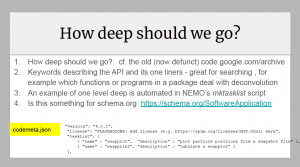 He thinks a conference would be an ideal event for getting all the stakeholders together, and has identified a possible candidate conference for this activity.
The floor, if there can be a floor in a virtual meeting, was then open for comments, questions, answers and ideas, though discussion had already started in the Discord channel. One outcome of this session was that before the end of it, several participants had added metadata files to code repositories!
All slides for this session are in the PDF file below. If you would like more information about the session, please let us know in the comments section below, pinging us at ADASS if you are participating in the meeting, or by emailing me at editor@ascl.net.
Slides (PDF)
-

This presentation covers research on software authorship and citation, which we carried out between July and September 2019. We examined codes authored by three or fewer people ("short author list" codes) and codes authored by institutional teams, to determine how many codes in the ASCL can be attributed to one of these categories. Utilizing ADS data, we measured the number of citations per authorship category. We carried out further research to determine whether we could infer software usage and code usage statistics from the number of citations to code description papers. Our research shows that citations to code description papers are not a reliable proxy for software usage.
P. Wesley Ryan, Astrophysics Source Code Library
Download poster (PDF)
-
This is a continuation of a previous post, and was written by Brian Thomas, Alice Allen, Marc W. Pound, and Peter Teuben.
Lessons Learned
As this was the first such event of this type for ADASS we were unsure of the outcome, as it was somewhat of an experiment. We share some lessons learned for future events.- Provide a list of interesting problems and related clean data. Doing so helps to bootstrap project ideas, as not all participants will have enough domain background to start quickly. Because the event was so short, it was helpful to provide microservices and point to datasets that were more or less cleaned and ‘ready to go’ for projects directed at these problem areas.
- Develop a marketing plan. We could have done a better job to garner interest in the event. We posted to a community BBS, a UMD subreddit, posted paper flyers in campus science and engineering buildings, and contacted student groups and faculty to help spread the word. However, we did not have a coordinated campaign that included social media and messaging targeted for specific dates and groups (e.g., “Save The Date” emails), nor was the hackathon mentioned in the ADASS registration form. A competing, large, all-women hackathon (https://gotechnica.org/) held the same weekend on campus also affected our enrollment.
- Venue (location and time) is important. The university was a good choice because of easy access to rooms, wifi, and food choices. Holding the hackathon at a large academic institution ensured that it would be easy for younger participants (undergrads) to attend, as did holding the event over a weekend to avoid conflicting with classes.
- Have an assessment tool/strategy. An exit survey or ending discussion with participants can help improve subsequent hackathons. We failed to take advantage of the opportunity to engage either the participants or the ADASS audience at the session where winning projects were presented about perceived problems and good aspects of our event.
- Narrow the range of participant experience. Future organizers should consider either limiting participation to non-professionals, or group the participants and awards into professional and non-professionals. It is somewhat unfair to have less experienced coders compete against domain specialists and possibly contrary to the avowed desire to use this event to advertise our field of work to outsiders.
- Time management is crucial. Scheduling a conference event right at the end of the hackathon was problematic, and not tightly managing the final presentation time and similar issues became important and detracted from the event. This will be particularly important in other events that have larger participation.
Conclusions
A community lives and dies by how well it nurtures the next generation. Folks enter the ADASS community by a number of means but typically by being either scientists who become attracted to the technical challenges of writing the software or as computer engineers and programmers who find the science use cases particularly interesting. We are not aware of any organized means to train the next generation of ADASS workers; there are no formal degree programs in “Astronomy Software.” As such, our community has taken a somewhat laissez-faire approach to training the next generation and this may lead to a future deficit in skilled professionals willing to work in our field. More and more our community’s skills are being found useful in application elsewhere; for example, many ADASS attendees can easily become highly sought after Data Scientists.Hackathons are a step towards being more proactive in our outreach and provide an ideal means to encourage and interest a younger group of programmers in the complex and interesting challenges that our community tackles. We found a number of lessons in hosting this event but no showstoppers, and a good deal of goodwill was generated. Based on our experience, we heartily recommend that future ADASS events include hackathon events.
Acknowledgments. We would like to thank the City of College Park for providing the prize money, Vigilante Coffee for supplying much needed coffee, ASCL for providing snacks and the University of Maryland Astronomy Department for hosting the hackathon.
-
This post was written by Brian Thomas, Alice Allen, Marc W. Pound, and Peter Teuben, and, with part 2, will appear in the ADASS XXVIII proceedings.
Brian is with the Office of Chief Information Officer, NASA HQ, Washington DC; Marc, Peter, and Alice are in the Astronomy Department at the University of Maryland in College Park, MD.
In this post, we describe the ADASS XXVIII hackathon, the first associated with an ADASS conference, and provide our motivation and the details of the event. A subsequent post discusses the lessons we learned from holding this event and our conclusions about it.
Introduction
A hackathon seeks to draw together a large group of folks for an intense and extended period of creative programming. Hackathons may be held for a variety of purposes including, but not limited to, teaching (Huppenkothen et al. 2018), to draw together a technical community as a social event (Kellogg et al. 2019), and to draw attention to solving particular challenges or themes (as found, for example, on popular sites such as Kaggle). Pa Pa Pe Than et al. (2018) provides a broader overview of hackathon applications and uses.Our motivation for holding a hackathon associated with the ADASS XXVIII meeting was aligned with outreach to interested individuals; we wanted to highlight topical technical problems that the ADASS community might be concerned with and introduce a new generation of rising computer programmers and scientists to the excitement of solving them. We chose the topic area of Time Domain Astronomy (TDA) to focus on for this event as it was also one of the themes for this year’s ADASS meeting and aligned well with the interests of the Department hosting the hackathon. We allowed a loose definition of TDA, dealing with any astronomical data where time was a parameter. Thus projects for this hackathon could involve, for example, variable stars, exoplanets, and bodies in the solar system.
Event Organization
The ADASS hackathon took place the weekend before the ADASS starting on Saturday morning and ending at noon on Sunday with the total event time being 27 hours. We provided a space in the University of Maryland Physical Sciences Complex (PSC) as well as snacks and coffee. The participants were required to attend the introduction and be present for final presentations at 11am on Sunday. Otherwise, they could stay in the PSC building or leave as they desired. A cash award (provided by the City of College Park) was available for the top 3 teams with $500, $350 and $150 being awarded to the first, second and third place teams respectively. The winning team was also provided time to present their hack during the ADASS meeting.We began by having the participants introduce themselves, their backgrounds and interests. We then introduced the participants to the field of TDA, providing some general background and challenges in this area. Presentations were given by Charlotte Ward (UMD graduate student), Gerbs Bauer (UMD Research Professor), and Brian Thomas (NASA). We highlighted some datasets which could be applied to solving aspects of the challenges. This was followed by a freely flowing brainstorming session where people could discuss ideas and questions, and potential hacks could be focused. Ideas were placed on sticky notes on a wall. Participants were then allowed a short period of time to form teams and brainstorm. After another hour or so, each team presented an outline of their hack, potentially allowing members to join another team if skill sets were better suited elsewhere. In our case nobody decided to join another team.
We allowed for a range of project types. Projects could be new analyses or approaches or novel ways of understanding existing solutions or problems. The final product could be a proof-of-concept app, a plugin to existing code, a storyboard design, or really anything that embodies creative hacking around the TDA theme. We did not require that the final project be polished; a good idea that was well fleshed out could also be submitted. A final presentation of a few slides describing the work including the motivation and approach was the only requirement for consideration for a prize.
We used Devpost to help structure the hackathon. This site served as a centralized location from which information could be disseminated including rules of conduct and a discussion board which we used to distribute ideas and answer participant questions. Hackathon rules can be summarized as follows:
- Each participant belongs to one team and one final submission, but is allowed to switch teams. Team makeup is not final until the presentation. The maximum team size was 5.
- Only 1 submission per team.
- A Code of Conduct. We did not tolerate harassment of hackathon participants in any form, including, but not limited to, harassment based on gender identity and expression, age, sexual orientation, disability, physical appearance, body size, race, ethnicity, nationality, religion, political views, previous hackathon attendance, lack of computing experience, or chosen programming language or tech stack. Sexual language and imagery was not appropriate at any point in the hackathon including in software hacks, social media, talks, presentations, or demos.
Hackathon participants violating any of these rules could be sanctioned or expelled
from the hackathon at the discretion of the hackathon organizers.Participants
Our event was set up as a community hackathon and attracted students, professional hackathonners, and ADASS participants who formed teams (see below). Members of the hosting department and the ADASS program organizing committee served as judges. Out of the 34 original registrations, 6 were present but not playing (being part of the organization or just cheerleading), and 9 did not show up.Judges, Organizers, and Teams
The session was organized by Peter Teuben, Brian Thomas, Alice Allen, Marc Pound, and Elizabeth Warner. Our judges were Alice Allen, Gerbs Bauer, Andy Harris, Nuria Lorente, Ada Nebot, and Brian Thomas. The 7 teams that participated are listed in Table 1. We have also noted which teams won which prizes.Team members Project name Sarah Frail and Patrick Shan Morpheus - Near Earth Objects Visualization Marco Lam Drag and drop ensemble (2nd prize) Paul Ross McWhirter and Josh Veitch-Michaelis Auto periodogram selection using MC (3rd prize) Timothy Henderson and Matt Graber Solar Activity Viewer Thomas Boch, Matthieu Baumann, and Siddha Mavuram Music of Light curves (1st prize) Kyle Kaplan, Sankalp Gilda, Hayden Hotham, Steve Gambino, and Abbie Petulante ML on ZTF pipeline Kevin Cai, Kael Lenus, James Zhou, and Justin Otor Fixed and Variable Time Kepler Viewer in WWT Table 1. Hackathon Teams
The winning team “The Music of Light Curves” made their hack, the sonification of variable stars from the Gaia catalogue, available on https://tboch.github.io/music-lightcurves-hack/. Their presentation to the ADASS audience during the TDA session on Wednesday met with resounding applause (and later a mention in the international press).
-
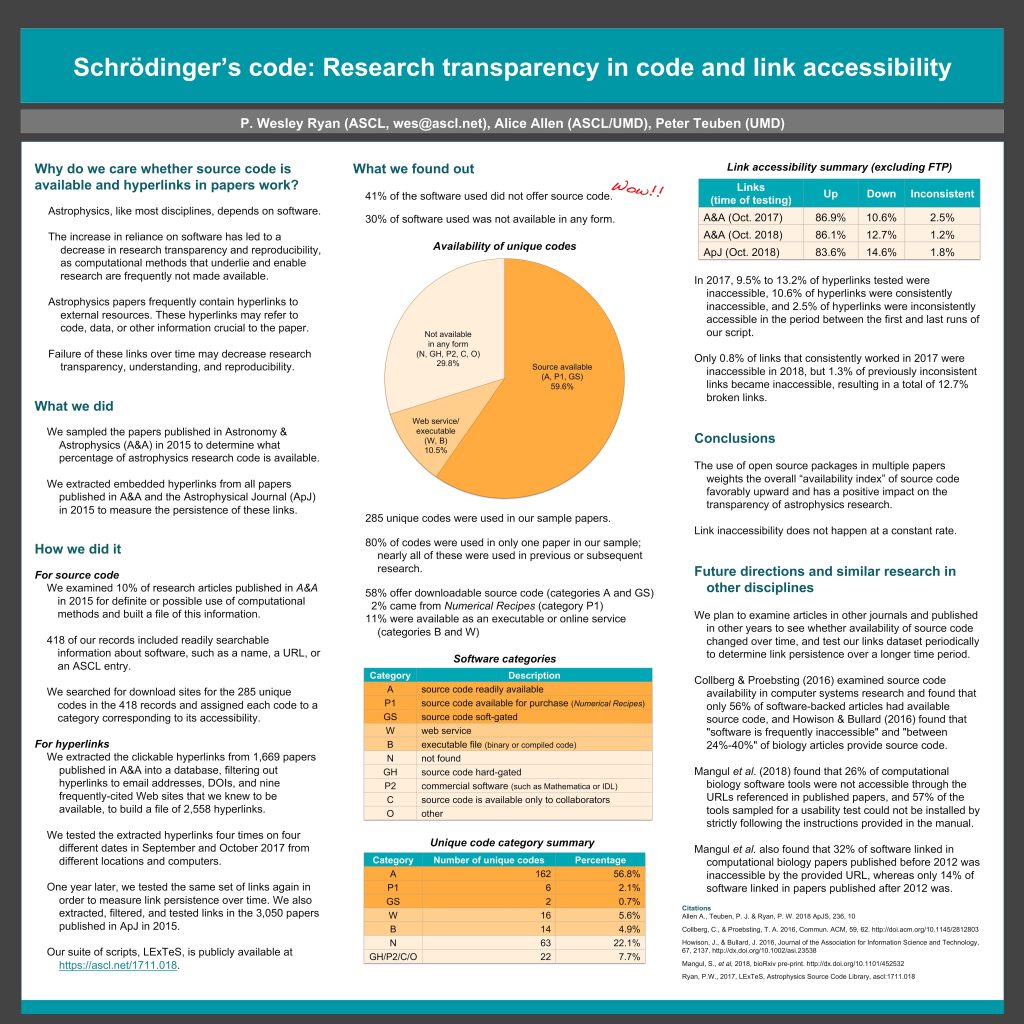
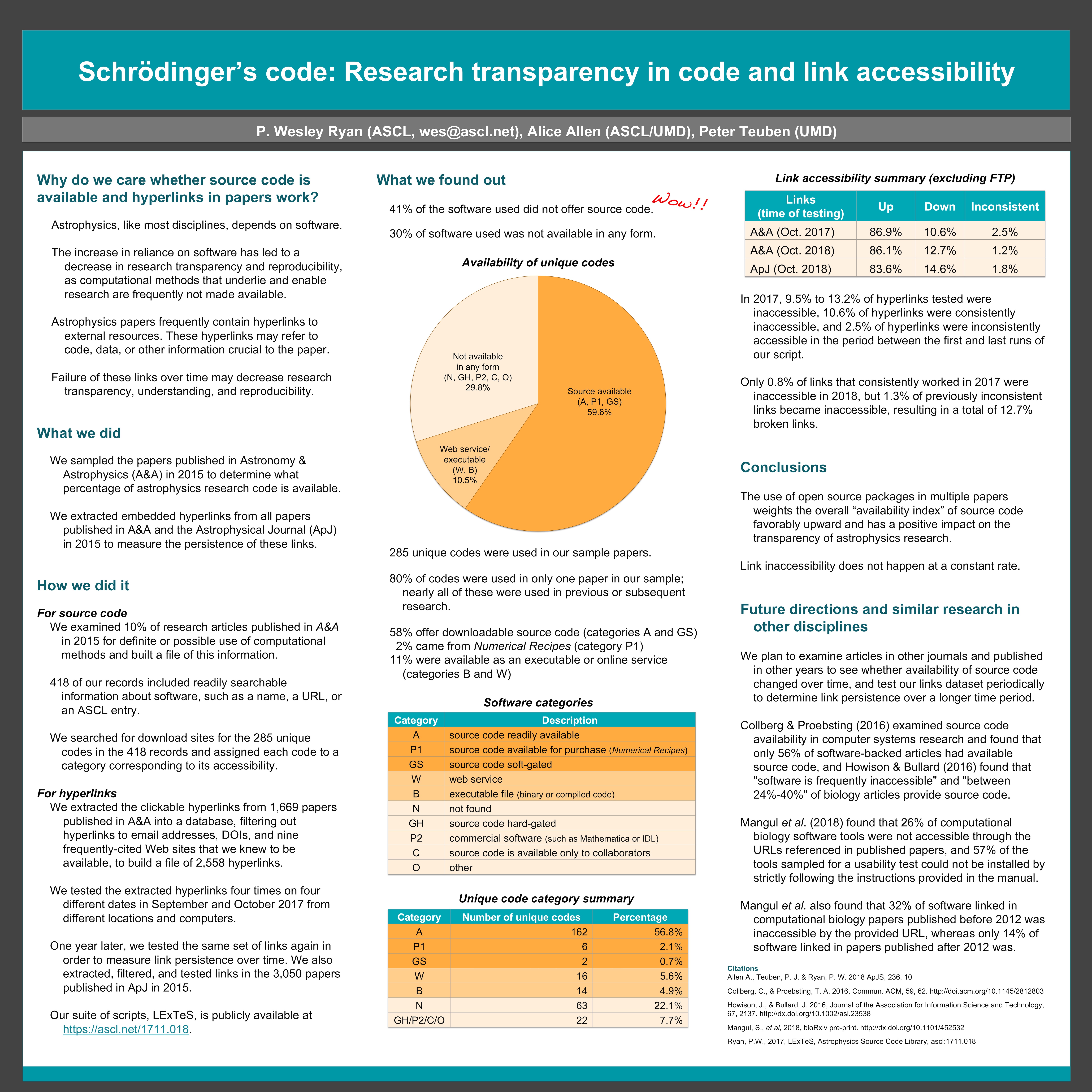
Astronomers use software for their research, but how many of the codes they use are available as source code? We examined a sample of 166 papers from 2015 for clearly identified software use, then searched for source code for the software packages mentioned in these research papers. We categorized the software to indicate whether source code is available for download and whether there are restrictions to accessing it, and if source code was not available, whether some other form of the software, such as a binary, was. Over 40% of the source code for the software used in our sample was not available for download. As URLs have often been used as proxy citations for software and data, we also extracted URLs from one journal’s 2015 research articles, removed those from certain long-term reliable domains, and tested the remainder to determine what percentage of these URLs were accessible in September and October, 2017. We repeated this test a year later to determine what percentage of these links were still accessible. This poster will present what we learned about software availability and URL accessibility in astronomy.P. Wesley Ryan, Astrophysics Source Code Library
Alice Allen, Astrophysics Source Code Library/University of Maryland
Peter Teuben, University of Maryland -
Presentation slides (PDF)
Journals
Journal of Open Source Software (JORS)
Astronomy and Computing (A&C)
Computational Astrophysics and Cosmology (ComAC)
Journal of Open Source Software (JOSS)
Change leaders and guidelines
Force11/Force11 Software Citation Principles
Working toward Sustainable Software for Science: Practice and Experiences (WSSSPE)
Social coding sites and archival services
Other resources
-

The Astrophysics Source Code Library (ASCL), established in 1999, is a citable online registry of source codes used in research that are available for download; the ASCL’s main purpose is to improve the transparency, reproducibility, and falsifiability of research. This presentation discusses the 2017 improvements to the resource, including real-time data backup for submissions and newly-published entries, improved cross-matching of research papers with software entries in ADS, and the expansion of preferred citation information for the software in the ASCL.
Alice Allen, Astrophysics Source Code Library/University of Maryland
Bruce Berriman, Caltech/IPAC-NExScI
Kimberly DuPrie, Space Telescope Science Institute/Astrophysics Source Code Library
Jessica Mink, Smithsonian Astrophysical Observatory
Robert Nemiroff, Michigan Technological University
P.W. Ryan, Astrophysics Source Code Library
Judy Schmidt, Astrophysics Source Code Library
Lior Shamir, Lawrence Technological University
Keith Shortridge, Knave and Varlet
Mark Taylor, University of Bristol
Peter Teuben, University of Maryland
John Wallin, Middle Tennessee State University
Rein H. Warmels, European Southern Observatory -
On Tuesday at ADASS, ASCL Advisory Committee Chair Peter Teuben led a Birds of a Feather session intended as a working session to have people put some of the ideas for improving software citation and credit into practice.
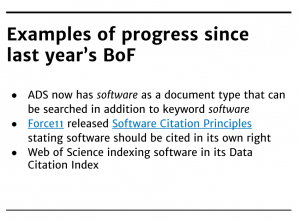
Slide from Peter's opening presentation He opened the session with a few remarks about last year's BoF, similar efforts elsewhere, and examples of progress since last year. Yes, there has been progress! He then showed a list of actionable items and asked people to work on them, adding their work to a common Google doc. His slides are here.
And they did! It was the quietest BoF ever, I believe, as Keith Shortridge, Bruce Berriman, and Jessica Mink wrote about their experiences in releasing software; Renato Callado Borges and Greg Sleap provided guidance on the types of software contributions that add value to science; Alberto Accomazzi, Nuria Lorente, and Kai Polsterer listed ways one can publish and take credit for software; Peter Teuben, Steven Crawford, and possibly others pulled together a list of organization web pages about software created at the institutions, this as a way to highlight and recognize scientific software contributions; Maurizio Tomasi added a suggestion for gathering licensing information; and Thomas Robitaille, Ole Streicher, Tim Jenness, Kimberly DuPrie, and I discussed exactly what should be in the "Preferred citation field" of the ASCL and various people listed about a dozen preferred citations to be added to the ASCL and others used the Suggest a change or addition link for several software packages to provide preferred citation information.
Though Peter had asked that people work for about 30 minutes, he monitored contributions to the Google doc and saw work was still being done so did not call us back together until only 15 minutes or so were left in the session. Instead of having people report back on what they had done as originally plan, he asked for other feedback instead, as progress made was evident in the shared document, and after a bit of discussion on licensing and a few other comments, closed the session.
Though the session is over, the next phase is to put this information to use or disseminate it in some way so it can do some good and be the changes we want to see for software!
-
 The James Webb Space Telescope (JWST) archive will store numerous metadata for the various files that it contains: at the time of this writing a single FITS file can have up to 250 different metadata fields in the archive, most of which map to keywords in the primary header or header extensions. One of the goals of the archive design is to allow for changes to the fields stored in the database without having to change the ingest code. We have found this to be very helpful during the code development phase of the mission when the FITS file definitions are frequently changing. We also anticipate it will be advantageous during the lifetime of the mission as changes to processing will likely result in changes to the keywords but should not require changes to the ingest code. This poster describes the methods we use to decouple the archive from the ingest process.
Kimberly DuPrie, Space Telescope Science Institute
Lisa Gardner, Space Telescope Science Institute
Michael Gough, Space Telescope Science Institute
Richard C. Kidwell Jr., Space Telescope Science Institute