ASCL News
-
Twenty-eight codes were added to the ASCL in April and May 2016:
2-DUST: Dust radiative transfer code
ASTRiDE: Automated Streak Detection for Astronomical Images
BACCHUS: Brussels Automatic Stellar Parameter
CAMELOT: Cloud Archive for MEtadata, Library and Online Toolkit
CCSNMultivar: Core-Collapse Supernova Gravitational Wavescluster-lensing: Tools for calculating properties and weak lensing profiles of galaxy clusters
DISCO: 3-D moving-mesh magnetohydrodynamics package
DNest3: Diffusive Nested Sampling
DUO: Spectra of diatomic molecules
FDPS: Framework for Developing Particle Simulatorsgrtrans: Polarized general relativistic radiative transfer via ray tracing
Halotools: Galaxy-Halo connection models
K2SC: K2 Systematics Correction
LAMBDAR: Lambda Adaptive Multi-Band Deblending Algorithm in R
libpolycomp: Compression/decompression librarymagicaxis: Pretty scientific plotting with minor-tick and log minor-tick support
MARZ: Redshifting Program
MUSCLE: MUltiscale Spherical-ColLapse Evolution
OpenMHD: Godunov-type code for ideal/resistive magnetohydrodynamics (MHD)
PDT: Photometric DeTrending Algorithm Using Machine LearningSAND: Automated VLBI imaging and analyzing pipeline
Shadowfax: Moving mesh hydrodynamical integration code
Surprise Calculator: Estimating relative entropy and Surprise between samples
The Tractor: Probabilistic astronomical source detection and measurement
TMBIDL: Single dish radio astronomy data reduction packageTRIPPy: Python-based Trailed Source Photometry
TTVFaster: First order eccentricity transit timing variations (TTVs)
zeldovich-PLT: Zel'dovich approximation initial conditions generator -
Eighteen codes were added to the ASCL in March, 2016:
Asfgrid: Asteroseismic parameters for a star
CORBITS: Efficient Geometric Probabilities of Multi-Transiting Exoplanetary Systems
Dedalus: Flexible framework for spectrally solving differential equations
DiskJockey: Protoplanetary disk modeling for dynamical mass derivation
ellc: Light curve model for eclipsing binary stars and transiting exoplanetsEQUIB: Atomic level populations and line emissivities calculator
ExoPriors: Accounting for observational bias of transiting exoplanets
FAST-PT: Convolution integrals in cosmological perturbation theory calculator
fibmeasure: Python/Cython module to find the center of back-illuminated optical fibers in metrology images
gPhoton: Time-tagged GALEX photon events analysis toolsHIIexplorer: Detect and extract integrated spectra of HII regions
PyGSM: Python interface to the Global Sky Model
PolRadTran: Polarized Radiative Transfer Model Distribution
ROBAST: ROOT-based ray-tracing library for cosmic-ray telescopes
SILSS: SPHERE/IRDIS Long-Slit Spectroscopy pipelineSMARTIES: Spheroids Modelled Accurately with a Robust T-matrix Implementation for Electromagnetic Scattering
tpipe: Searching radio interferometry data for fast, dispersed transients
VIP: Vortex Image Processing pipeline for high-contrast direct imaging of exoplanets -
Twenty-one codes were added to the ASCL in February, 2016:
Automark: Automatic marking of marked Poisson process in astronomical high-dimensional datasets
Celestial: Common astronomical conversion routines and functions
CHIP: Caltech High-res IRS Pipeline
CLOC: Cluster Luminosity Order-Statistic Code
COLAcode: COmoving Lagrangian Acceleration codeDELightcurveSimulation: Light curve simulation code
DUSTYWAVE: Linear waves in gas and dust
FilTER: Filament Trait-Evalutated Reconstruction
GANDALF: Graphical Astrophysics code for N-body Dynamics And Lagrangian Fluids
IRSFRINGE: Interactive tool for fringe removal from Spitzer IRS spectrak2photometry: Read, reduce and detrend K2 photometry
LensTools: Weak Lensing computing tools
LIRA: LInear Regression in Astronomy
LRGS: Linear Regression by Gibbs Sampling
mbb_emcee: Modified Blackbody MCMCNuCraft: Oscillation probabilities for atmospheric neutrinos calculator
POPPY: Physical Optics Propagation in PYthon
pyraf-dbsp: Reduction pipeline for the Palomar Double Beam Spectrograph
TailZ: Redshift distributions estimator of photometric samples of galaxies
The Cannon: Data-driven method for determining stellar parameters and abundances from stellar spectra -
Twenty-one codes were added to the ASCL in January, 2016:
BASCS: Bayesian Separation of Close Sources
CosmicPy: Interactive cosmology computations
ctools: Cherenkov Telescope Science Analysis Software
Fit Kinematic PA: Fit the global kinematic position-angle of galaxies
Hyper-Fit: Fitting routines for multidimensional data with multivariate Gaussian uncertaintiesImpactModel: Black Hole Accretion Disk Impact Model
ISO: Isochrone construction
K2fov: Field of view software for NASA's K2 mission
LACEwING: LocAting Constituent mEmbers In Nearby Groups
LIRA: Low-counts Image Reconstruction and AnalysisMATPHOT: Stellar photometry and astrometry with discrete point spread functions
Nulike: Neutrino telescope likelihood tools
Odyssey: Ray tracing and radiative transfer in Kerr spacetime
PARAVT: Parallel Voronoi Tessellation code
ProC: Process CoordinatorQDPHOT: Quick & Dirty PHOTometry
SAGE: Semi-Analytic Galaxy Evolution
SavGolFilterCov: Savitzky Golay filter for data with error covariance
SCOUSE: Semi-automated multi-COmponent Universal Spectral-line fitting Engine
TRADES: TRAnsits and Dynamics of Exoplanetary SystemsWzBinned: Binned and uncorrelated estimates of dark energy EOS extractor
-
Twenty codes were added to the ASCL in December, 2015:
ALFA: Automated Line Fitting Algorithm
AstroBlend: Visualization package for use with Blender
Bisous model: Detecting filamentary pattern in point processes
CounterPoint: Zeeman-split absorption lines
CubeIndexer: Indexer for regions of interest in data cubesDiffuseModel: Modeling the diffuse ultraviolet background
DRACULA: Dimensionality Reduction And Clustering for Unsupervised Learning in Astronomy
EDRS: Electronography Data Reduction System
EDRSX: Extensions to the EDRS package
ExoData: Open Exoplanet Catalogue exploration and analysis toolFFTLog: Fast Fourier or Hankel transform
GetData: A filesystem-based, column-oriented database format for time-ordered binary data
GPC: General Polygon Clipper library
growl: Growth factor and growth rate of expanding universes
IRACpm: Distortion correction for IRAC astrometric dataSpirality: Spiral arm pitch angle measurement
TACT: The Action Computation Tool
TM: Torus Mapper
UPSILoN: AUtomated Classification of Periodic Variable Stars using MachIne LearNing
ZeldovichRecon: Halo correlation function using the Zeldovich approximation -
The ASCL is offering clones of its infrastructure for any group or discipline wanting to build a code registry or repository of its own, with control of the new resource residing with the requesting parties. If you would like to build your own software resource, you can take our infrastructure, configure it as you like, and use it.
Specifically, we’re offering to:
- clone the ASCL infrastructure to your domain name
- host the infrastructure for at least three years (if you’d like) at MTU
- share innovations on ASCL with those who accept this offer
- maintain the host
- let you move your site elsewhere with data intact
We would expect you to:
- pay for/provide a domain name
- have control over the site and configure it for your own use
- use the site for a software repository/registry
- gather ye codes as ye may
- share innovations on the site with the ASCL and others who accept this offer
- not do anything harmful to MTU’s computing environment
ASCL.net is built using these open source tools:
- mySQL
- WordPress
- phpbb
- CodeIgniter
Interested? Let us know at editor@ascl.net or comment below.
-
Thirty codes were added to the ASCL in October and November 2015:
ASPIC: STARLINK image processing package
batman: BAsic Transit Model cAlculatioN in Python
ccdproc: CCD data reduction software
CCDtoRGB: RGB image production from three-band atronomical images
CosmoBolognaLib: Open source C++ libraries for cosmological calculationsDEBiL: Detached Eclipsing Binary Light curve fitter
DES exposure checker: Dark Energy Survey image quality control crowdsourcer
EPIC: E-field Parallel Imaging Correlator
GALFORM: Galactic modeling
Galileon-Solver: N-body codeGeorge: Gaussian Process regression
GGADT: Generalized Geometry Anomalous Diffraction Theory
HumVI: Human Viewable Image creation
JKTLD: Limb darkening coefficients
JSPAM: Interacting galaxies modellerLCD3: Three-parameter limb darkening coefficient sampling
MCAL: M dwarf metallicity and temperature calculator
Mercury-T: Tidally evolving multi-planet systems code
MHF: MLAPM Halo Finder
milkywayproject_triggering: Correlation functions for two catalog datasetsPangloss: Reconstructing lensing mass
PromptNuFlux: Prompt atmospheric neutrino flux calculator
pyhrs: Spectroscopic data reduction package for SALT
PyLDTk: Python toolkit for calculating stellar limb darkening profiles and model-specific coefficients for arbitrary filters
SkyView Virtual TelescopeSparsePZ: Sparse Representation of Photometric Redshift PDFs
SuperFreq: Numerical determination of fundamental frequencies of an orbit
T-Matrix: Codes for Computing Electromagnetic Scattering by Nonspherical and Aggregated Particles
Xgremlin: Interferograms and spectra from Fourier transform spectrometers analysis
ZInCo: Zoomed Initial Conditions -
As promised in a previous post, here is the list of software activities at the upcoming January AAS meeting in Kissimmee; I hope to add a Software Publishing Special Interest Group meeting to the list, but other than that, the list should be complete. If I missed anything that should be here, please (please!) let me know. Thank you, and see you there!
SUNDAY, JANUARY 03, 2016
Introduction to Software Carpentry 2 Day Workshop (day 1 of 2)
Organizer: Software Carpentry
9:00 AM - 5:30 PM; St. George 106 (Gaylord Palms Resort and Convention Center)
MONDAY, JANUARY 04, 2016
Introduction to Software Carpentry 2 Day Workshop (day 2 of 2)
Organizer: Software Carpentry
8:00 AM - 5:30 PM; St. George 106 (Gaylord Palms Resort and Convention Center)Astrostatistics and R
Organizer: Eric D. Feigelson (Penn State University) and two assistants
9:00 AM - 6:00 PM; Emerald 8 (Gaylord Palms Resort and Convention Center)Using Python for Astronomical Data Analysis
Organizer: Perry Greenfield
9:00 AM - 4:30 PM; St. George 114 (Gaylord Palms Resort and Convention Center)SciCoder Presents: Developing Larger Software Projects
Organizer: Demitri Muna
10:00 AM - 6:00 PM; Emerald 6 (Gaylord Palms Resort and Convention Center)Bayesian Methods in Astronomy: Hands-on Statistics
Organizer: Jake VanderPlas (U. Washington) and two assistants
1:00 PM - 6:00 PM; Emerald 2 (Gaylord Palms Resort and Convention Center)
TUESDAY, JANUARY 05, 2016
Tools and Tips for Better Software (aka Pain Reduction for Code Authors)
Organizers: Astrophysics Source Code Library (ASCL)/Moore-Sloan Data Science Environment at NYU
2:00 PM - 3:30 PM; Sanibel (Gaylord Palms Resort and Convention Center)
WEDNESDAY, JANUARY 06, 2016
Lectures in AstroStatistics
10:00 AM - 11:30 AM; Osceola 5 (Gaylord Palms Resort and Convention Center)Extrasolar Planet Atmospheres: BART Atmospheric Modelling Code and Applications
10:00 AM - 10:10 AM; 212.01. A Random Walk on WASP-12b with the Bayesian Atmospheric Radiative Transfer (BART) Code
Presenter: Joseph Harrington10:10 AM - 10:20 AM; 212.02. Bayesian Atmospheric Radiative Transfer (BART) Code and Application to WASP-43b
Presenter: Jasmina BlecicTopics in Astrostatistics
1:30 PM - 3:30 PM; St. George 106 (Gaylord Palms Resort and Convention Center)AGN, QSO, Blazars Poster Session
243.46 Time-dependent Photoionization of Gaseous Nebulae: TD_XSTAR Code
Presenter: Ehab E. Elhoussieny243.37. Bayesian and Profile Likelihood Approaches to Time Delay Estimation for Stochastic Time Series of Gravitationally Lensed Quasars
Presenter: Hyungsuk TakMajors and Graduate Student Education and Professional Development Poster Session
247.07 Astronomy education and the Astrophysics Source Code Library
Presenter: Alice Allen
THURSDAY, JANUARY 07, 2016
Catalogs, Surveys, and Data Viewing
2:00 PM - 2:10 PM; 324.01. Introducing Nightlight: A New, Modern FITS Viewer
Presenter: Demitri Muna
Tampa (Gaylord Palms Resort and Convention Center)2:10 PM - 2:20 PM; 324.02. Synthesizing Understanding from Data with yt
Presenter: Matthew Turk
Tampa (Gaylord Palms Resort and Convention Center)Cosmological Simulations of Galaxies
3:00 PM - 3:10 PM; 316.05. The Non-parametric Concentration of Dark Matter Halos in Cosmological N-body Simulations
Presenter: Meagan Lang
Sun A (Gaylord Palms Resort and Convention Center)3:10 PM - 3:20 PM; 316.06. The Scylla Multi-Code Comparison Project
Presenter: Ariyeh Maller
Sun A (Gaylord Palms Resort and Convention Center)348. Computation, Data Handling, Image Analysis Poster Session
Posters in other sections:
338.17. Simulating magnetospheres with numerical relativity: The GiRaFFE code
Presenter: Maria Babiuc-Hamilton342.05. Machine Learning and Cosmological Simulations
Presenter: Harshil Kamdar342.07. SurveySim: a new MCMC code to explore the evolution of the IR luminosity function
Presenter: Matteo Bonato
FRIDAY, JANUARY 08, 2016
Beyond the Academy: Showcasing Astronomy Alumni in Non-Academic Careers
413.01. Astronomers as Software Developers
Presenter: Rachel A. Pildis
10:00 AM - 10:25 AM; Osceola 4 (Gaylord Palms Resort and Convention Center)Hack Day
Organizer: Kelle Cruz (Hunter College/CUNY and AMNH)
10:00 AM - 5:00 PM; Tallahassee (Gaylord Palms Resort and Convention Center)
To participate in Hack Day, please register at http://www.astrobetter.com/wiki/AASHackDay. -
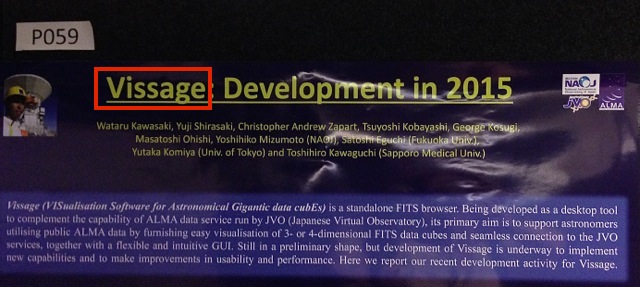
I used to read ADASS posters in part to find new codes to register. I still do that, but it's harder these days, for reasons that make me very happy: many of the codes are already in the ASCL! Here is a sampling from a quick and definitely not thorough perusal of posters.
CIGALE [ascl:1111.004] and LePHARE [ascl:1108.009]

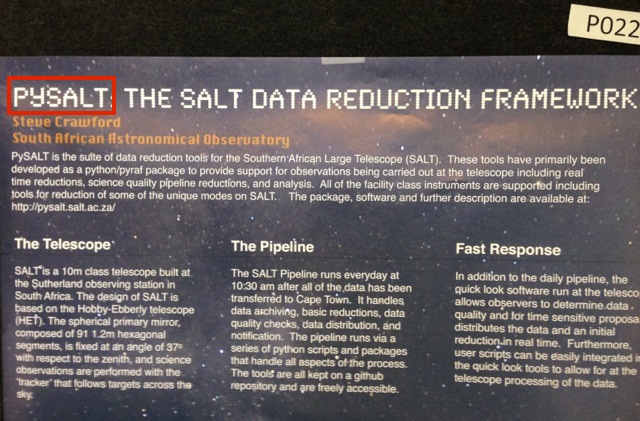
PySALT [ascl:1207.010]

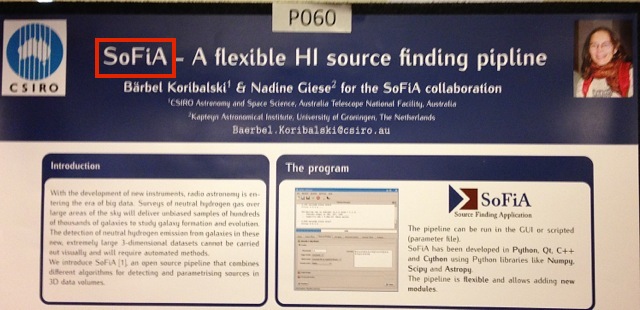
SoFiA [ascl:1412.001]

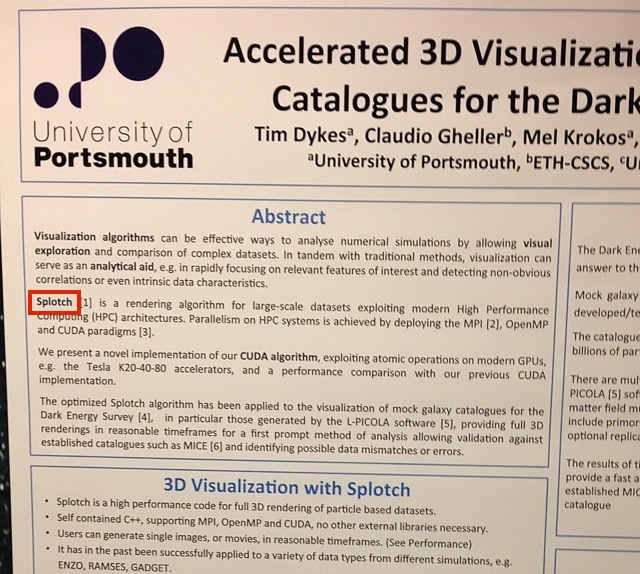
Splotch [ascl: 1103.005]

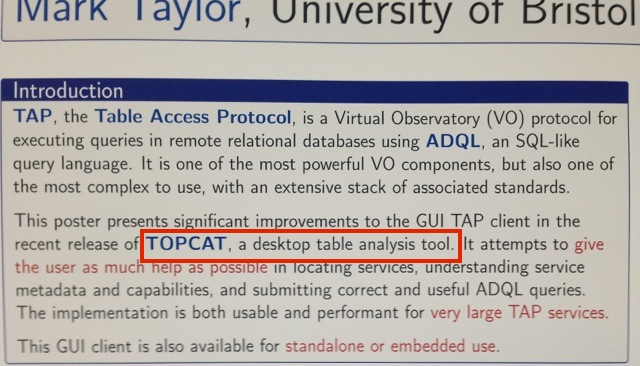
TOPCAT [ascl:1101.010]

Vissage [ascl:1402.001]

It's lovely to see ADASS folks I've met before, and lovely to see codes I already know. It's also great to meet new people and run across new codes, and I'll be highlighting some of the new codes added as a result of this ADASS in a future blog post.
-
Have you found an error in an ASCL entry?
 Is there a paper using your code you'd like to add? Would you like to specify right in an ASCL entry how your code should be cited?
We have added a "Suggest a change or addition" link to every code entry in the ASCL. This link brings up a form that is similar to the Submissions form and allows you to not only request changes to fields currently displayed, but also enter information for fields we are considering adding.
For example, we would like to disambiguate the URLs for refereed papers into those that describe a code and those that use a code; we'd also like to add categories to make searching for codes easier.

Something that's been on our wish list for a while is a "see also" feature, one that identifies, for a particular code, codes having a similar function or that someone looking at that code would likely be interested in, too.
 All we need to do this are the data!
Last update: July 20, 2021