ASCL News
-
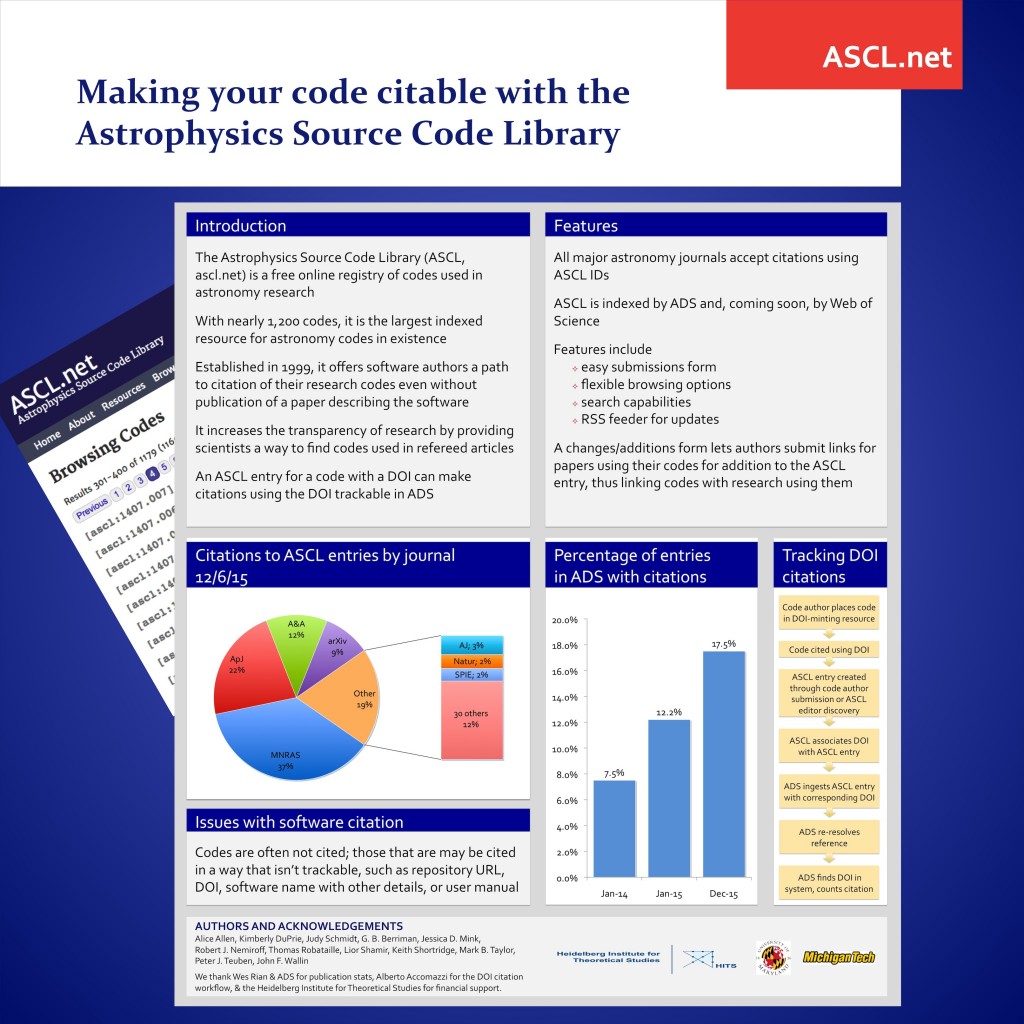
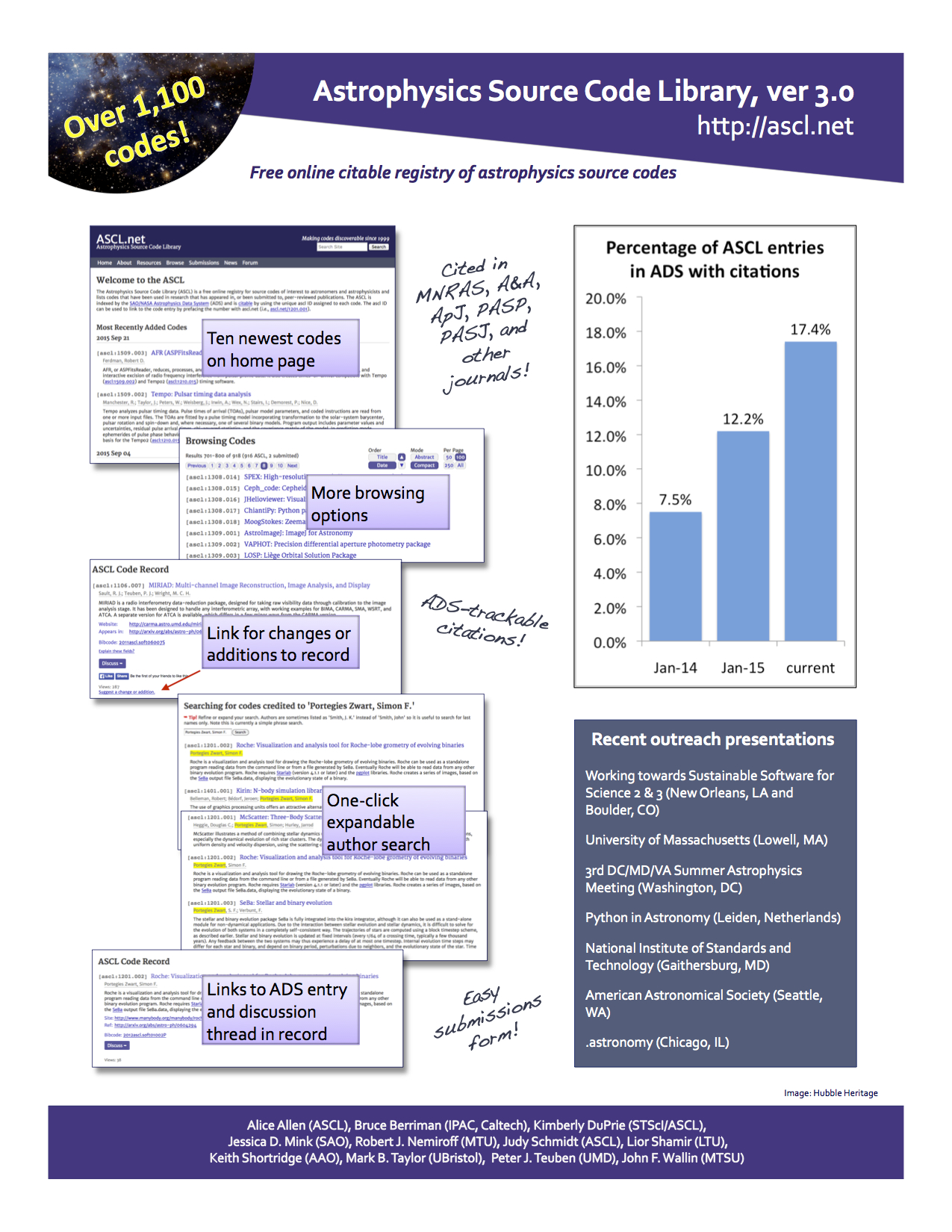
The Astrophysics Source Code Library (ASCL, ascl.net) is a free online registry of codes used in astronomy research. With nearly 1,200 codes, it is the largest indexed resource for astronomy codes in existence. Established in 1999, it offers software authors a path to citation of their research codes even without publication of a paper describing the software, and offers scientists a way to find codes used in refereed publications, thus improving the transparency of the research. Citations using ASCL IDs are accepted by major astronomy journals and if formatted properly are tracked by ADS and other indexing services. The number of citations to ASCL entries increased sharply from 110 citations in January 2014 to 456 citations in September 2015. The percentage of code entries in ASCL that were cited at least once rose from 7.5% in January 2014 to 17.4% in September 2015. The ASCL’s mid-2014 infrastructure upgrade added an easy entry submission form, more flexible browsing, search capabilities, and an RSS feeder for updates. A Changes/Additions form added this past fall lets authors submit links for papers that use their codes for addition to the ASCL entry even if those papers don’t formally cite the codes, thus increasing the transparency of that research and capturing the value of their software to the community.
-
Posters! Sessions! Meetings! The upcoming AAS meeting in Kissimmee, Florida is shaping up to be the busiest ever! Here are the formal meeting activities the ASCL is participating in.
Special Session: Tools and Tips for Better Software (aka Pain Reduction for Code Authors)
Tuesday, January 05, 2:00 PM - 3:30 PM; Sanibel
Organizers: Astrophysics Source Code Library (ASCL)/Moore-Sloan Data Science Environment at NYUResearch in astronomy is increasingly dependent on software methods and astronomers are increasingly called upon to write, collaborate on, release, and archive research quality software, but how can these be more easily accomplished? Building on comments and questions from previous AAS special sessions, this session, organized by the Astrophysics Source Code Library (ASCL) and the Moore-Sloan Data Science Environment at NYU, explores methods for improving software by using available tools and best practices to ease the burden and increase the reward of doing so. With version control software such as git and svn and companion online sites such as GitHub and Bitbucket, documentation generators such as Doxygen and Sphinx, and Travis CI, Intern, and Jenkins available to aid in testing software, it is now far easier to write, document and test code. Presentations cover best practices, tools, and tips for managing the life cycle of software, testing software and creating documentation, managing releases, and easing software production and sharing. After the presentations, the floor will be open for discussion and questions.
The topics and panelists are:
Source code management with version control software, Kenza S. Arraki
Software testing, Adrian M. Price-Whelan
The importance of documenting code, and how you might make yourself do it, Erik J. Tollerud
Best practices for code release, G. Bruce Berriman
Community building and its impact on sustainable scientific software, Matthew Turk
What to do with a dead research code, Robert J. Nemiroff
Poster 247.07: Astronomy education and the Astrophysics Source Code Library
Wednesday, January 06, Exhibit Hall AThe Astrophysics Source Code Library (ASCL) is an online registry of source codes used in refereed astrophysics research. It currently lists nearly 1,200 codes and covers all aspects of computational astrophysics. How can this resource be of use to educators and to the graduate students they mentor? The ASCL serves as a discovery tool for codes that can be used for one’s own research. Graduate students can also investigate existing codes to see how common astronomical problems are approached numerically in practice, and use these codes as benchmarks for their own solutions to these problems. Further, they can deepen their knowledge of software practices and techniques through examination of others’ codes.
Poster 348.01: Making your code citable with the Astrophysics Source Code Library
Thursday, January 07, Exhibit Hall AThe Astrophysics Source Code Library (ASCL, ascl.net) is a free online registry of codes used in astronomy research. With nearly 1,200 codes, it is the largest indexed resource for astronomy codes in existence. Established in 1999, it offers software authors a path to citation of their research codes even without publication of a paper describing the software, and offers scientists a way to find codes used in refereed publications, thus improving the transparency of the research. Citations using ASCL IDs are accepted by major astronomy journals and if formatted properly are tracked by ADS and other indexing services. The number of citations to ASCL entries increased sharply from 110 citations in January 2014 to 456 citations in September 2015. The percentage of code entries in ASCL that were cited at least once rose from 7.5% in January 2014 to 17.4% in September 2015. The ASCL’s mid-2014 infrastructure upgrade added an easy entry submission form, more flexible browsing, search capabilities, and an RSS feeder for updates. A Changes/Additions form added this past fall lets authors submit links for papers that use their codes for addition to the ASCL entry even if those papers don’t formally cite the codes, thus increasing the transparency of that research and capturing the value of their software to the community.
-
As promised in a previous post, here is the list of software activities at the upcoming January AAS meeting in Kissimmee; I hope to add a Software Publishing Special Interest Group meeting to the list, but other than that, the list should be complete. If I missed anything that should be here, please (please!) let me know. Thank you, and see you there!
SUNDAY, JANUARY 03, 2016
Introduction to Software Carpentry 2 Day Workshop (day 1 of 2)
Organizer: Software Carpentry
9:00 AM - 5:30 PM; St. George 106 (Gaylord Palms Resort and Convention Center)
MONDAY, JANUARY 04, 2016
Introduction to Software Carpentry 2 Day Workshop (day 2 of 2)
Organizer: Software Carpentry
8:00 AM - 5:30 PM; St. George 106 (Gaylord Palms Resort and Convention Center)Astrostatistics and R
Organizer: Eric D. Feigelson (Penn State University) and two assistants
9:00 AM - 6:00 PM; Emerald 8 (Gaylord Palms Resort and Convention Center)Using Python for Astronomical Data Analysis
Organizer: Perry Greenfield
9:00 AM - 4:30 PM; St. George 114 (Gaylord Palms Resort and Convention Center)SciCoder Presents: Developing Larger Software Projects
Organizer: Demitri Muna
10:00 AM - 6:00 PM; Emerald 6 (Gaylord Palms Resort and Convention Center)Bayesian Methods in Astronomy: Hands-on Statistics
Organizer: Jake VanderPlas (U. Washington) and two assistants
1:00 PM - 6:00 PM; Emerald 2 (Gaylord Palms Resort and Convention Center)
TUESDAY, JANUARY 05, 2016
Tools and Tips for Better Software (aka Pain Reduction for Code Authors)
Organizers: Astrophysics Source Code Library (ASCL)/Moore-Sloan Data Science Environment at NYU
2:00 PM - 3:30 PM; Sanibel (Gaylord Palms Resort and Convention Center)
WEDNESDAY, JANUARY 06, 2016
Lectures in AstroStatistics
10:00 AM - 11:30 AM; Osceola 5 (Gaylord Palms Resort and Convention Center)Extrasolar Planet Atmospheres: BART Atmospheric Modelling Code and Applications
10:00 AM - 10:10 AM; 212.01. A Random Walk on WASP-12b with the Bayesian Atmospheric Radiative Transfer (BART) Code
Presenter: Joseph Harrington10:10 AM - 10:20 AM; 212.02. Bayesian Atmospheric Radiative Transfer (BART) Code and Application to WASP-43b
Presenter: Jasmina BlecicTopics in Astrostatistics
1:30 PM - 3:30 PM; St. George 106 (Gaylord Palms Resort and Convention Center)AGN, QSO, Blazars Poster Session
243.46 Time-dependent Photoionization of Gaseous Nebulae: TD_XSTAR Code
Presenter: Ehab E. Elhoussieny243.37. Bayesian and Profile Likelihood Approaches to Time Delay Estimation for Stochastic Time Series of Gravitationally Lensed Quasars
Presenter: Hyungsuk TakMajors and Graduate Student Education and Professional Development Poster Session
247.07 Astronomy education and the Astrophysics Source Code Library
Presenter: Alice Allen
THURSDAY, JANUARY 07, 2016
Catalogs, Surveys, and Data Viewing
2:00 PM - 2:10 PM; 324.01. Introducing Nightlight: A New, Modern FITS Viewer
Presenter: Demitri Muna
Tampa (Gaylord Palms Resort and Convention Center)2:10 PM - 2:20 PM; 324.02. Synthesizing Understanding from Data with yt
Presenter: Matthew Turk
Tampa (Gaylord Palms Resort and Convention Center)Cosmological Simulations of Galaxies
3:00 PM - 3:10 PM; 316.05. The Non-parametric Concentration of Dark Matter Halos in Cosmological N-body Simulations
Presenter: Meagan Lang
Sun A (Gaylord Palms Resort and Convention Center)3:10 PM - 3:20 PM; 316.06. The Scylla Multi-Code Comparison Project
Presenter: Ariyeh Maller
Sun A (Gaylord Palms Resort and Convention Center)348. Computation, Data Handling, Image Analysis Poster Session
Posters in other sections:
338.17. Simulating magnetospheres with numerical relativity: The GiRaFFE code
Presenter: Maria Babiuc-Hamilton342.05. Machine Learning and Cosmological Simulations
Presenter: Harshil Kamdar342.07. SurveySim: a new MCMC code to explore the evolution of the IR luminosity function
Presenter: Matteo Bonato
FRIDAY, JANUARY 08, 2016
Beyond the Academy: Showcasing Astronomy Alumni in Non-Academic Careers
413.01. Astronomers as Software Developers
Presenter: Rachel A. Pildis
10:00 AM - 10:25 AM; Osceola 4 (Gaylord Palms Resort and Convention Center)Hack Day
Organizer: Kelle Cruz (Hunter College/CUNY and AMNH)
10:00 AM - 5:00 PM; Tallahassee (Gaylord Palms Resort and Convention Center)
To participate in Hack Day, please register at http://www.astrobetter.com/wiki/AASHackDay. -
Judy Schmidt, our designer/developer, and I have a new paper, "Looking before Leaping: Creating a Software Registry," in the Journal of Open Research Software. The article is open access and can be found here: http://doi.org/10.5334/jors.bv
When I started work on the ASCL in 2010, I wanted to understand why the original ASCL -- started in 1999 -- and other previous similar resources had not reached critical mass. I looked at these resources, what they offered, and how they were structured, and for some of them, talked with the people who had started them, to see what I could learn from their experiences. In addition, Robert Nemiroff and I have had many conversations about the early days of the ASCL, and I also talked with researchers who used some of these services. The lessons from this look back has informed our work on the ASCL. My background in change management has also been helpful in determining the ASCL's path forward. In the paper, we share not only some of what was learned, but also specific steps we've taken, why we've taken them, how the ASCL has changed over time, and some of our future plans.
The first version of this paper was accepted for the 2nd Workshop on Sustainable Software for Science: Practice and Experiences (WSSSPE2), which took place in New Orleans in November 2014, and was later revised for publication.
WSSSPE2 blog post
3rd Workshop on Sustainable Software for Science: Practice and Experiences -
On Tuesday, October 27, the ASCL held a Birds of a Feather session at ADASS on Improving Software Citation and Credit. The session was opened with a brief presentation by Bruce Berriman, who reported on a Software Publishing Special Interest Group meeting held at the January 2015 AAS meeting and the ongoing work that has come out of that. I followed with a quick overview of other efforts to improve software credit and citation, not just in astronomy but across disciplines, after which Keith Shortridge moderated a lively discussion among the forty people present. The slides Bruce and I presented are now available online.
Previously, we shared resources for the session and the Google doc created during the session to capture some of the main points from the discussion.
-
I used to read ADASS posters in part to find new codes to register. I still do that, but it's harder these days, for reasons that make me very happy: many of the codes are already in the ASCL! Here is a sampling from a quick and definitely not thorough perusal of posters.
CIGALE [ascl:1111.004] and LePHARE [ascl:1108.009]

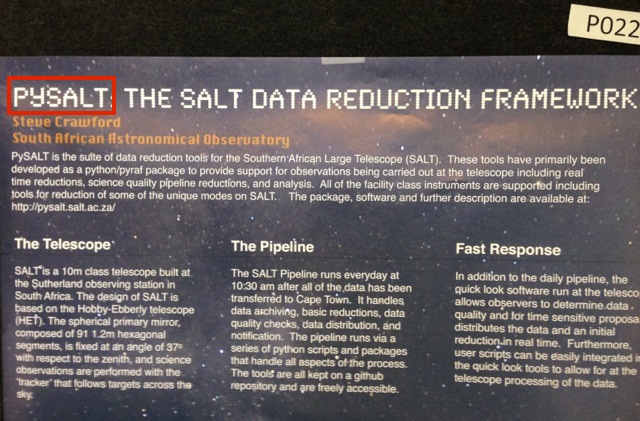
PySALT [ascl:1207.010]

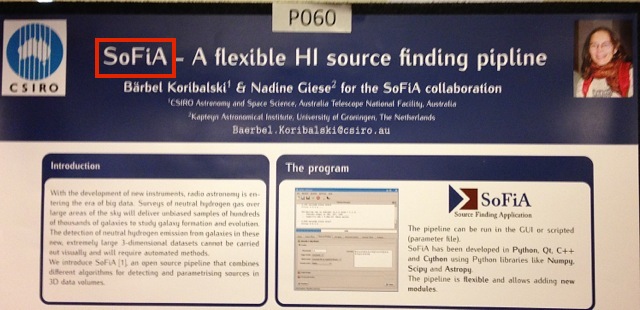
SoFiA [ascl:1412.001]

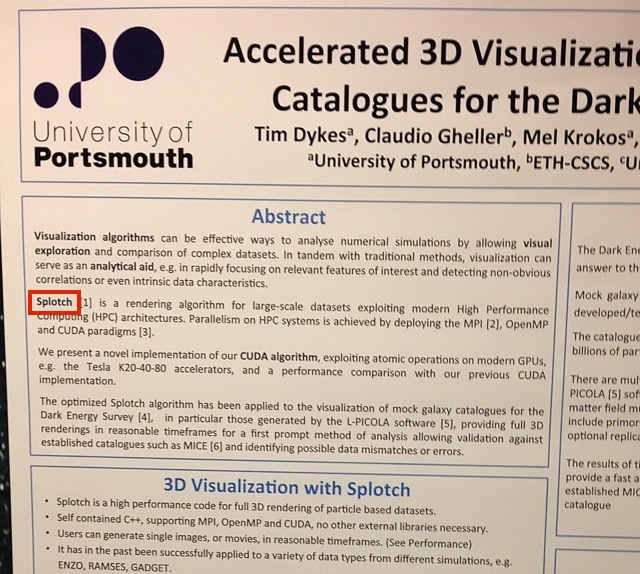
Splotch [ascl: 1103.005]

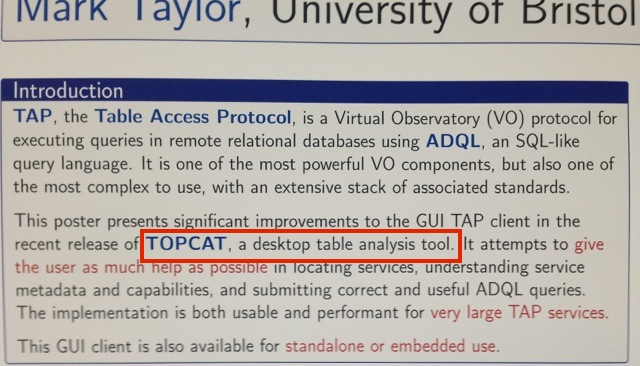
TOPCAT [ascl:1101.010]

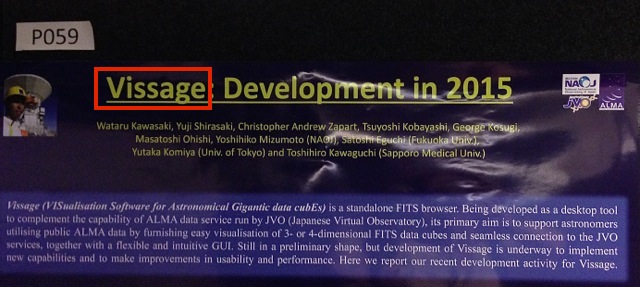
Vissage [ascl:1402.001]

It's lovely to see ADASS folks I've met before, and lovely to see codes I already know. It's also great to meet new people and run across new codes, and I'll be highlighting some of the new codes added as a result of this ADASS in a future blog post.
-
The ASCL has organized a Birds of a Feather session (BoF) at ADASS to discuss improving software citation and credit to be held on Tuesday, October 27; the following links may be helpful for the discussion.
Astronomy-specific
Astronomy software citation examples and ideas (working [Google] document arising from AAS SPSIG discussion)Astronomy software indexing workshop
Cross-disciplinary
Workshop on Sustainable Software for Science: Practice and Experiences (WSSSPE)
Force11 Software Citation Working Group (Mission statement, member list, timeline, communications plan, etc. on GitHub)Center for Open Science's Transparency and Openness Promotion (TOP) Guidelines
Google doc created during the BoF session; anyone with the link can comment.
-
 The Astrophysics Source Code Library, started in 1999, moved to a new infrastructure in 2014 with enhancements developed in response to feedback from users and publishers. With one-click author search, flexible browsing options, and a simple form-based submission process, the ASCL offers a better experience for users. Since the introduction of the new platform in mid-2014, users have submitted nearly 100 codes, more than in all previous years combined. Data sharing options, including the ability to pull all of the resource’s public data in JSON and XML, provide new ways to collaborate with the resource. The ASCL now houses information on more than 1000 codes and its entries are increasingly used for citation, with over 15% of its entries cited, up from 7.5% in January of last year. Exciting opportunities to collaborate have been presented to the ASCL, including participation in the 2nd Workshop on Sustainable Software for Science: Practice and Experiences and a request from the AAS to form a special interest group on software publishing. This presentation will demonstrate the new capabilities of the ASCL and discuss its growth and recent outreach and collaborations.
Alice Allen, Astrophysics Source Code Library; G. Bruce Berriman, Infrared Processing and Analysis Center, California Institute of Technology; Kimberly DuPrie, Space Telescope Science Institute/Astrophysics Source Code Library; Jessica Mink, Harvard-Smithsonian Center for Astrophysics; Robert Nemiroff, Michigan Technological University; Judy Schmidt, Astrophysics Source Code Library; Lior Shamir, Lawrence Technological University; Keith Shortridge, Australian Astronomical Observatory; Mark Taylor, University of Bristol; Peter Teuben, Astronomy Department, University of Maryland; John Wallin, Middle Tennessee State University
-
Already it's shaping up to be a software maven's dream AAS meeting, with workshops and Special Sessions focused on expanding your software skills and a Hack Day to put them to use! We'll have a comprehensive listing closer to the meeting date, but here are the activities already on the schedule, with more to come!
Introduction to Software Carpentry 2 Day Workshop
Astrostatistics and R
Using Python for Astronomical Data Analysis
SciCoder Presents: Developing Larger Software Projects
Bayesian Methods in Astronomy: Hands-on Statistics
Tools and Tips for Better Software (aka Pain Reduction for Code Authors)
Lectures in AstroStatistics
Hack Day -
On Thursday, June 25, I attended part of the 3rd annual DC/MD/VA Summer Astrophysics Meeting; duties elsewhere prevented me from attending the whole event, alas. This meeting, which rotates among the sponsoring universities, was held this year at the Catholic University of America in Washington, DC, and is intended for senior undergraduates and graduate students to network, present their work, and facilitate interaction among local institutions. At least ten area universities were represented at the event.
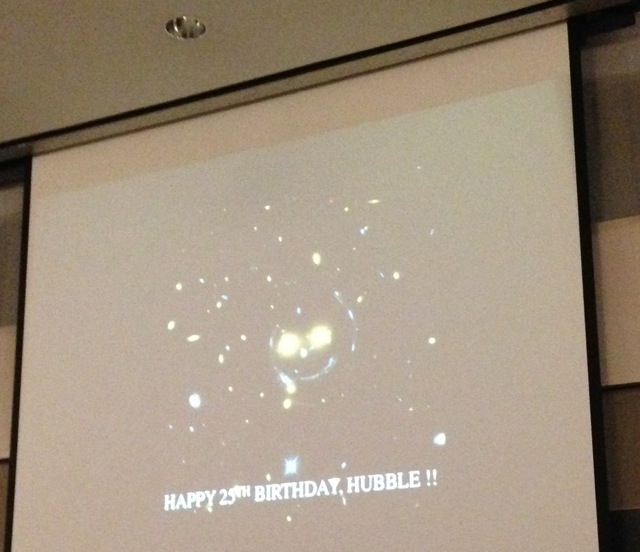
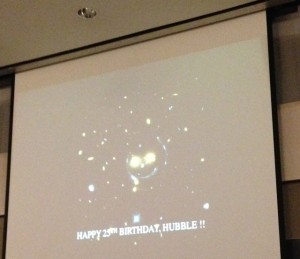 I arrived in plenty of time to hear keynote speaker Dr. Jennifer Wiseman's excellent presentation The Hubble Space Telescope: 25 Years of Science and Discovery; it is always a pleasure to hear her speak.
Next on the agenda were Jeremy Hare from George Washington University, who presented Unveiling the nature of high energy sources using machine learning and Joel Coley from the University of Maryland, Baltimore County, with Probing the long-term variability and eclipsing properties of high-mass X-ray binaries. After a short break, the program continued with a presentation on The science of WFIRST: Gravitational microlensing, the galactic bulge, and the transit method, this originally to be presented by Kathryn Waychoff of Dartmouth College and NASA Goddard Space Flight Center, but given in her absence instead by three of GSFC undergraduate summer interns
whose names I unfortunately did not catch* Nyki Anderson, Emily Kilen, and Sean Terry; they did an amazing job. (I kept thinking, "These are summer interns?!?!" They really knew their stuff!) My presentation on the ASCL was the last of the day. Only a few people present had heard of the ASCL before this meeting; I was happy for the opportunity to bring the ASCL to this audience. My talk covered what the ASCL is, why it exists, and how it has grown and is used by the community; my PowerPoint presentation (with speaker notes) is available for download.
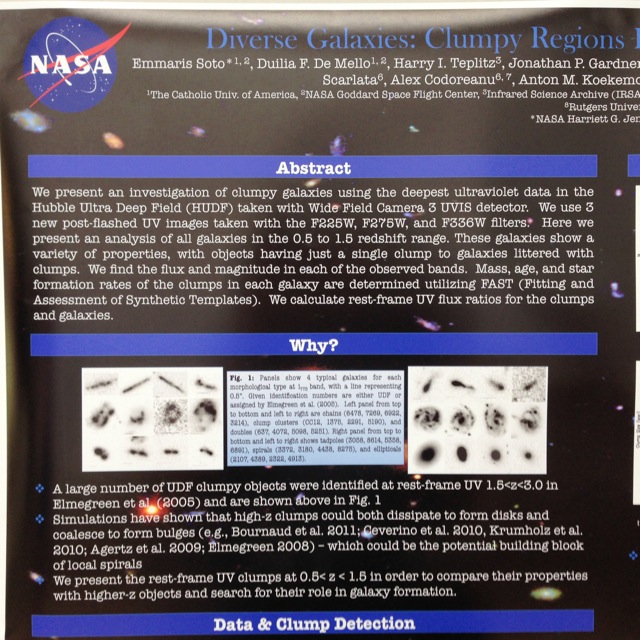
In addition to Thursday afternoon's presentations, I got a chance to peruse posters and talk with some of the poster presenters. I'm so pleased I could participate, and wish only that I had been able to attend all of it! The future of astrophysics is in good hands. Kudos to the organizers and participants for such an excellent event.
*My thanks to Sean for filling in the blanks for me!