ASCL News
-
I'll be representing the ASCL at next month's WSSSPE4 meeting in Manchester, and in October, the ASCL will be at ADASS XXVI and will hold an Advisory Committee (AC) meeting while there. Peter Teuben, chair of the ASCL AC, will moderate a Birds of a Feather session at ADASS on Implementing Ideas for Improving Software Citation and Credit; this is a follow-up on the discussion at last year's BoF Improving Software Citation and Credit, with a goal of taking action on some of the ideas generated at last year's BoF. Watch this space in October for more!
For January's American Astronomy Society meeting in Texas, the Moore-Sloan Data Science Environment at NYU and the ASCL have organized another Special Session, Perspectives in Research Software. This will follow the format of previous sessions, with presentations in the first half of the session and discussion open to all for the second half. Bruce Berriman from the Infrared Processing and Analysis Center at Caltech will moderate; the presenters include Ivelina Momcheva (Space Telescope Science Institute), Tracy Teal (Data Carpentry), Lior Shamir (Lawrence Technological University), and Michael Hucka (Caltech). I'm rationally exuberant about this session!
-
The day started with a quick discussion about the afternoon; it is traditional for Schloss Dagstuhl seminars that Wednesday afternoons involve a social activity. It was determined on Tuesday that the activity was to be a hike some distance away from Dagstuhl with dinner after in another town, but several changes to these plans had to be ironed out and announced. After a few minutes spent on that, the morning session got underway and was furiously fast! This was an Open Mic, with participants having signed up while here to give short talks (ten minutes or less).
First up was Daniel Garijo on Software Metadata: Describing “dark software” in Geosciences. By "dark software," he means that which is often hidden from view. He described the current state of the art for software description in geosciences and demonstrated Ontosoft.org, a semantic registry for scientific software, which currently includes information from several geosciences resources. As Ontosoft is not domain-specific, it has the capacity to expand into other fields as well. This is a very attractive and capable site. It uses a distributed approach to software registries and depends on crowdsourcing for metadata maintenance. The resource organizes software metadata using the OntoSoft ontology along six dimensions: identify software, understand and assess software, execute software, get support for the software, do research with the software, and update the software. Slideshare
Jurgen Vinju was next with Organising a research team around the research software around the research team in software engineering: Motivation, experiences, lessons. He talked about his experiences as the group leader of the SWAT (Software Analysis and Transformation) team at Centrum Wiskunde and Informatica (CWI), the national research institute for math and computer science in the Netherlands.
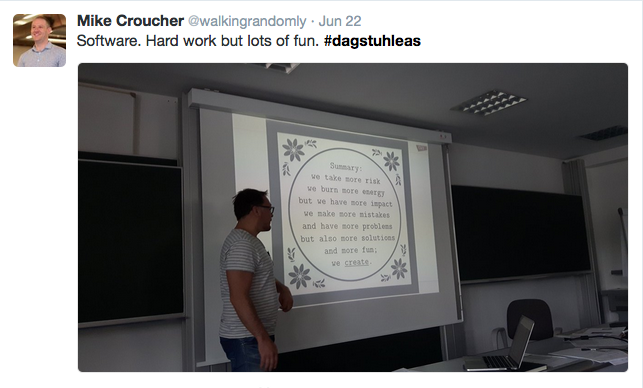 SWAT is all about the source code and supporting programmers to create more efficient, maintainable software. They work to understand and control software complexity to enable more and better tools. He made the point that research teams "prioritise for academic output which is not software." He showed UseTheSource, a resource developed by CWI with contributions from other institutes and housing open-source projects related to software language engineering and metaprogramming. This allows more efficient programming by automating tasks that are cumbersome or hard, and allows synergies between software engineers, researchers, and industry. PDF

Dan Katz gave an overview of work done by the Force11 Software Citation Working Group; his presentation was titled Software Citation: Principles, Discussion, and Metadata. He provided
 rationales for citing software, information on the WSSSPE and Force11 groups involved in developing software citation principles and the process used to develop them, and then the six principles, which focus on the importance of software, the need to credit and attribute the contributions software makes to research and to be able to uniquely identify software in a persistent and specific way, and that citations should enable access to the software and associated information about the software that informs its use. Katz brought up many of the discussions the WSSSPE and Force11 working groups had and their determinations, such as what software to cite, how to uniquely identify software, that peer-review of software is important but not required for citation, and how publishers can help.
 Each of the Open Mic sessions generated immediate discussion during the sessions and while the next presenter was setting up, and this session was no exception. When Katz pointed out that a common practice is to publish and cite papers about software (“software papers”), but that the Importance principle of the Force11 Working Group calls for the citation of the software itself, "on the same basis as any other research product", this was countered with a comment that people should cite software papers if the software authors have requested that method of citation. Katz stated that could be done in addition to citing to the software, as one of his slides stated. The presentation concluded with information on the next steps for the Force11 Software Citation Working Group -- to finalize the principles, and publish and circulate them for endorsement -- and the likelihood of a Software Citation Implementation Group being formed to work with institutions, researchers, publishers, and other interested parties to put the principles into practice. PDF
 The fourth Open Mic talk was by Katerena Kuksenok on Best Practices (by any other name). This interesting talk looked at
 intersections of the technical, social, and cognitive aspects of software engineering in research, and asked how the available community and skill resources could be leveraged. brought together various elements brought up through the workshop so far, including different roles that had been identified, the need for software engineers to learn from scientists just as we hope researchers learn software engineering practices,
  and overcoming communications barriers. She referred back to a comment Mike Croucher had made in his talk on Monday, agreeing that software engineers should "do CS/SE with people not at them!" PowerPoint
After Kuksenok's talk, I presented Restoring reproducibility: Making scientist software discoverable. This presentation was a quick overview of the ASCL, its history and a few of the changes to our infrastructure, the lessons we learned from
 looking at what other astro code registries and repositories had done and what we did with those lessons, and some of the impact we have on the community. As with every other session, there was intermittent discussion, questions asked and answered, and conversation on the topic as I headed back to my chair and the next speaker set up. PowerPoint PDF
Robert Haines was up next with A Short* History of Research Software Engineers in the UK (*and probably incomplete). Before there were Research Software Engineers (RSE), there were RSEs going by other names, such as Post Doc and Research Assistant. These were the people in the lab who could code, and
 fell "foul of publish or perish" because they were writing code rather than papers. RSEs might also have been hiding as those working in high performance computing or as a research group admin. He is an example of someone who has always done RSE work, though was not called an RSE until fairly recently. It was at a Software Sustainability Institute Collaborations Workshop in 2012 that there was a call to arm to recognize the
  contributions of those who write code rather than papers and are not purely researchers. They decided they needed a name, to unionize, and a policy campaign. He described the current environment, both the challenges and the positives, and shared that many people want to work in this field. Yes, discussion broke out in this session, too! It was remarkable how engaged everyone at the workshop was, and how often and easily discussion took place. PDF
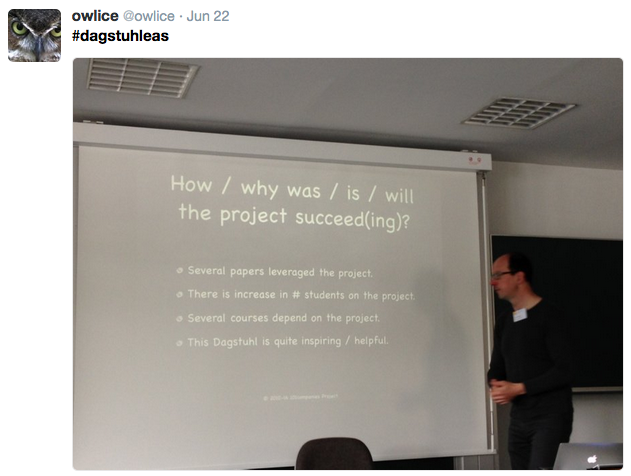 Dan Katz made a very brief presentation and instigated more discussion on career paths when Robert Haines was finished, then after a brief coffee break, the morning Open Mic session continued with Ralf Lämmel's presentation intriguingly called Making a failing project succeed?! about the 101Companies project. He called 101Companies a software chrestomathy, from chresto, meaning "useful" and mathein, meaning "to learn." He shared other chrestomathies, such as the Hello World Collection and the Evolution of a Haskell programmer. (One of the previous links will lead you to a song about a popular beverage.) 101Companies is a resource for learning
  more about software, for comparing technologies, for programming education, and can serve as "a playground for student projects." He discussed some of the challenges the project is having and some of the ways in which it is succeeding. PDF
The last Open Mic talk of the morning was by Ashish Gehani giving a quick overview of his work on software, including software to make data more manageable, particularly the
The last agenda item for the morning was to discuss the manifesto that is one of the required
 outputs for this workshop. This discussion was led by James Howison, who shared the link for the Google Doc that was to become the manifesto, and which was discussed and created in tandem (and wild abandon) by many in the room du
 ring the time remaining before lunch. The manifesto is our public declaration, our own call to action. Our work is only beginning at Schloss Dagstuhl; we must put what we have discussed here into practice. We shared other manifestos (manifesti!), determined authorship as opt-in (by adding our names to the author list), and talked about but did not determine where this might be published. I found the creation of this document interesting and inspiring, very much in line with the philosophy of "be the change you want to see in the world."

After getting a good start on the manifesto, we broke for a longer than usual lunch period, after which some took a long hike with a lakeside stop for a refreshing beverage, and some did other things. I took a much-needed nap and then noodled around for a bit in the music room,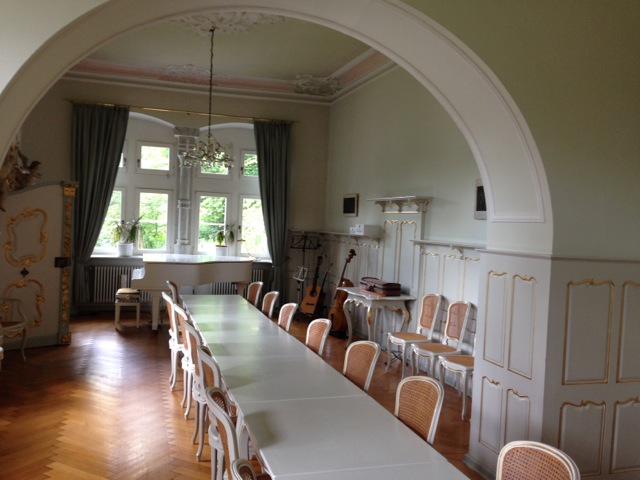 a lovely large, long room with wonderful acoustics and a recently-tuned grand piano, two guitars, a cello, and a violin available. (I discovered later in the week that the violin case also holds a kazoo.)
 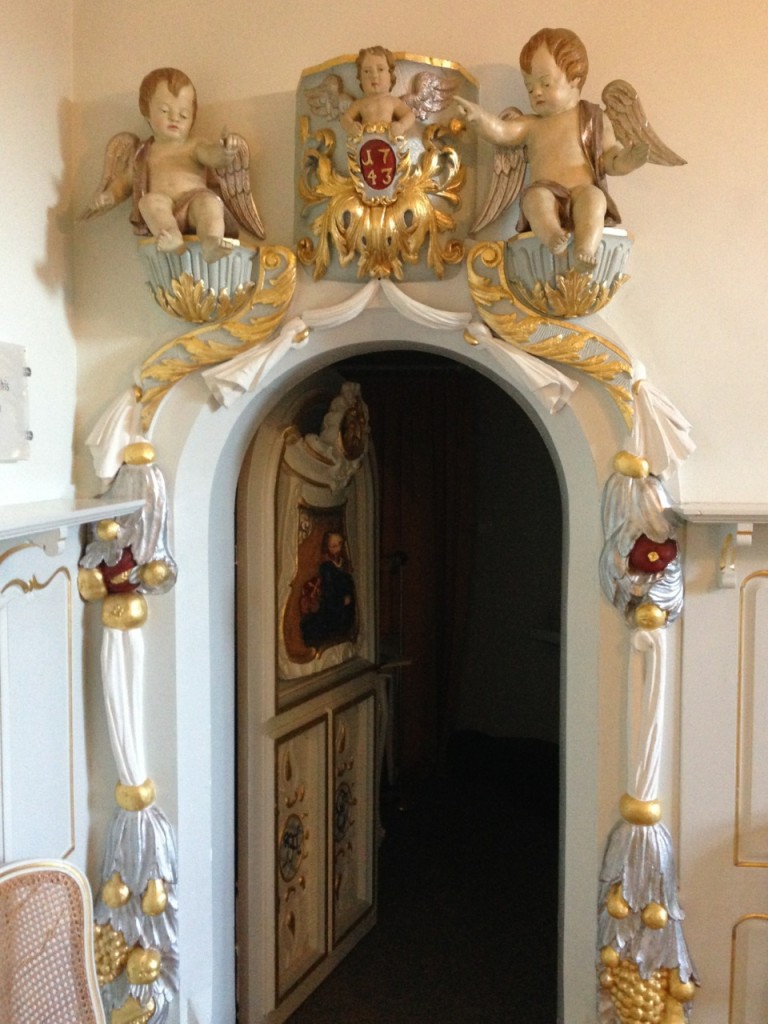 Scores for solo and ensemble music are stocked in a room at one end of the music room, the (small) door to which is watched over by cherubs. Most of the Schloss is modern in appearance; this is one of the few rooms that reveals the building's history. I found plenty of music to amuse myself with, including a collection of Bach preludes and fugues from the WTC apparently edited by Bartók and in what to me was a confusing order, and Beethoven sonatas that at one time I knew how to butcher. Others reported having taken shorter walks than the one that was organized, listening to podcasts, trying out the bicycles available for guests, and also napping.
As you have likely surmised by now, the Twitter hashtag for this event was
#dagstuhleas, and the Twitter feed offers more pictures and information about this workshop. -
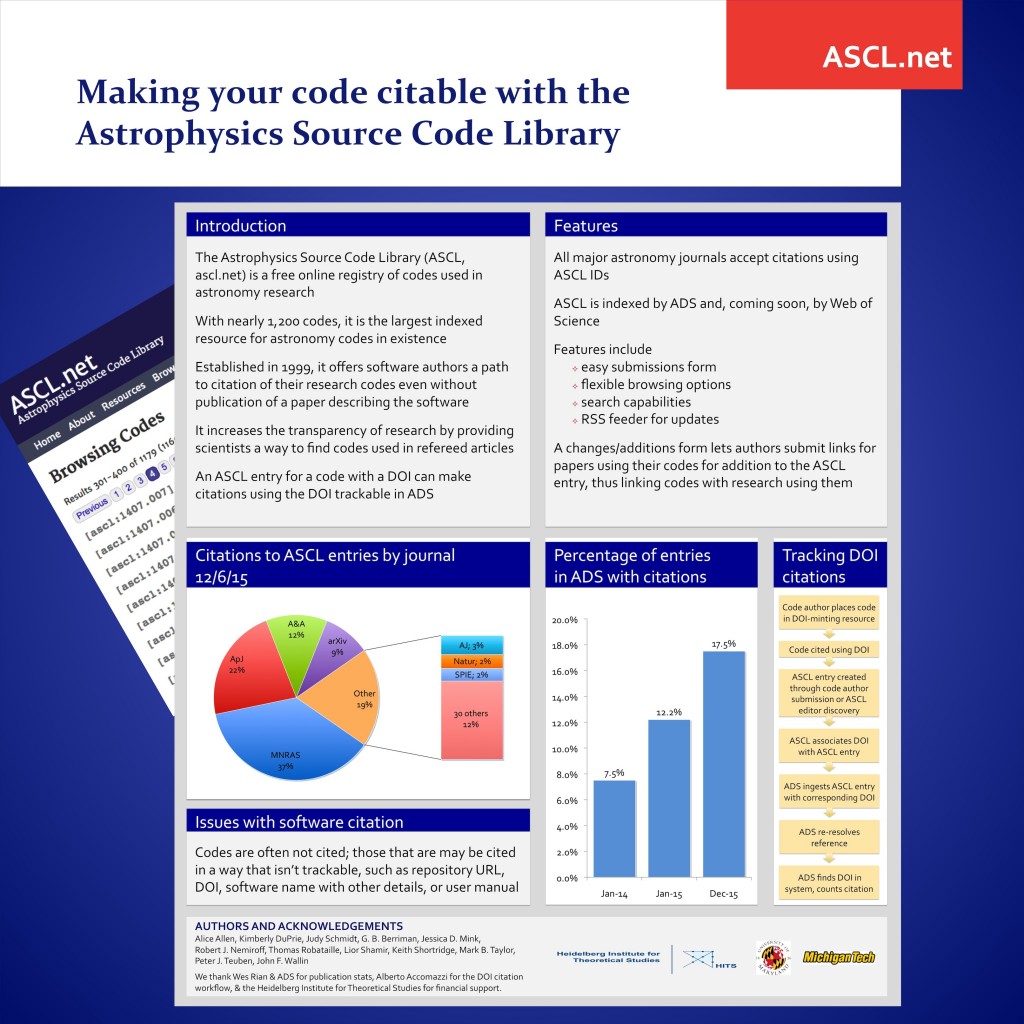
The Astrophysics Source Code Library (ASCL, ascl.net) is a free online registry of codes used in astronomy research. With nearly 1,200 codes, it is the largest indexed resource for astronomy codes in existence. Established in 1999, it offers software authors a path to citation of their research codes even without publication of a paper describing the software, and offers scientists a way to find codes used in refereed publications, thus improving the transparency of the research. Citations using ASCL IDs are accepted by major astronomy journals and if formatted properly are tracked by ADS and other indexing services. The number of citations to ASCL entries increased sharply from 110 citations in January 2014 to 456 citations in September 2015. The percentage of code entries in ASCL that were cited at least once rose from 7.5% in January 2014 to 17.4% in September 2015. The ASCL’s mid-2014 infrastructure upgrade added an easy entry submission form, more flexible browsing, search capabilities, and an RSS feeder for updates. A Changes/Additions form added this past fall lets authors submit links for papers that use their codes for addition to the ASCL entry even if those papers don’t formally cite the codes, thus increasing the transparency of that research and capturing the value of their software to the community.
-
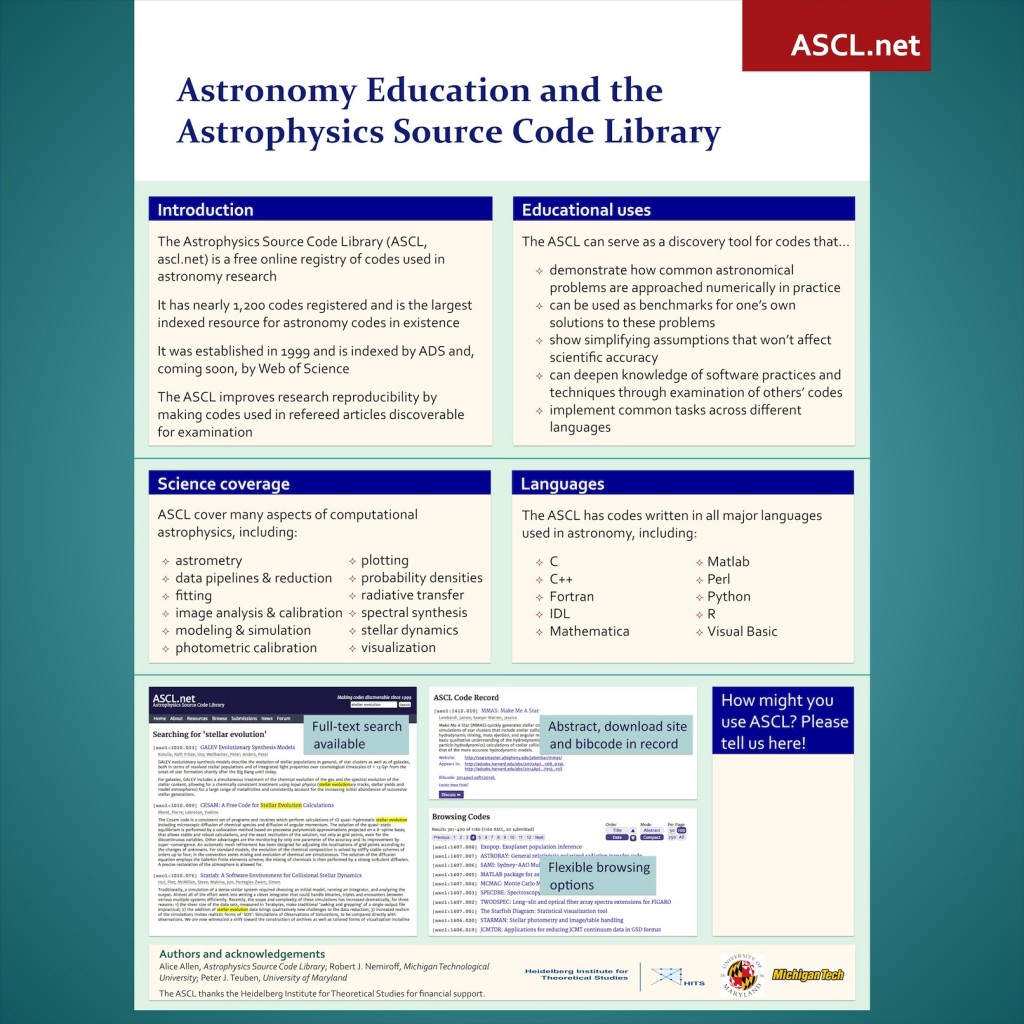
The Astrophysics Source Code Library (ASCL) is an online registry of source codes used in refereed astrophysics research. It currently lists nearly 1,200 codes and covers all aspects of computational astrophysics. How can this resource be of use to educators and to the graduate students they mentor? The ASCL serves as a discovery tool for codes that can be used for one’s own research. Graduate students can also investigate existing codes to see how common astronomical problems are approached numerically in practice, and use these codes as benchmarks for their own solutions to these problems. Further, they can deepen their knowledge of software practices and techniques through examination of others’ codes.
-
Posters! Sessions! Meetings! The upcoming AAS meeting in Kissimmee, Florida is shaping up to be the busiest ever! Here are the formal meeting activities the ASCL is participating in.
Special Session: Tools and Tips for Better Software (aka Pain Reduction for Code Authors)
Tuesday, January 05, 2:00 PM - 3:30 PM; Sanibel
Organizers: Astrophysics Source Code Library (ASCL)/Moore-Sloan Data Science Environment at NYUResearch in astronomy is increasingly dependent on software methods and astronomers are increasingly called upon to write, collaborate on, release, and archive research quality software, but how can these be more easily accomplished? Building on comments and questions from previous AAS special sessions, this session, organized by the Astrophysics Source Code Library (ASCL) and the Moore-Sloan Data Science Environment at NYU, explores methods for improving software by using available tools and best practices to ease the burden and increase the reward of doing so. With version control software such as git and svn and companion online sites such as GitHub and Bitbucket, documentation generators such as Doxygen and Sphinx, and Travis CI, Intern, and Jenkins available to aid in testing software, it is now far easier to write, document and test code. Presentations cover best practices, tools, and tips for managing the life cycle of software, testing software and creating documentation, managing releases, and easing software production and sharing. After the presentations, the floor will be open for discussion and questions.
The topics and panelists are:
Source code management with version control software, Kenza S. Arraki
Software testing, Adrian M. Price-Whelan
The importance of documenting code, and how you might make yourself do it, Erik J. Tollerud
Best practices for code release, G. Bruce Berriman
Community building and its impact on sustainable scientific software, Matthew Turk
What to do with a dead research code, Robert J. Nemiroff
Poster 247.07: Astronomy education and the Astrophysics Source Code Library
Wednesday, January 06, Exhibit Hall AThe Astrophysics Source Code Library (ASCL) is an online registry of source codes used in refereed astrophysics research. It currently lists nearly 1,200 codes and covers all aspects of computational astrophysics. How can this resource be of use to educators and to the graduate students they mentor? The ASCL serves as a discovery tool for codes that can be used for one’s own research. Graduate students can also investigate existing codes to see how common astronomical problems are approached numerically in practice, and use these codes as benchmarks for their own solutions to these problems. Further, they can deepen their knowledge of software practices and techniques through examination of others’ codes.
Poster 348.01: Making your code citable with the Astrophysics Source Code Library
Thursday, January 07, Exhibit Hall AThe Astrophysics Source Code Library (ASCL, ascl.net) is a free online registry of codes used in astronomy research. With nearly 1,200 codes, it is the largest indexed resource for astronomy codes in existence. Established in 1999, it offers software authors a path to citation of their research codes even without publication of a paper describing the software, and offers scientists a way to find codes used in refereed publications, thus improving the transparency of the research. Citations using ASCL IDs are accepted by major astronomy journals and if formatted properly are tracked by ADS and other indexing services. The number of citations to ASCL entries increased sharply from 110 citations in January 2014 to 456 citations in September 2015. The percentage of code entries in ASCL that were cited at least once rose from 7.5% in January 2014 to 17.4% in September 2015. The ASCL’s mid-2014 infrastructure upgrade added an easy entry submission form, more flexible browsing, search capabilities, and an RSS feeder for updates. A Changes/Additions form added this past fall lets authors submit links for papers that use their codes for addition to the ASCL entry even if those papers don’t formally cite the codes, thus increasing the transparency of that research and capturing the value of their software to the community.
-
As promised in a previous post, here is the list of software activities at the upcoming January AAS meeting in Kissimmee; I hope to add a Software Publishing Special Interest Group meeting to the list, but other than that, the list should be complete. If I missed anything that should be here, please (please!) let me know. Thank you, and see you there!
SUNDAY, JANUARY 03, 2016
Introduction to Software Carpentry 2 Day Workshop (day 1 of 2)
Organizer: Software Carpentry
9:00 AM - 5:30 PM; St. George 106 (Gaylord Palms Resort and Convention Center)
MONDAY, JANUARY 04, 2016
Introduction to Software Carpentry 2 Day Workshop (day 2 of 2)
Organizer: Software Carpentry
8:00 AM - 5:30 PM; St. George 106 (Gaylord Palms Resort and Convention Center)Astrostatistics and R
Organizer: Eric D. Feigelson (Penn State University) and two assistants
9:00 AM - 6:00 PM; Emerald 8 (Gaylord Palms Resort and Convention Center)Using Python for Astronomical Data Analysis
Organizer: Perry Greenfield
9:00 AM - 4:30 PM; St. George 114 (Gaylord Palms Resort and Convention Center)SciCoder Presents: Developing Larger Software Projects
Organizer: Demitri Muna
10:00 AM - 6:00 PM; Emerald 6 (Gaylord Palms Resort and Convention Center)Bayesian Methods in Astronomy: Hands-on Statistics
Organizer: Jake VanderPlas (U. Washington) and two assistants
1:00 PM - 6:00 PM; Emerald 2 (Gaylord Palms Resort and Convention Center)
TUESDAY, JANUARY 05, 2016
Tools and Tips for Better Software (aka Pain Reduction for Code Authors)
Organizers: Astrophysics Source Code Library (ASCL)/Moore-Sloan Data Science Environment at NYU
2:00 PM - 3:30 PM; Sanibel (Gaylord Palms Resort and Convention Center)
WEDNESDAY, JANUARY 06, 2016
Lectures in AstroStatistics
10:00 AM - 11:30 AM; Osceola 5 (Gaylord Palms Resort and Convention Center)Extrasolar Planet Atmospheres: BART Atmospheric Modelling Code and Applications
10:00 AM - 10:10 AM; 212.01. A Random Walk on WASP-12b with the Bayesian Atmospheric Radiative Transfer (BART) Code
Presenter: Joseph Harrington10:10 AM - 10:20 AM; 212.02. Bayesian Atmospheric Radiative Transfer (BART) Code and Application to WASP-43b
Presenter: Jasmina BlecicTopics in Astrostatistics
1:30 PM - 3:30 PM; St. George 106 (Gaylord Palms Resort and Convention Center)AGN, QSO, Blazars Poster Session
243.46 Time-dependent Photoionization of Gaseous Nebulae: TD_XSTAR Code
Presenter: Ehab E. Elhoussieny243.37. Bayesian and Profile Likelihood Approaches to Time Delay Estimation for Stochastic Time Series of Gravitationally Lensed Quasars
Presenter: Hyungsuk TakMajors and Graduate Student Education and Professional Development Poster Session
247.07 Astronomy education and the Astrophysics Source Code Library
Presenter: Alice Allen
THURSDAY, JANUARY 07, 2016
Catalogs, Surveys, and Data Viewing
2:00 PM - 2:10 PM; 324.01. Introducing Nightlight: A New, Modern FITS Viewer
Presenter: Demitri Muna
Tampa (Gaylord Palms Resort and Convention Center)2:10 PM - 2:20 PM; 324.02. Synthesizing Understanding from Data with yt
Presenter: Matthew Turk
Tampa (Gaylord Palms Resort and Convention Center)Cosmological Simulations of Galaxies
3:00 PM - 3:10 PM; 316.05. The Non-parametric Concentration of Dark Matter Halos in Cosmological N-body Simulations
Presenter: Meagan Lang
Sun A (Gaylord Palms Resort and Convention Center)3:10 PM - 3:20 PM; 316.06. The Scylla Multi-Code Comparison Project
Presenter: Ariyeh Maller
Sun A (Gaylord Palms Resort and Convention Center)348. Computation, Data Handling, Image Analysis Poster Session
Posters in other sections:
338.17. Simulating magnetospheres with numerical relativity: The GiRaFFE code
Presenter: Maria Babiuc-Hamilton342.05. Machine Learning and Cosmological Simulations
Presenter: Harshil Kamdar342.07. SurveySim: a new MCMC code to explore the evolution of the IR luminosity function
Presenter: Matteo Bonato
FRIDAY, JANUARY 08, 2016
Beyond the Academy: Showcasing Astronomy Alumni in Non-Academic Careers
413.01. Astronomers as Software Developers
Presenter: Rachel A. Pildis
10:00 AM - 10:25 AM; Osceola 4 (Gaylord Palms Resort and Convention Center)Hack Day
Organizer: Kelle Cruz (Hunter College/CUNY and AMNH)
10:00 AM - 5:00 PM; Tallahassee (Gaylord Palms Resort and Convention Center)
To participate in Hack Day, please register at http://www.astrobetter.com/wiki/AASHackDay. -
Already it's shaping up to be a software maven's dream AAS meeting, with workshops and Special Sessions focused on expanding your software skills and a Hack Day to put them to use! We'll have a comprehensive listing closer to the meeting date, but here are the activities already on the schedule, with more to come!
Introduction to Software Carpentry 2 Day Workshop
Astrostatistics and R
Using Python for Astronomical Data Analysis
SciCoder Presents: Developing Larger Software Projects
Bayesian Methods in Astronomy: Hands-on Statistics
Tools and Tips for Better Software (aka Pain Reduction for Code Authors)
Lectures in AstroStatistics
Hack Day -
On Thursday, June 25, I attended part of the 3rd annual DC/MD/VA Summer Astrophysics Meeting; duties elsewhere prevented me from attending the whole event, alas. This meeting, which rotates among the sponsoring universities, was held this year at the Catholic University of America in Washington, DC, and is intended for senior undergraduates and graduate students to network, present their work, and facilitate interaction among local institutions. At least ten area universities were represented at the event.
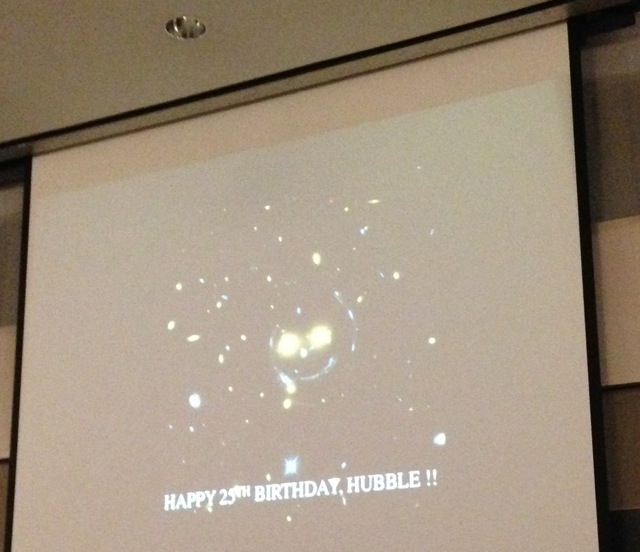
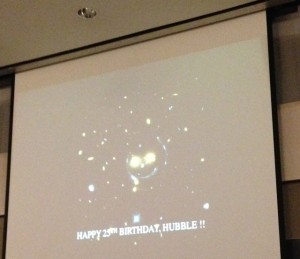 I arrived in plenty of time to hear keynote speaker Dr. Jennifer Wiseman's excellent presentation The Hubble Space Telescope: 25 Years of Science and Discovery; it is always a pleasure to hear her speak.
Next on the agenda were Jeremy Hare from George Washington University, who presented Unveiling the nature of high energy sources using machine learning and Joel Coley from the University of Maryland, Baltimore County, with Probing the long-term variability and eclipsing properties of high-mass X-ray binaries. After a short break, the program continued with a presentation on The science of WFIRST: Gravitational microlensing, the galactic bulge, and the transit method, this originally to be presented by Kathryn Waychoff of Dartmouth College and NASA Goddard Space Flight Center, but given in her absence instead by three of GSFC undergraduate summer interns
whose names I unfortunately did not catch* Nyki Anderson, Emily Kilen, and Sean Terry; they did an amazing job. (I kept thinking, "These are summer interns?!?!" They really knew their stuff!)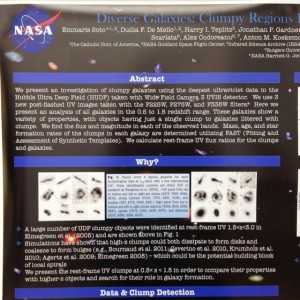 My presentation on the ASCL was the last of the day. Only a few people present had heard of the ASCL before this meeting; I was happy for the opportunity to bring the ASCL to this audience. My talk covered what the ASCL is, why it exists, and how it has grown and is used by the community; my PowerPoint presentation (with speaker notes) is available for download.
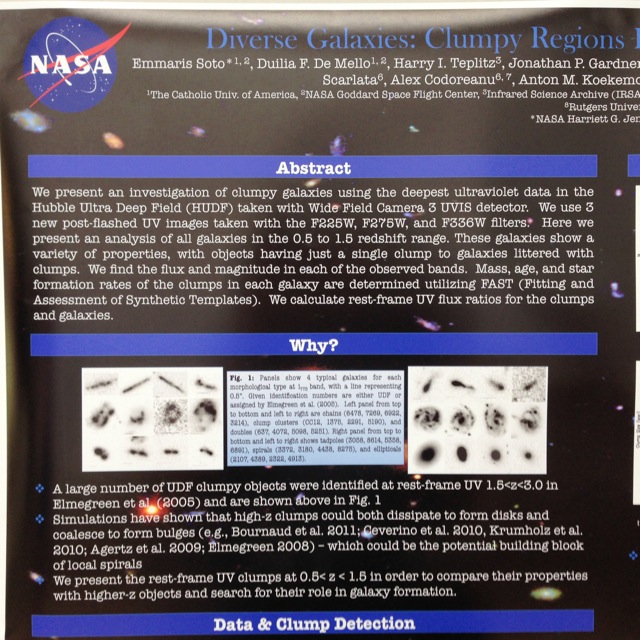
In addition to Thursday afternoon's presentations, I got a chance to peruse posters and talk with some of the poster presenters. I'm so pleased I could participate, and wish only that I had been able to attend all of it! The future of astrophysics is in good hands. Kudos to the organizers and participants for such an excellent event.
*My thanks to Sean for filling in the blanks for me!
-
On Thursday, February 12, I visited the National Institute of Standards and Technology (NIST) in Gaithersburg, MD on February 12 to present a seminar titled Restoring reproducibility: Making scientist software discoverable to the research reproducibility users' group there. Hosted by Chandler Becker and Robert Hanisch, I also had the opportunity to talk with Jim Warren before the presentation; he asked excellent questions during the Q&A, too. Bob and I have often discussed (even argued!) about the amount of metadata the ASCL should maintain, and Jim's questions were on this point.
After the presentation, I talked with Dan Wheeler, Kimberly Tryka, Andrea Medina-Smith, and Jonathan Guyer. Dan had excellent ideas for the ASCL; as we were standing by the conference room door, I didn't have the opportunity to write these down but I hope to continue the discussion via email. Kimberly, Andrea, and I talked about metadata, indexing software, and how the ASCL maintains its links to software download sites. We would like to create a way to exchange and share discussion with a larger community and have already started chatting about how to do this in email. Jonathan and I talked generally about the ASCL and how change can occur in a community. After that, Chandler took me to the NIST museum (so cool!) and Bob showed me around a bit before my departure. I had a very interesting and thoroughly enjoyable afternoon!
The abstract and PowerPoint file for my presentation are below; the notes in the slides provide most of the text of my talk, though sometimes simply as bullet points.
Abstract: Source codes are increasingly important for the advancement of science in general and astrophysics in particular. Journal articles meant to detail the general logic behind new results and ideas often do not make the source codes that generated these results available, decreasing the transparency and integrity of the research. The Astrophysics Source Code Library (ASCL) is a registry of scientist-written software used in astronomy research. The challenges of creating and growing the resource will be covered by its current editor, who will also discuss specific steps the ASCL has taken to improve code discovery in astronomy and the effect this work is having within astronomy and more broadly in other research areas.