ASCL News
-
The EWASS/NAM Software in Astronomy Symposium gets underway at 9:00 AM today in Room 11A of the Liverpool ACC. This six-session Symposium includes presentations on:
- Software engineering and sustainability, education for better software, and the ecosystem around Python in astronomy (Wednesday, 9:00 - 10:30 AM)
- Software publishing, impact, and credit (Wednesday, 2:30 - 4:00 PM)
- Software packages for research (Wednesday, 4:30 - 6:00 PM)
- Open and Transparent Data Services (Thursday, 9:00 - 10:30 AM)
- Machine Learning and Data Mining (Thursday, 2:30 - 4:00 PM)
The last session of the Symposium is a Software Publishing Special Interest Group meeting, and will take place on Thursday from 4:30 to 6:00 PM.
For more information on this session, including abstracts, check the interactive guide for Symposium S6a - S6f. See you there!
-
On Thursday, January 11, the Astrophysics Source Code Library (ASCL) and Astronomical Data Group at the Flatiron Institute organized a Special Session at the 231st AAS meeting in National Harbor, MD on Astronomy Software Publishing: Community Roles and Services, the sixth in a series of software-focused sessions that the ASCL, sometimes with others, has organized at AAS meetings.
 Peter Teuben from the University of Maryland and chair of the ASCL's Advisory Committee) opened the session with a few words about the use of software in research articles. He outlined the layout of the session. A talk by Matteo Cantiello set the scene on how we have reached the point where we are now. Four presentations by representatives from different journals presented their policies on software publication followed Cantiello's talk, and they were followed by presentations by representatives of others with roles in publishing software: the software author, the data editor, the ADS and the ASCL. The floor was then opened for discussion and Q&A. Teuben moderated the discussion, and at the end of it, turned the podium over to Robert Nemiroff from Michigan Technological University, and a founder of the ASCL, for a summary and closing remarks.
Presentations
Some of the main points from each presentation are summarized below; the titles of each are links to the slides used by the presenters.- The Evolution of Software Publication in Astronomy, Matteo Cantiello (Flatiron Institute)
Cantiello states that the complexity of astrophysics requires computationally intensive models, making astronomy a digital science, and that astronomers have a rich computational environment available, allowing them to easily version, share, and deploy astronomy software.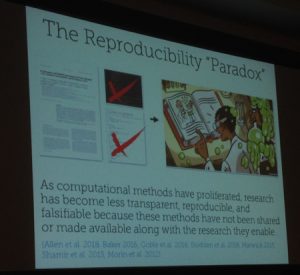 Despite this, software is often not shared, resulting in a reproducibility paradox: astronomers use computation to provide precise, accurate results, but research has become less transparent with the increase in the use of computational methods. Adding external links to papers to link to software is not a reliable solution to software sharing because of link rot. Formats have changed very little in the last 400 years; despite progress both technologically and socially, the format of papers is still largely the same. He stated that astronomy now has an opportunity to rethink scientific papers as research repositories, with executable objects containing narrative, figures, data, and code.
 - Software papers and citation in the AAS Journals, Chris Lintott (AAS Journals)
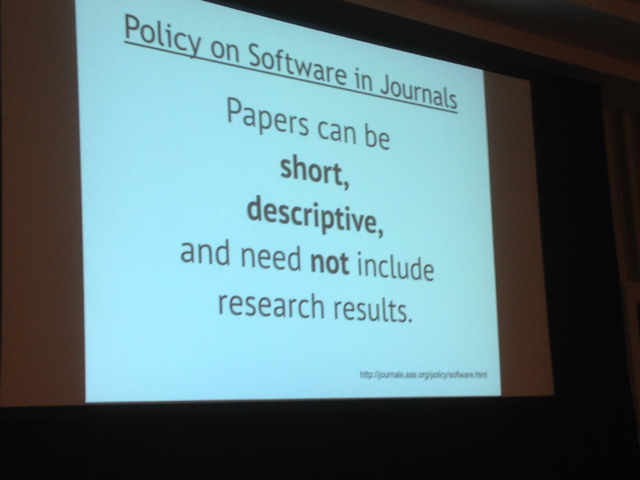
The AAS journals policy on software until recently was set in 1964, which stated that the “need for communication between astronomers interested in computation is already supplied by associations of users of automated computing machines.” The AAS journals changed their policies at the beginning of 2016, and recognized that if novel code is important to published research then it is likely appropriate to describe it in such a paper.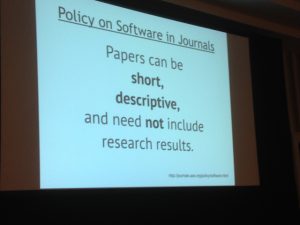 AAS journals are interested in disclosing software in a form that is currently recognized: the research article, so now allow short papers on code that can be short, descriptive, and do not need to include scientific results. AAS formally recommends open source licensing but does not require it. AAS journals ask people to cite the software paper, as this is the currency the field cares about and also ask people to cite the code. In addition, they request people use the \software{} tag to create a software section in a paper; this is similar to the \facilities{} tag already in use. AAS Publishing continues to think about how to improve, and are introducing the concept of ‘living’ papers, which can be updated with new sections and expanded author lists, so software authors don't need to publish a new paper to give credit to software authors who have contributed to a new version of the software. Lintott encouraged those interested in living papers to contact him.
 - Software policies and guidelines at Nature, Leslie J. Sage (Nature)
First, Sage explained the context in which Nature's policy is created: Nature is driven by biologists, who live in a very different world from astronomers. Unlike astronomers, biologists live in Windows world. Right now, two journals, Nature Methods and Nature Biotech, require code to be made available, and there are ongoing discussions about whether Nature should do this for other journals. There are formidable problems because of the issue of very specialized code, for example, code that is optimized to compile on a particular Beowulf cluster that may not compile anywhere else. There will be a call for public comment, and Sage hopes astronomers will provide input that is useful for astronomers within that context. Sage raised a number of points that warrant public discussion, such as a preference voiced by some to see detailed descriptions of the algorithms used rather than having the scripts published. Another point to consider for input is that though a lot of software has been made publicly available, all software is written with certain constraints and boundary conditions; some people not aware of these constraints and conditions may drive the software beyond those limits; this raises the question as to whether the results are physically meaningful. - SpringerNature data and software policies for astrophysics journals, Ramon Khanna (Springer)
Springer is encouraging authors to take care of transparency and reproducibility of their results presented in articles, allowing them to append relevant information on source code or the full code in an appendix of the paper; authors can also append the full code, or use other methods to provide this information, such as alternative repositories (e.g., CDS, ASCL, Figshare), and making this information available. They would like the full data and code available. Khanna acknowledged some challenges, including that authors are often not willing to share their software and/or data, editors are often not willing or at least not determined enough to execute policy, and citation standards are unclear. Questions arise as to how software can be peer reviewed; this would require standards for documentation, presenting how the results were obtained, making data and software available, and for reviewing the source code itself. How can referees handle this effort? Khanna pointed out that in a field as advanced as astronomy is, and already having some standards and domain resources such as archives, it’s not so much the publisher that should drive new standards, but the community itself.
 - Journal of Open Source Software (JOSS): Design and first-year review, Arfon M. Smith (STScI/JOSS)
Smith stated that he created JOSS accidentally, from frustration about the overhead of publishing papers about software, and acknowledged that software papers are a hack of the current system to provide a citable, creditable research object for software. JOSS (http://joss.theoj.org/) seeks to improve the quality of software; its peer review process is almost entirely about the software that’s submitted, and includes making sure the documentation is sufficiently fleshed out, that the package includes automated tests, and that the software has an open source license so can be reused. Smith said it should take about an hour to write a one-page paper for JOSS for those with a well set up repository for their code. The reviews are public on Github and accepted submissions appear on the JOSS site, which has published 200 papers online. - Lessons Learned through the Development and Publication of AstroImageJ, Karen Collins (Center for Astrophysics)
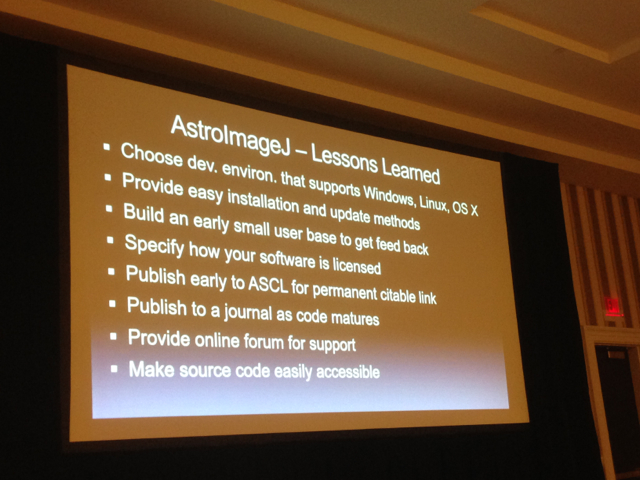
Collins discussed her experience with publishing her software AstroImageJ, a data reduction and image display interface with analysis capabilities specialized for time series differential photometry. She developed the code over several years to support her research. She initially had no intention of releasing the code to the public, but her collaborators saw her plots and graphs and asked to use the software, which was posted to the university's website to give team members access to it.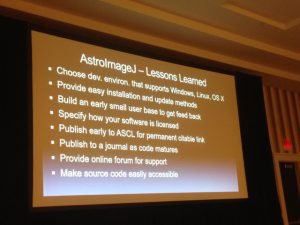 She found her fellow KELT-FUN team members were an excellent focus group; they provided great feedback on the software before it was published, enabling her to add useful features to the software. Results using AstroImageJ started appearing in journals; she registered the software with the ASCL to give it a citable reference, and as usage (and support tasks) grew, she and others working on the code decided to submit a paper to the Astronomical Journal (AJ) to provide good exposure to the potential userbase for the software. This resulted in about 4K downloads of the software in the first year, and the paper is listed 4th on AJ’s most read list. Among the lessons learned in publishing AstroImageJ are to specify how your code is licensed and how it should be cited, make the source code easily accessible, and provide easy way to install and update the software.
 - The roles of the AAS Journals’ Data Editors, August Muench (AAS Journals)
Muench covered the data editors' workflow for all submitted manuscripts. A quick review of 60%-90% of all submitted manuscripts is performed, with scripts run on the manuscripts to identify references to code by looking for such things as Github repositories to see whether their citations need to be reviewed. The editors make notes on the software, data, and figures for review by a scientific editor or the author with recommendations for improving citations for these research artifacts. A subset of accepted articles, 15-20%, undergo a more rigorous post-acceptance data review; this includes a review of tabular data, figures, and interactive elements in addition to software. If necessary, the data editors request that authors acquire DOIs or get preferred citati ons for the software used in the research. Muench mentioned that he uses ten keywords in his scripts to identify software, and ends up with a surprising number of articles that do not mention code at all. He stated that part of a data editor's role to improve software and data citation is educating authors.
 - The role of the ADS in software discovery and citation, Alberto Accomazzi (NASA Astrophysics Data System)
Accomazzi described what ADS does to promote software discovery and citation, but first he shared ADS's traditional core responsibilities: to discover content, typically science papers, related to astronomy. Some years ago, the capability to track citations was introduced. As the expectations of community have evolved, so have ADS's policies, moving from ingesting records about scientific papers to records about scholarly works, including data catalogs, observing proposals, and other artifacts such as software. They have also evolved from tracking citations to articles to citations to tracking citations to scholarly content.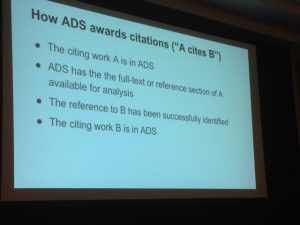 ADS has an interest in enabling linking so users can easily and uniquely identify the software that was used. Accomazzi covered how ADS ingestion works; for content to be considered for inclusion in ADS, it must be scholarly, related to astronomy, and published formally -- not just on a website, but following an explicit editorial process. He also discussed how citations are tracked and what ADS needs to count a citation, going through several examples of what does and does not work for citation. The bottom line for software is to cite it by using a formal citation and a unique identifier; a URL to a website or a DOI in a footnote are not captured as citations. ASCL, JOSS, and Zenodo are ways software can get a persistent identifier to use in a formal citation, and these citations can be tracked by ADS. Accomazzi also discussed how software may have several records in ADS, and that in the future, these records will be crosslinked, as will different versions of a software package so that eventually, ADS can provide cumulative metrics for all different versions of that software product, and like all citation data, this information will become publicly available through an API.
 - The Astrophysics Source Code Library: Supporting software publication and citation, Alice Allen (ASCL/UMD)
Allen gave a brief overview of what the ASCL is, and stated that though entries in this citable online registry usually point to a software package's download it, the ASCL can and does serve as a repository for those authors who want to deposit an archive file for their code. The ASCL assigns a DOI to software that it stores. She covered the three main reasons the ASCL exists: to make research more transparent, to improve communication about research computations, and to disseminate software of utility to others. Allen acknowledged that though there is software that might be useful to astronomy, the ASCL focuses on that which has been used in refereed research or submitted for refereeing, this to support the research record. ASCL editors take an active approach in looking for software in research papers and registering them; authors are encouraged to submit their own software, too, and submission by author increased 23% in 2017 over 2016. The ASCL supports software publication and citation in a number of ways, including providing a citation avenue for software and listing preferred citation information in ASCL entries. The ASCL has been online since 1999; it supports the Force11 software citation principles and was a party to developing them. It was also party to a Dagstuhl Manifesto, another cross-disciplinary effort that focused on steps members of a research community can take on their own. Among these steps is citing software properly -- in a trackable way -- and when reviewing a paper, ensuring that it cites the software used in the research.
Discussion
After the presentations, Teuben commented that he thought journals could do a better job in instructing referees about software, to identify when code is involved in research and insist on citations to it. He hoped the discussion would touch on this, and then opened the floor to all. Discussion was lively and may be covered in more depth in a future post, but some of the major points were:
- There's still fear about releasing software, still resistance to doing so
- Science is all about reproducibility; it’s not science if it’s not reproducible
- Who should push for greater openness is an open question, with some wanting journals to do this, and others feeling it's up to the astronomy community -- us! -- to enforce the standards we want
- Astronomers are often not trained in software engineering techniques; greater education in this area would be helpful

Teuben brought the discussion to an end and turned the floor over to Robert Nemiroff (Michigan Technological University), who briefly summarized the presentations and discussion and closed the session.
My thanks to David W. Hogg and Peter Teuben for work on developing the session, to Peter for his excellent moderating, to Robert for closing the session, and for PW Ryan for serving as scribe. My thanks to Matteo, Chris, Leslie, Ramon, Arfon, Karen, Gus, and Alberto for their excellent presentations and participation, to the Astronomical Data Group at the Flatiron Institute for partnering with the ASCL, and to the Heidelberg Institute for Theoretical Studies, the University of Maryland College Park, and Michigan Technological University for supporting the ASCL.
- The Evolution of Software Publication in Astronomy, Matteo Cantiello (Flatiron Institute)
-
THURSDAY, 11 JANUARY 2018
Special Session: Astronomy Software Publishing: Community Roles and Services
10:00 am – 11:30 am
National Harbor 2The Astrophysics Source Code Library (ASCL) and Astronomical Data Group at the Flatiron Institute organized a Special Session at the 231st AAS meeting in National Harbor, MD on Astronomy Software Publishing: Community Roles and Services. Click on a talk's title to download its slides.
Matteo Cantiello (Flatiron Institute), The Evolution of Software Publication in Astronomy
Chris Lintott (AAS Journals), Software papers and citation in the AAS Journals
Leslie J. Sage (Nature), Software policies and guidelines at Nature
Ramon Khanna (Springer), SpringerNature data and software policies for astrophysics journals
Arfon M. Smith (STScI/JOSS), Journal of Open Source Software (JOSS): Design and first-year review
Karen Collins (Center for Astrophysics), Lessons Learned through the Development and Publication of AstroImageJ
August Muench (AAS Journals), The roles of the AAS Journals' Data Editors
Alberto Accomazzi (NASA Astrophysics Data System), The role of the ADS in software discovery and citation
Alice Allen (ASCL/UMD), The Astrophysics Source Code Library: Supporting software publication and citation -
It's AAS meeting time, and that means a busy busy week! There are some of the ASCL's activities at this meeting; we hope to see you at our posters and in the Special Session!
Poster 150.10: The Astrophysics Source Code Library by the numbers
Tuesday, January 09, Prince Georges Exhibit HallAbstract: The Astrophysics Source Code Library (ASCL, ascl.net) was founded in 1999 by Robert Nemiroff and John Wallin. ASCL editors seek both new and old peer-reviewed papers that describe methods or experiments that involve the development or use of source code, and add entries for the found codes to the library. Software authors can submit their codes to the ASCL as well. This ensures a comprehensive listing covering a significant number of the astrophysics source codes used in peer-reviewed studies. The ASCL is indexed by both NASA’s Astrophysics Data System (ADS) and Web of Science, making software used in research more discoverable. This presentation covers the growth in the ASCL’s number of entries, the number of citations to its entries, and in which journals those citations appear. It also discusses what changes have been made to the ASCL recently, and what its plans are for the future.
Poster 150.28: Schroedinger’s code: Source code availability and transparency in astrophysics
Tuesday, January 09, Prince Georges Exhibit HallAbstract: Astronomers use software for their research, but how many of the codes they use are available as source code? We examined a sample of 166 papers from 2015 for clearly identified software use, then searched for source code for the software packages mentioned in these research papers. We categorized the software to indicate whether source code is available for download and whether there are restrictions to accessing it, and if source code was not available, whether some other form of the software, such as a binary, was. Over 40% of the source code for the software used in our sample was not available for download.
As URLs have often been used as proxy citations for software, we also extracted URLs from one journal’s 2015 research articles, removed those from certain long-term, reliable domains, and tested the remainder to determine what percentage of these URLs were still accessible in September and October, 2017.
Special Session: Astronomy Software Publishing: Community Roles and Services
Thursday, January 11, 10:00 AM - 11:30 AM; National Harbor 2
Organizers: Astrophysics Source Code Library (ASCL)/Astronomical Data Group at the Flatiron InstituteThe importance of software to astronomy research is well-established, and excellent arguments to reveal these computational methods to support the research record have been advanced and much discussed in recent years. But what avenues are open to software authors to publish their codes, and what roles and services exist in the community to support their efforts? This session, organized by the Astrophysics Source Code Library (ASCL) and Astronomical Data Group at the Flatiron Institute, answers that question. It builds on previous AAS special sessions and brings together a panel of experts to present on the various avenues for publishing codes and the pros and cons of these avenues, the roles of authors, data editors, and publication indexers in software publication, the benefits of publication to authors and the discipline, and efforts of related community projects to improve aspects of software publication. After the presentations, the floor will be open for discussion and questions.
The topics and panelists are:
Introductory remarks, Peter Teuben (University of Maryland)
The evolution of software publication in astronomy, Matteo Cantiello (Flatiron Institute, Center for Computational Astrophysics/Princeton University)
Software papers and citation in the AAS journals, Chris Lintott (AAS Journals/University of Oxford)
Software policies and guidelines at Nature, Leslie J. Sage (Physical Sciences, Nature)
SpringerNature data and software policies for astrophysics journals, Ramon Khanna (Astronomy, Springer)
Journal of Open Source Software (JOSS): design and first-year review, Arfon M. Smith (Space Telescope Science Institute)
Lessons learned through the development and publication of AstroImageJ, Karen Collins (Harvard-Smithsonian Center for Astrophysics)
The roles of the AAS Journals' Data Editors, August Muench (Journals Division, AAS)
The role of the ADS in software discovery and citation, Alberto Accomazzi (Smithsonian Astrophysical Observatory)
The Astrophysics Source Code Library: Supporting software publication and citation, Alice Allen (ASCL/University of Maryland)
Open discussion and Q&A, Moderated by Peter Teuben (University of Maryland)
Summary and closing remarks, Robert J. Nemiroff (Michigan Technological University) -
THURSDAY, 11 JANUARY 2018
Special Session: Astronomy Software Publishing: Community Roles and Services
10:00 am – 11:30 am
National Harbor 2The Astrophysics Source Code Library (ASCL) and Astronomical Data Group at the Flatiron Institute have organized a Special Session at January's AAS meeting. The session, Astronomy Software Publishing: Community Roles and Services, will be moderated by Peter Teuben (University of Maryland).
The importance of software to astronomy research is well-established, and excellent arguments to reveal these computational methods to support the research record have been advanced and much discussed in recent years. But what avenues are open to software authors to publish their codes, and what roles and services exist in the community to support their efforts? This session answers these questions. It builds on previous AAS special sessions and brings together a panel of experts to present various avenues for publishing codes and the pros and cons of these avenues, the roles of authors, data editors, and publication indexers in software publication, the benefits of publication to authors and the discipline, and efforts of related community projects to improve aspects of software publication. After the presentations, the floor will be open for discussion and questions. The presenters and topics covered are:
Matteo Cantiello (Flatiron Institute), The Evolution of Software Publication in Astronomy
Chris Lintott (AAS Journals), Software papers and citation in the AAS Journals
Leslie J. Sage (Nature), Software policies and guidelines at Nature
Ramon Khanna (Springer), SpringerNature data and software policies for astrophysics journals
Arfon M. Smith (STScI/JOSS), Journal of Open Source Software (JOSS): Design and first-year review
Karen Collins (Center for Astrophysics), Lessons Learned through the Development and Publication of AstroImageJ
August Muench (AAS Journals), The roles of the AAS Journals' Data Editors
Alberto Accomazzi (NASA Astrophysics Data System), The role of the ADS in software discovery and citation
Alice Allen (ASCL/UMD), The Astrophysics Source Code Library: Supporting software publication and citationAnd you, astro software authors and users, are as always important participants in the discussion. Please come with your questions, observations, and comments; I hope to see you there!
-
The annual meeting of the European Astronomical Society (EAS), the European Week of Astronomy and Space Science (EWASS), was held June 26-30 in beautiful Prague. As mentioned in a previous blog post, Abigail Stevens (U Amsterdam), Amruta Jaodand (ASTRON), Matteo Bachetti (INAF-Osservatorio Astronomico di Cagliari), Rein Warmels (ESO), and I organized a Special Session titled Developments and Practices in Astronomy Research Software. Special Sessions at EWASS can be from one to three 90-minute blocks; we organized three blocks, each with its own focus and all scheduled on Wednesday, June 28, which were:
Best practices for code development and management
Perspectives in research software
Astronomy software packages reviewThe first two sessions opened with review talks, then had a series of slightly shorter presentations, each with a particular focus. Each of these sessions concluded with a 30-minute period in which the floor was open to all to ask questions of the speakers and discuss the issues and information that had been shared during the 90 minutes. The third session offered talks on specific popular software packages and concluded with lightning talks on the software posters submitted to this Special Session. In addition to this series of talks, a Hack Together Day was organized collaboratively that offered more information on and assistance with installing and/or using many of the software packages presented.
Session titles and presenters for the software sessions that Abigail Stevens (U Amsterdam), Amruta Jaodand (ASTRON), Matteo Bachietti (INAF-Osservatorio Astronomico di Cagliari), Rein Warmels (ESO), and I organize are listed below, and if you want to read through the Storify of session tweets, compiled by Stevens as a Hack Together Day project, that’s here: https://storify.com/abigailstev/developments-and-practices-in-astronomy-research-s
Best practices for code development and management
Moderator: Rein Warmels, ESO, Germany
This session opened with a talk by Simon Portegies Zwart (Leiden University, NL), author of AMUSE and other astro codes, on Reproducible science in scientific computing. He laid the groundwork for this block of talks by presenting the difficulties of reproducibility in simulation software, the best practices his group uses, and the philosophy behind AMUSE, which includes standardizing interfaces and automating as much as possible. His talk included simulations that made for an extremely large presentation file, so a partial set of his slides is provided.
(slides: PDF)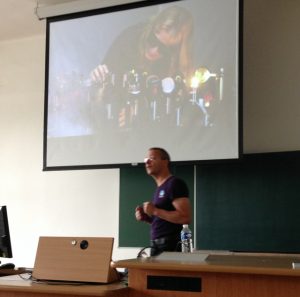
Simon Portegies Zwart In the interest of time, I will not summarize the other talks in this block, but will say you should have been there! These were excellent presentations with many great practices and ideas shared. In the discussion, moderated by Warmels, someone asked about "short codes," and as luck would have it, the next block had a talk on just that topic. There was disagreement on some voiced opinions, and many ideas shared that warrant greater discussion.
The other talks in this block were:
Software development best practices from Astropy
Thomas Robitaille, Freelance, UK (slides: PDF)A Computer Science Perspective on the Astronomy Research Software Process
John Wenskovitch, Virginia Tech & Allegheny College, US (slides: PDF)TARDIS: A radiative transfer code, an open source community, and an interdisciplinary collaboration
Wolfgang Kerzendorf, ESO, DE (slides: PDF)Research software best practices: Transparency, credit, and citation
Alice Allen, ASCL, US (slides: PDF, PPTX)
Perspectives in research software
Moderator: Alice Allen, ASCL, USA/
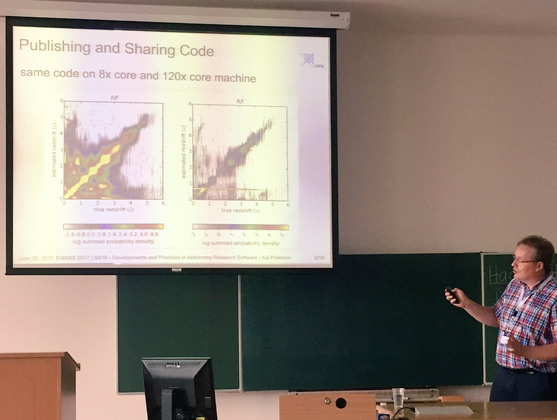
Kai Polsterer (Heidelberg Institute for Theoretical Studies, DE) set the stage for the second block in the Special Session with his presentation Reproducibility in Era of Data-Driven Science. He also highlighted the difficulties of reproducibility, among them that different computing environments can produce different results from the same code, and though he acknowledged the difficulties in doing so, advocates that publications, datasets (including raw and training data), codes, component and software configuration, and computing environments need to be shared for full reproducibility. Or as John Wenskovitch summarized in a tweet during this presentation, "Publish everything. EVERYTHING. Architecture, model, code, data, parameters, ..." We are not there yet, but must share what we can when we can to increase reproducibility.
(slides: PDF)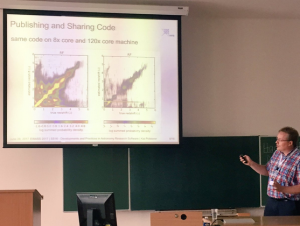
Kai Polsterer, image by @K_Bonson The other talks in this second of three blocks were:
Should short codes used for astronomy research be made public?
Robert Nemiroff, Michigan Technological University, US (slides: PDF, PPTX)Giving credit where credit is due: the role of ADS in discovering and citing software in scholarly publications
Sergi Blanco-Cuaresma, Harvard-Smithsonian Center for Astrophysics, US (slides: PDF)Fifteen years of WISE technology software development and operations
Gijs Verdoes Kleijn, University of Groningen, NL (slides: PDF)CDS reference services supporting astronomy research
Mark Allen, CDS, Observatoire Astronomique De Strasbourg, FR (slides: PDF)
Astronomy software packages review
Moderator: Amruta Jaodand, ASTRON, NL
The third block of talks in this Special Session presented software packages useful for software research, from the well-established AstroPy to, in the short poster presentations, newly-developed software such as SPARTAN. The talks in this 90-minute block were:The Astropy Project
Thomas Robitaille, Freelance, UK (slides: PDF)Stingray and Dave: Spectral timing for all
Matteo Bachetti, INAF-Osservatorio Astronomico di Cagliari, IT (slides: PDF)Living on the fringe: Making CASA ready for VLBI
Ilse van Bemmel, JIVE, NLInteractive widgets for the Jupyter notebook
Maarten Breddels, Kapteyn Astronomical Institute, NL (Jupyter notebook, ipywidgets demo (PDF), poster)Lightning poster talks
Again, you should have been there! One blog post cannot possibly convey everything shared in this Special Session, but the slides the presenters have shared captures some of the great goodness in these talks. My thanks to all the presenters, to my co-organizers, and to the attendees who made this session so interesting and excellent, to EWASS for accepting our proposals, and to HITS for providing the ASCL with funding that allowed us to participate.
-
The European Week of Astronomy and Space Science (EWASS) was held June 26-30 in Prague and attended by over 1,100 people, and the ASCL was there! This post is an overview of the ASCL's participation in the event; a subsequent post (or two) will provide more detailed information and links to slide decks for sessions the ASCL was involved in organizing.
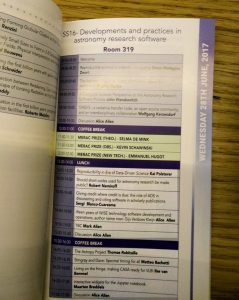
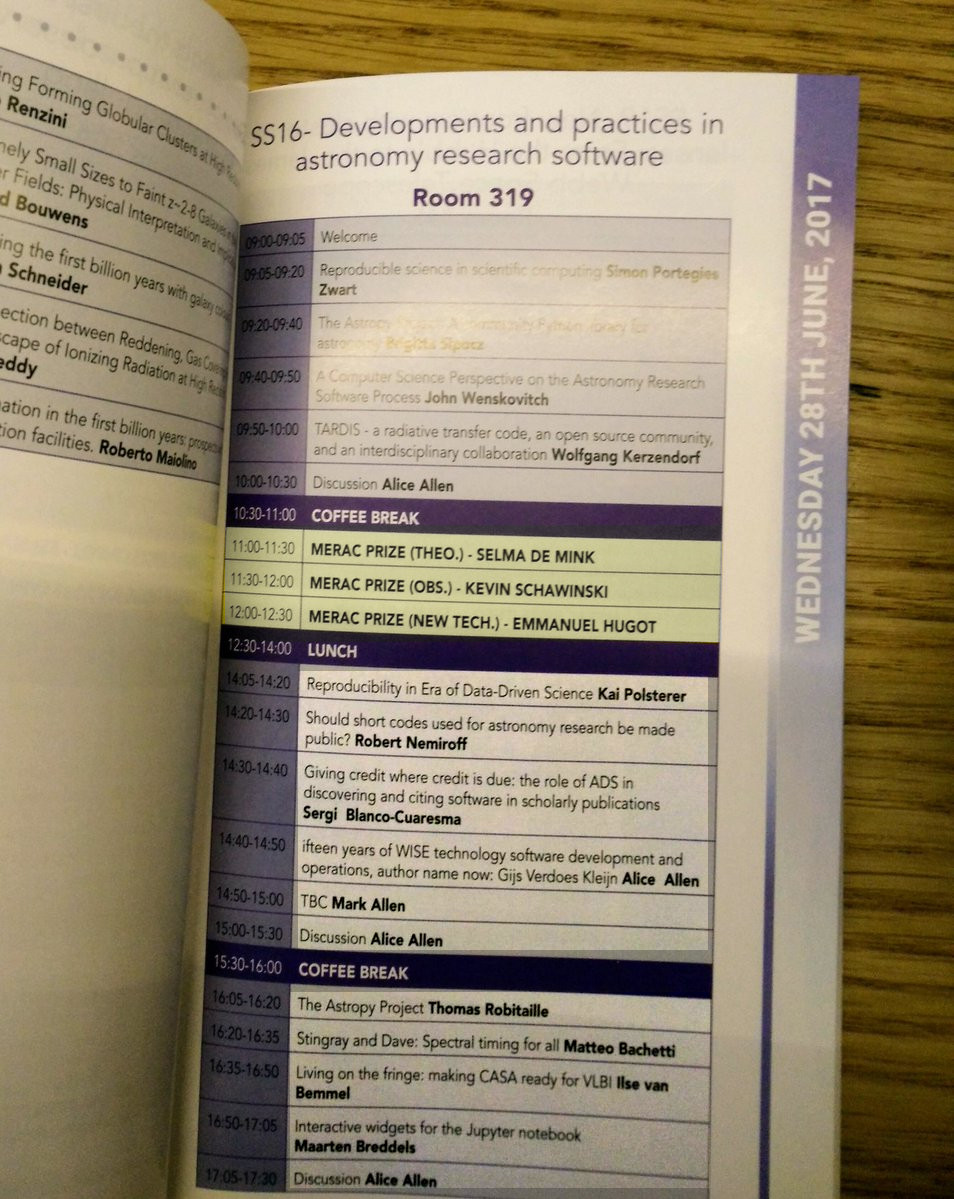
Program page for software talks
Image by Amruta JaodandThis was my first time attending EWASS, which was initially brought to my attention by Keith Smith (Science). It was also my first time in Prague. My activities since the meeting have included submitting proposals (with others) for EWASS 2018, which will be in Liverpool, and pricing short-term apartment rentals in Prague; clearly, I liked both the meeting and the city very much! My thanks to Keith for cluing me in to this fine meeting.
ASCL Advisory Committee member Rein Warmels (ESO) and I partnered with Abigail Stevens (U Amsterdam), Amruta Jaodand (ASTRON), and Matteo Bachetti (INAF-Osservatorio Astronomico di Cagliari) on software-related sessions for EWASS 2017; our collaboration resulted in a day of talks on Wednesday called Developments and Practices in Astronomy Research Software and a Hack Together Day on Thursday, this latter coordinated by Stevens, Jaodand, and Bachetti.
The ASCL was well represented, with ASCL co-founder Robert Nemiroff (MTU) giving a talk on short codes and Warmels and I each moderating 90-minute sessions on software, both with a discussion period; I also gave a presentation on the ASCL and participated in the Hack Together Day.
The Hack Together Day had numerous exciting projects; the ASCL's projects were less glamorous than most others but yielded really useful information, some of which has already been added to ASCL entries.
 Our collective efforts went very well, despite a few worrisome moments along the way. The room our Special Session presentations were in had 98 seats; perhaps 90% were filled for these sessions, and there were people also standing in the room. The presenters/presentations were great and the discussions were lively, and more information about these sessions will be posted soon.
There was of course much much more to EWASS than our efforts; notable for those software-inclined were the astrometry, big data, and astroinformatics sessions and associated posters for all of these sessions. In all, an excellent conference!
-
FRIDAY, 6 JANUARY 2017
Special Session: Perspectives in Research Software: Education, Funding, Reproducibility, Citation, and Impact
10:00 am – 11:30 am
Grapevine 2The Moore-Sloan Data Science Environment at NYU and the ASCL have organized a Special Session at January's AAS. The session, Perspectives in Research Software: Education, Funding, Reproducibility, Citation, and Impact, will be moderated by Bruce Berriman (IPAC, Caltech/Astronomy Computing Today). The session will feature short presentations and will include a discussion period with the floor open for questions and comments, and maybe even a few answers, too. The topics and presenters are :
Tracy Teal (Data Carpentry), Software not as a service
Michael Hucka (Caltech), Finding the right wheel when you don’t want to reinvent it
Lior Shamir (LTU), Reproducibility and reusability of scientific software
Ivelina Momcheva (STScI), Funding research software development
Heather Piwowar (ImpactStory), Capturing the impact of software
David W. Hogg (NYU), The relationships between software publications and software systems
Alice Allen (ASCL), Update on research software citation effortsThat last speaker looks a wee bit dodgy, but the moderator and other panelists are aces! And you, software authors and users, are as always important participants in the discussion. I hope to see you there!
-
On Tuesday, January 6, the ASCL, AAS Working Group on Astronomical Software (WGAS), and the Moore-Sloan Data Science Environment at NYU sponsored a special session on software licenses, with support from the AAS. This subject was suggested as a topic of interest in the Astrophysics Code Sharing II: The Sequel session at AAS 223.
Frossie Economou from the LSST and chair of the WGAS opened the session with a few words of welcome and stressed the importance of licensing. I gave a 90-second overview of the ASCL before turning the podium over to Alberto Accomazzi from NASA/Astronomy Data System (ADS), who introduced the panel of speakers and later moderated the open discussion (opening slides), after which Frossie again took the podium for some closing remarks. The panel of six speakers discussed different licenses and shared considerations that arise when choosing a license; they also covered institutional concerns about intellectual property, governmental restrictions on exporting codes, concerns about software beyond licensing, and information on how much software is licensed and characteristics of that software. The floor was then opened for discussion and questions.
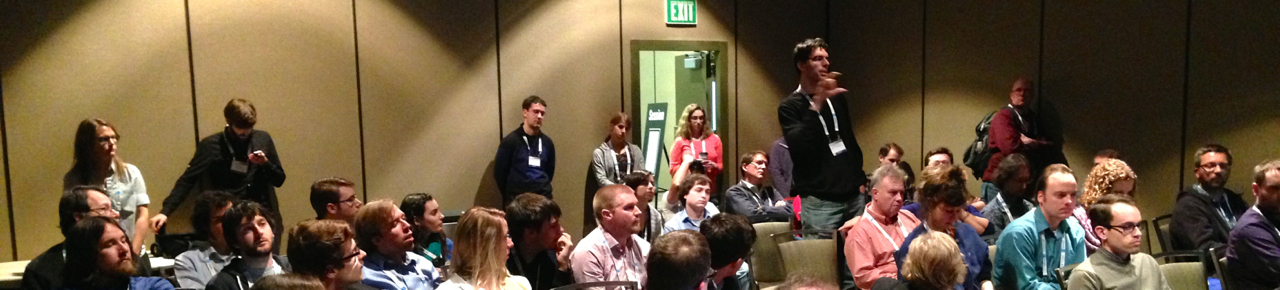
Discussion period moderated by Alberto Accomazzi Presentations
Some of the main points from each presentation are summarized below, with links to the slides used by the presenters.-
- Copy-left and Copy-right, Jacob VanderPlas (eScience institute, University of Washington)
Jake extolled everyone to always license codes, as in the US, copyright law defaults to "all privileges retained" unless otherwise specified. He pointed out that "free software" can refer to the freedoms that are available to users of the software. He covered the major differences between BSD/MIT-style "permissive" licensing and GPL "sticky" licensing while acknowledging that the difference between them can be a contentious issue.
slides (PDF)
- Copy-left and Copy-right, Jacob VanderPlas (eScience institute, University of Washington)
-
- University tech transfer perspective on software licensing, Laura L. Dorsey (Center for Commercialization, University of Washington)
Universities care about software licenses for a variety of reasons, Laura stated, which can include limiting the university's risk, respecting IP rights, complying with funding obligations, and retaining academic and research use rights. She also covered factors software authors may care about, among them receiving attribution, controlling the software, and making money. She reinforced the importance of licensing code and discussed the common components of a software license.
slides (PDF)
- University tech transfer perspective on software licensing, Laura L. Dorsey (Center for Commercialization, University of Washington)
-
- Relicensing the Montage Image Mosaic Engine, G. Bruce Berriman (Infrared Processing and Analysis Center, Caltech)
In last year's Astrophysics Code Sharing session, Bruce had discussed the limitations of the Caltech license under which the code Montage was licensed; since then, Montage has been relicensed to a BSD 3-Clause License. Following on the heels of Laura's discussion and serving as a case study for institutional concerns regarding software, Bruce related the reasons for and concerns about the relicensing, and discussed working with the appropriate office at Caltech to bring about this change.
slides (PDF)
- Relicensing the Montage Image Mosaic Engine, G. Bruce Berriman (Infrared Processing and Analysis Center, Caltech)
-
- Export Controls on Astrophysical Simulation Codes, Daniel Whalen (Institute for Theoretical Astrophysics, University of Heidelberg)
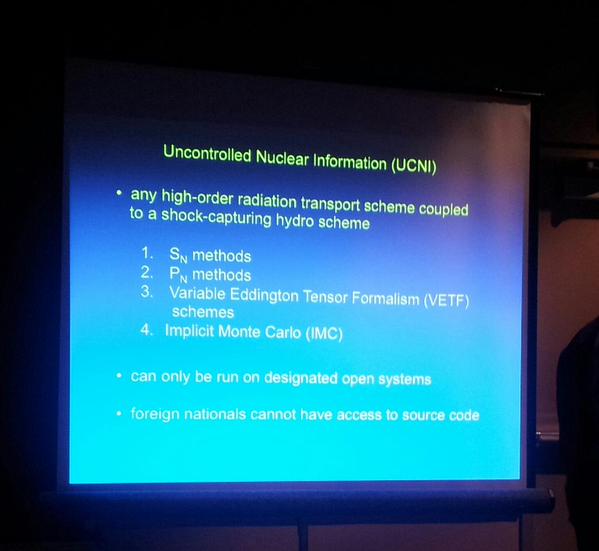
Restricted algorithms; image by Adam M. Jacobs Dan's presentation covered some of the government issues that arise from research codes, including why certain codes fall under export controls; a primary reason is to prevent the development of nuclear weapons.Dan also brought up how foreign intelligence agencies collect information and what specific simulations are restricted, and stated that Federal rules are changing, but slowly.
slides (PDF)
- Export Controls on Astrophysical Simulation Codes, Daniel Whalen (Institute for Theoretical Astrophysics, University of Heidelberg)
-
- Why licensing is just the first step, Arfon M. Smith (GitHub Inc.)
Arfon went beyond licensing in his presentation to discuss open source and open collaborations, and how GitHub delivers on a "theoretical promise of open source." He shared statistics on the growth of collaborative coding using GitHub, and demonstrated how a collaborative coding process can work and pointed out that through this exposed process, community knowledge is increased and shared. He challenged the audience to contemplate the many reasons for releasing a project and to ask themselves what kind of project they want to create.
slides (PDF)
- Why licensing is just the first step, Arfon M. Smith (GitHub Inc.)
-
- Licenses in the wild, Daniel Foreman-Mackey (New York University)
First, I have to note that Dan made it through 41 slides in just over the six minutes allotted for his talk, covering about seven slides/minute; I don't know whether to be more impressed with his presentation skills or the audience's information-intake abilities!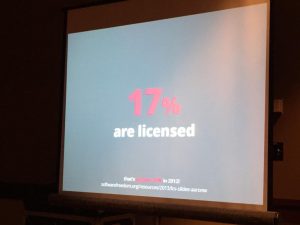
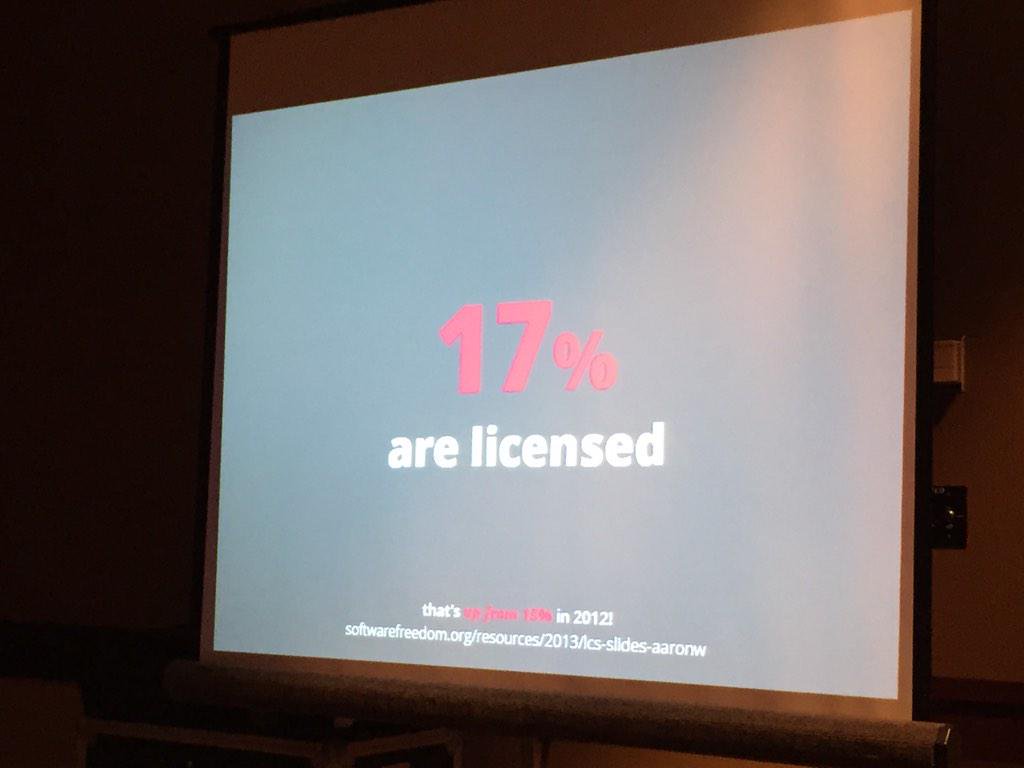
Percentage of licensed GitHub repos; image by Arfon Smith After declaring that he knows nothing about licensing, Dan showed us, and how, that he knows plenty about mining data and extracting information from it. From his "random" selection of 1.6 million GitHub repositories, he noted with some glee that 63 languages are more popular on GitHub than IDL is, the number of repositories with licenses have increased since 2012 to 17%, and that only 28,972 of the 1.6 million mentioned the license in the README file. Dan also determined the popularity of various licenses overall and by language and shared that information as well.
slides (PDF)
- Licenses in the wild, Daniel Foreman-Mackey (New York University)
Open Discussion
After Dan's presentation, Alberto Accomazzi opened the floor for discussion. Takeaway points included:- Discuss licensing with your institution; it's likely there is an office/personnel devoted to deal with these issues
- This office is likely very familiar with issues you bring to it, including who to refer you to when the issues are outside their purview
- "Friends don't let friends write their own licenses." IOW, select an existing license rather than writing your own
- License your code
- Let others know how you want your code cited/acknowledged
My thanks to David W. Hogg, Kelle Cruz, Matt Turk, and Peter Teuben for work -- which started last March! -- on developing the session, to Alberto for his excellent moderating and to Frossie for opening and closing it. My thanks also to the wonderful Jake, Laura, Bruce, Dan W, Arfon, and Dan F-M for presenting at this session, and to the Moore-Sloan Data Science Environment at NYU and AAS for their sponsorship.
Resources
Many resources on licensing, including excellent posts by Jake and Bruce, can be found here. -
-
The code sharing crowd took over the AAS Twitter feed, it seems, during the Special Session on code sharing at AAS 223. Bottom up is the best way to read these, as the most recent tweet is on the top, and please note they aren't strictly in order of occurrence and I likely missed some (there were so many!). I'm happy to add those I missed if someone tells me about them. Thanks to all those who tweeted throughout the session!
-
 ASCL
ASCL @asclnet 10 Jan
@#astroCodeShare folks here: http://asterisk.apod.com/viewtopic.php?f=35&t=21544 ….#aas223 -
 Lucianne Walkowicz
 @shaka_lulu 10 Jan
For those who were interested in the#astroCodeShare session: "Best Practices for Scientific Computing": http://www.plosbiology.org/article/info%3Adoi%2F10.1371%2Fjournal.pbio.1001745 …#aas223 -
 August Muench
 @augustmuench 7 Jan
Relevant to#astroCodeShare#aas223 RT@swcarpentry: Our 'Best Practices' Paper Has Been Published: http://software-carpentry.org/blog/2014/01/best-practices-has-been-published.html … -
 Nuria Lorente
 @NoTruerAlien 7 Jan
@@bruceberriman Absolutely, but NOT releasing code also comes at a price, which is often forgotten.#aas223#astroCodeShare -
 Zach Pace
 @zpacefromspace 7 Jan
Just got finished with an awesome breakout session at#aas223 on code sharing. The moral: your code may be crap, but release it anyway! -
Nuria Lorente
@NoTruerAlien 7 Jan
Morin et al: Informative paper on Sw licensing for Scientist-Programmer. MT@augustmuench: http://bit.ly/QlZKDP#astroCodeShare#aas223 -
 Chrissy Madison
 @cmmadiso 7 Jan
See. It happens! RT@bathompso: Pulling a@cmmadiso: my phone has 1% battery after the#astroCodeShare session.#AAS223 -
 Ben Thompson
 @bathompso 7 Jan
Pulling a@cmmadiso: my phone has 1% battery after the#astroCodeShare session.#AAS223 -
Lucianne Walkowicz
@shaka_lulu 7 Jan
Astronomical source code library: http://ascl.net#aas223#astroCodeShare -
 Adrian Price-Whelan
 @a_p_w 7 Jan
RE: writing quick/dirty code to get papers out. "Weeks of programming can save you hours of planning."#aas223
-
Lucianne Walkowicz
@shaka_lulu 7 Jan
Working group on astronomical software: http://aas.org/comms/working-group-astronomical-software-wgas …#aas223#astroCodeShare -
Lucianne Walkowicz
@shaka_lulu 7 Jan
Hanisch: there should also be a prize for software, esp since Webber prize is for hardware only#aas223#astroCodeShare -
August Muench
@augustmuench 7 Jan
.@AlexaVillaume note: that paper is for software. licensing of *data/papers* is distinct but VERY important thing.#aas223#astroCodeShare -
August Muench
@augustmuench 7 Jan
.@AlexaVillaume try this paper: http://bit.ly/QlZKDP#astroCodeShare#aas223 -
Lucianne Walkowicz
@shaka_lulu 7 Jan
Licensing: BSD or MIT and forget about it- but we should discuss it more as community -@davidwhogg#astroCodeShare#aas223 cc@jonmccann -
Lucianne Walkowicz
@shaka_lulu 7 Jan
@#astroCodeShare tag if someone else got it -
 Christopher Hanley
 @chanley 7 Jan
@#astroCodeShare -
August Muench
@augustmuench 7 Jan
so@aaccomazzi brings us back to licensing: unlicenced code is the WORST.@davidwhogg echos this point#aas223#astroCodeShare -
 Lia Corrales
 @eblur27 7 Jan
Hey#astroCodeShare, I still want to know how I should cite software I get through github. Could help with fluid contributor lists#aas223 -
Lucianne Walkowicz
@shaka_lulu 7 Jan
Something to be gleaned from size of room v attendance v perceived necessary size of room & how code is valued.#aas223#astroCodeShare -
 Ben Cook
 @bacook17 7 Jan
Reference in#aas223 code sharing session. http://wssspe.researchcomputing.org.uk  Kelle Cruz
 @kellecruz 7 Jan
#- Lucianne Walkowicz
@shaka_lulu 7 Jan
Comment in back: u make good science by making good investments- invest in quality code by encouraging code sharing#aas223#astroCodeShare - Kelle Cruz
@kellecruz 7 Jan
#  Alexa Villaume
 @AlexaVillaume 7 Jan
A mortifying story of a misplaced 2 in a program causing 8 years of research going down the drain. Share your code. It'll be ok.#aas223-
 Meredith Rawls
 @merrdiff 7 Jan
.@kellecruz If it's easy to share code & get credit, we'll do it. Reminds me of this: http://theoatmeal.com/comics/game_of_thrones …#aas223#astroCodeShare -
Lucianne Walkowicz
@shaka_lulu 7 Jan
There are more ppl in this room than were in the Kepler session I attended yesterday.#aas223#astroCodeShare -
August Muench
@augustmuench 7 Jan
@#astroCodeShare -
August Muench
@augustmuench 7 Jan
So@eteq is gonna drop the mic: papers have fixed author lists. software authorship if fluid and grows. Et tu, ADS?#astroCodeShare#aas223 -
Lucianne Walkowicz
@shaka_lulu 7 Jan
Reply: if it goes on arXiv you can never update contributor list, so subsequent contributors don't get credit#aas223#astroCodeShare -
Lucianne Walkowicz
@shaka_lulu 7 Jan
Prsa: would be great if announcement of code went up on arXiv (I think they often do as release papers, e.g. emcee)#aas223#astroCodeShare -
August Muench
@augustmuench 7 Jan
interesting point: Montage built under contract to NASA; astropy built by cats, hosted on a cat based website#astroCodeShare#aas223 -
Meredith Rawls
@merrdiff 7 Jan
Andrej Prsa implores everyone in#astroCodeShare session to post code on astro-ph every time you submit a paper.#aas223 -
Meredith Rawls
@merrdiff 7 Jan
My advisor has said not to "waste time" writing generalized code; contradicting this is troubling. Mixed messages.#aas223
#astroCodeShare -
Lucianne Walkowicz
@shaka_lulu 7 Jan
Cost to sharing: making code useable by anyone req more time than just making it work for you then publishing w it#aas223#astroCodeShare -
Meredith Rawls
@merrdiff 7 Jan
Recurring theme of how do I maximize research productivity and make my code useable for others? Not an easy Q.#AAS223#astroCodeShare -
Lucianne Walkowicz
@shaka_lulu 7 Jan
That is, proprietary data sometimes equates to leverage- there is prob some analogy in code community-@davidwhogg#aas223#astroCodeShare -
Lucianne Walkowicz
@shaka_lulu 7 Jan
panelists doubt ppl are being hired for a specific code as opposed to skill, but must be analogy w proprietary data#aas223#astroCodeShare -
Lucianne Walkowicz
@shaka_lulu 7 Jan
Q: how do we reward ppl in ways that don't req keeping code proprietary? As in, ppl get hired bc they have the code#aas223#astroCodeShare -
Lia Corrales
@eblur27 7 Jan
Sad I'm missing#astroCodeShare, but reports of a packed room and massive twitter coverage are letting me stay comfy in COS session#aas223 -
Lucianne Walkowicz
@shaka_lulu 7 Jan
Besides, every little thing you think no one else needs- *someone* will prob find it useful#aas223#astroCodeShare -
Lucianne Walkowicz
@shaka_lulu 7 Jan
A: do what you need, if no one else needs it then that's fine, you haven't made anyone's life worse -@davidwhogg#aas223#astroCodeShare -
Lucianne Walkowicz
@shaka_lulu 7 Jan
Q: what's the balance bt needing to make code work for yourself vs making it useful for everyone always?#aas223#astroCodeShare -
Lucianne Walkowicz
@shaka_lulu 7 Jan
Comment in back: u make good science by making good investments- invest in quality code by encouraging code sharing#aas223#astroCodeShare -
Lucianne Walkowicz
@shaka_lulu 7 Jan
Katz: not really, unlikely beyond a few years' horizon at a time#aas223#astroCodeShare -
Lucianne Walkowicz
@shaka_lulu 7 Jan
No long term stewardship of code like there is for results (i.e. pubs)- does NSF have plans for that? -@davidwhogg#aas223#astroCodeShare -
Ben Thompson
@bathompso 7 Jan
.@kellecruz starting off the#astroCodeShare question session strong. Why no AAS reps here?#AAS223 -
Lucianne Walkowicz
@shaka_lulu 7 Jan
Do you use other people's codes? Do you modify them or use them as is?#astroCodeShare#aas223 - Lucianne Walkowicz
@shaka_lulu 7 JanDo you share code? If not, why not?#astroCodeShare#aas223 -
Lucianne Walkowicz
@shaka_lulu 7 Jan
Benefits: perceived priority on work, visibility & good will, citations, bug-catching, and moral high ground - DWH#astroCodeShare#aas223 - Alexa Villaume
@AlexaVillaume 7 Jan
Releasing code establishes priority and good will. Benefit from bug catching. Also, you get to be smug.#aas223  Laura Watkins
 @laurawatkins_ 7 Jan
@#aas223 Ian Paul Freeley
 @ianpaulfreeley 7 Jan
If your not embarrassed by your code/website, you launched too late--Hogg#aas223-
Ben Thompson
@bathompso 7 Jan
If you’re not embarrassed by your code, you’re releasing it too late#AAS223#astroCodeShare - Meredith Rawls
@merrdiff 7 Jan
.@davidwhogg debunks cons to code sharing. Only real cost is email & support requests. He knows of NO example of being scooped.#aas223 -
August Muench
@augustmuench 7 Jan
hogg: "if you're not embarrassed by the code/website you put out there then you put it out there too late." so good.#astroCodeShare#aas223 -
Lucianne Walkowicz
@shaka_lulu 7 Jan
Cost: embarrassment! You know your code is crap, but if yr not embarrassed you released too late. -@davidwhogg#aas223#astroCodeShare -
Lucianne Walkowicz
@shaka_lulu 7 Jan
Costs: getting scooped?@davidwhogg knows of no cases of scooping caused by *release of code*#astroCodeShare#aas223 -
Lucianne Walkowicz
@shaka_lulu 7 Jan
All papers, grant writing, etc - not just code - are developed out in the open since 2005. -@davidwhogg#astroCodeShare#aas223 -
 Matthew Turk
 @powersoffour 7 Jan
@#astroCodeShare -
Lucianne Walkowicz
@shaka_lulu 7 Jan
And boom,@davidwhogg right on time. Also, who mic'd him?#astroCodeShare#aas223 -
Laura Watkins
@laurawatkins_ 7 Jan
+1 MT@augustmuench "and this fact terrifies me because we have no idea collectively what sharing should look like.#astroCodeShare#aas223” -
August Muench
@augustmuench 7 Jan
and this fact terrifies me because education -- we have no idea collectively what sharing should look like.#astroCodeShare#aas223 -
August Muench
@augustmuench 7 Jan
Who enforces software/data sharing in astronomy? YOU DO! WE DO! PEER REVIEW DOES! not nsf/nasa.#aas223#astroCodeShare -
Lucianne Walkowicz
@shaka_lulu 7 Jan
Its UP TO YOU to include good data management plan as part of panel reviews. The community must enforce importance.#aas223#astroCodeShare -
Lucianne Walkowicz
@shaka_lulu 7 Jan
Data management plans in NSF proposals are required to detail how results/data/software will be shared. - Katz#astroCodeShare#aas223 -
Lucianne Walkowicz
@shaka_lulu 7 Jan
NSF policy for sharing research results: supposed to share not only the data and the results but the software#astroCodeShare#aas223 -
Lucianne Walkowicz
@shaka_lulu 7 Jan
NSF does include "products" in addtn to pubs in bio sketches, but could be better abt following up on code release#AAS223#astroCodeShare -
Lucianne Walkowicz
@shaka_lulu 7 Jan
Do we have policies that mandate code release in conjunction w publication or receipt of fed funds?#aas223#astroCodeShare
-
August Muench
@augustmuench 7 Jan
Software that enables all this new software: Github, Travis, Sphinx, Jenkins.#aas223#astroCodeShare - August Muench
@augustmuench 7 Jan
Agreed. RT@kellecruz: .@augustmuench we need to make data/code sharing requirements part of AAS journal policy. those two things.#aas223 -
Ben Thompson
@bathompso 7 Jan
Testing code is an important part of code sharing.#aas224 session?#AAS223 - Kelle Cruz
@kellecruz 7 Jan
.@augustmuench we need to make data/code sharing requirements part of AAS journal policy. those two things.#aas223 -
Lucianne Walkowicz
@shaka_lulu 7 Jan
If you build it, they will code - Tollerud#aas223#astroCodeShare -
Lucianne Walkowicz
@shaka_lulu 7 Jan
Need infrastructure, a few software ppl to do housekeeping, let scientists do whatev & set expectations - Tollerud#astroCodeShare#aas223 -
Lucianne Walkowicz
@shaka_lulu 7 Jan
Most ppl who have contributed code to AstroPY have never met each other - all via@github - Tollerud#astroCodeShare#aas223 -
Ben Thompson
@bathompso 7 Jan
Almost 60 people (who have not met) have all worked together to build@astropy#astroCodeShare#AAS223 -
Lucianne Walkowicz
@shaka_lulu 7 Jan
AstroPY: a python library for and by astronomers, developed by self-herding astronomers since 2011 - Tollerud#astroCodeShare#aas223 -
August Muench
@augustmuench 7 Jan
I hoping that we see some cool diffs between the@astropy and montage *support* networks in the open discussion in#astroCodeShare#aas223 -
August Muench
@augustmuench 7 Jan
.@merrdiff "research objects" is I think the new age terminology.#aas223#astroCodeShare -
 David Morrison
 @drmorr0 7 Jan
@#astroCodeShare -
-
Lucianne Walkowicz
@shaka_lulu 7 Jan
I have used this exact cat herding graphic in Erik Tollerud's talk in an LSST talk hehe#aas223#astroCodeShare -
August Muench
@augustmuench 7 Jan
the@astropy project -- cat herding software development from@eteq at#astroCodeShare#aas223 -
Ian Paul Freeley
@ianpaulfreeley 7 Jan
Damn it--tweets from code sharing session sounded cool, but I got here late and now crowd out the door.#aas223 -
 Alex Parker
 @Alex_Parker 7 Jan
I'm nodding so vigorously at the#astroCodeShare tweets that I might need to ice my neck later. -
 Dr Chris Tibbs
 @chris_tibbs 7 Jan
Love the fact that my timeline is currently full of great tweets about code sharing and EPO#aas223- Kelle Cruz
@kellecruz 7 Jan
##interesting -
Alexa Villaume
@AlexaVillaume 7 Jan
"I wrote my first fortran code when Apollo 12 was on the moon."#aas223 -
August Muench
@augustmuench 7 Jan
Decision to code Cloudy in C++ was partly motivated to use industry grade lang & give students real world job ops!#astroCodeShare#aas223 -
Meredith Rawls
@merrdiff 7 Jan
Learning about the CLOUDY code, but speaker has no visuals :( Jokes that the code can be opaque; "C++: write once, read never."#aas223 -
Lucianne Walkowicz
@shaka_lulu 7 Jan
Complaining astros aren't comp scientists is like saying they shldn't learn math bc they aren't mathematicians#astroCodeShare#aas223 -
 Timothy Pickering
 @te_pickering 7 Jan
#@shaka_lulu: I'll paraphrase@mjuric here: code is to modern astronomy what calculus once was.#aas223#astroCodeShare -
Lucianne Walkowicz
@shaka_lulu 7 Jan
I'll paraphrase@mjuric here: code is to modern astronomy what calculus once was.#aas223#astroCodeShare -
Kelle Cruz
@kellecruz 7 Jan
# - Kelle Cruz
@kellecruz 7 Jan
# -
-
Lucianne Walkowicz
@shaka_lulu 7 Jan
Q: how much do you think we fail to educate our young researchers to write good code?#astroCodeShare#aas223 - Ben Thompson
@bathompso 7 Jan
Q on why students are not educated on how to write good code (or code at all!)#AAS223
We have all failed here. -
August Muench
@augustmuench 7 Jan
The code base under question is Montage http://bit.ly/1aELvEz , dev'd & now volunteerly supported by IPAC scientists#aas223#astroCodeShare -
August Muench
@augustmuench 7 Jan
"Releasing your code comes with a price" --@bruceberriman Hmm, let's see if this pivots to the positive+solutions!#aas223#astroCodeShare -
Lucianne Walkowicz
@shaka_lulu 7 Jan
Lastly, resist the pundit-technician divide. - Weiner#aas223#astroCodeShare -
August Muench
@augustmuench 7 Jan
I completely agree with@cloud149: a lot of our concerns about sharing code are "pseudo" or hypothetical problems.#aas223#astroCodeShare -
 Michelle Collins
 @michelle_lmc 7 Jan
We are failing to teach students how to write GOOD code in astronomy. Need to do better. Some programs in place, but not standard#aas223 -
Laura Watkins
@laurawatkins_ 7 Jan
"Do we do enough to teach our researchers how to write good code?" No. Fundamental skills but so many are left to learn alone.#aas223 - Kelle Cruz
@kellecruz 7 Jan
##exaggerating - Laura Watkins
@laurawatkins_ 7 Jan
Standing room only at the code sharing session. Apparently this is more popular than anticipated (this can only be a good thing)!#aas223 - Meredith Rawls
@merrdiff 7 Jan
Astrophysics code sharing session 225 at#aas223. Let's stop re-inventing the wheel. Our hardware is built to last; why not software? - Michelle Collins
@michelle_lmc 7 Jan
Oh, there are no women on the code sharing panel. Are we not sharing code? I'm currently not, but i'm here to learn how to#aas223 -
Ben Thompson
@bathompso 7 Jan
Excited for the Astronomy Code Sharing session. Wondering what to do with all my research programs.#AAS223  Erik Tollerud
 @eteq 7 Jan
#@astropy on how code can be shared, along side@owlice@davidwhogg@bruceberriman@cloud149 Benjamin Weiner
 @cloud149 7 Jan
My talk "Occupy Hard Drives" for code session Tues 2 pm#aas223 is here: http://bit.ly/1acClmg@davidwhogg@bruceberriman@owlice@eteq-
 ADASS
ADASS @astroADASS 7 Jan
Follow discussion on astronomy code sharing at the#aas223 meeting using#astroCodeShare hashtag. - Benjamin Weiner
@cloud149 7 Jan
Tues 2pm#aas223 I aim to provoke on astro code sharing and why we don't respect software with@davidwhogg@bruceberriman@owlice@eteq -
 Astropy
 @astropy 6 Jan
At the#aas223? Don't miss Tuesday's 14:00-15:30 session on code sharing - including a talk by@eteq about@astropy!  David W. Hogg
 @davidwhogg 6 Jan
Tues at 2 see@owlice Hanisch Teuben@cloud149@bruceberriman Ferland Katz@eteq and me get all crazy about#code sharing at#aas223 in NH5
-



 Jessica Lu