ASCL News
-
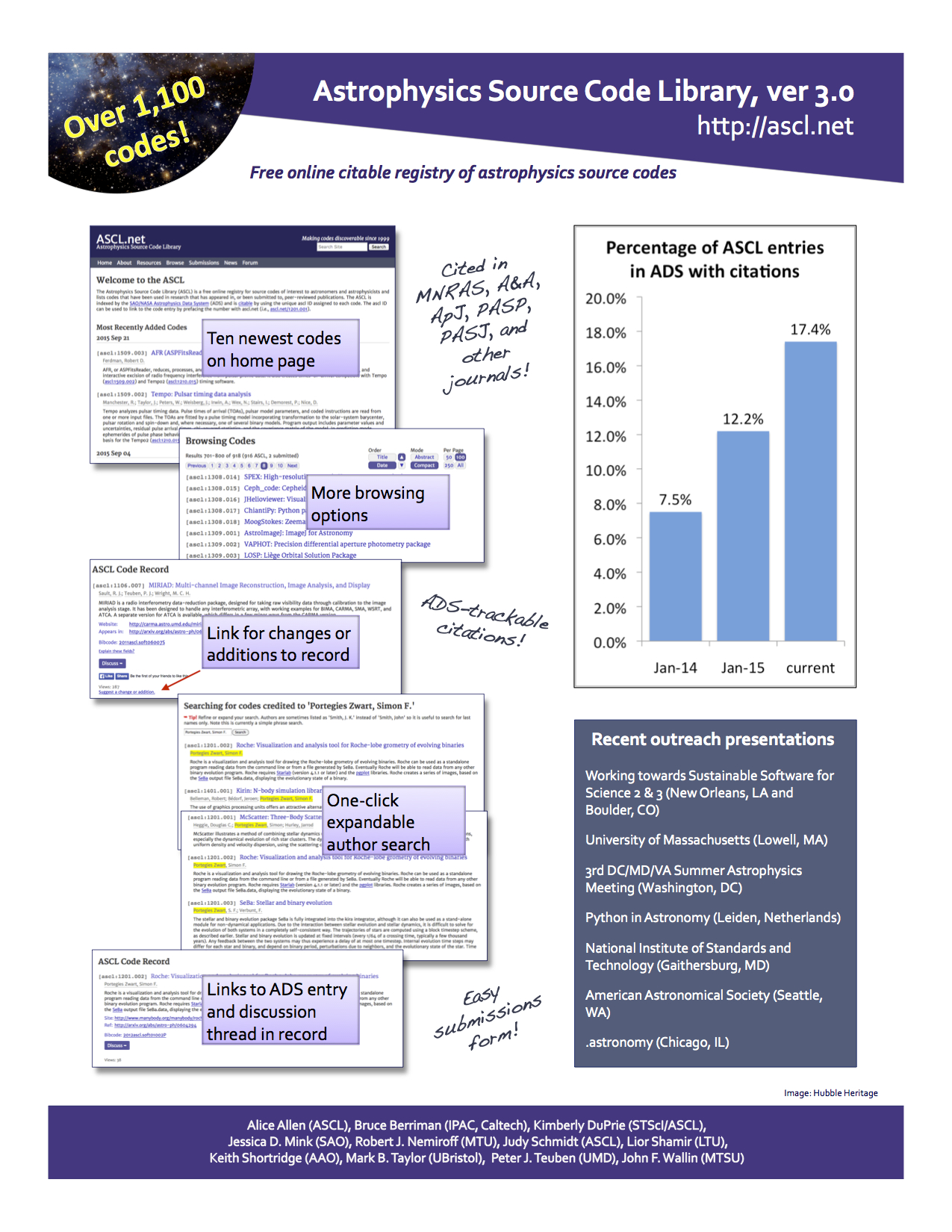
 The Astrophysics Source Code Library, started in 1999, moved to a new infrastructure in 2014 with enhancements developed in response to feedback from users and publishers. With one-click author search, flexible browsing options, and a simple form-based submission process, the ASCL offers a better experience for users. Since the introduction of the new platform in mid-2014, users have submitted nearly 100 codes, more than in all previous years combined. Data sharing options, including the ability to pull all of the resource’s public data in JSON and XML, provide new ways to collaborate with the resource. The ASCL now houses information on more than 1000 codes and its entries are increasingly used for citation, with over 15% of its entries cited, up from 7.5% in January of last year. Exciting opportunities to collaborate have been presented to the ASCL, including participation in the 2nd Workshop on Sustainable Software for Science: Practice and Experiences and a request from the AAS to form a special interest group on software publishing. This presentation will demonstrate the new capabilities of the ASCL and discuss its growth and recent outreach and collaborations.
Alice Allen, Astrophysics Source Code Library; G. Bruce Berriman, Infrared Processing and Analysis Center, California Institute of Technology; Kimberly DuPrie, Space Telescope Science Institute/Astrophysics Source Code Library; Jessica Mink, Harvard-Smithsonian Center for Astrophysics; Robert Nemiroff, Michigan Technological University; Judy Schmidt, Astrophysics Source Code Library; Lior Shamir, Lawrence Technological University; Keith Shortridge, Australian Astronomical Observatory; Mark Taylor, University of Bristol; Peter Teuben, Astronomy Department, University of Maryland; John Wallin, Middle Tennessee State University
-
Earlier this month, Robert Hanisch stepped down as an adviser on the ASCL's Advisory Committee (AC); we are grateful for his service to the ASCL and thank him for his assistance.
Thomas Robitaille from the Max Planck Institute for Astronomy (MPIA) has joined the AC. He brings with him a wealth of experience as a software author, having developed Hyperion and APLpy; he's also work on Glue and AstroPy and other astronomy software. We are delighted to have his input!
-
Have you found an error in an ASCL entry?
 Is there a paper using your code you'd like to add? Would you like to specify right in an ASCL entry how your code should be cited?
We have added a "Suggest a change or addition" link to every code entry in the ASCL. This link brings up a form that is similar to the Submissions form and allows you to not only request changes to fields currently displayed, but also enter information for fields we are considering adding.
For example, we would like to disambiguate the URLs for refereed papers into those that describe a code and those that use a code; we'd also like to add categories to make searching for codes easier.

Something that's been on our wish list for a while is a "see also" feature, one that identifies, for a particular code, codes having a similar function or that someone looking at that code would likely be interested in, too.
 All we need to do this are the data!
Last update: July 20, 2021
-
Ten codes were added to the ASCL in September 2015:
AFR (ASPFitsReader): A pulsar FITS file reader and analysis package
FalconIC: Initial conditions generator for cosmological N-body simulations in Newtonian, Relativistic and Modified theories
FARGO3D: Hydrodynamics/magnetohydrodynamics code
GFARGO: FARGO for GPU
OPERA: Objective Prism Enhanced Reduction AlgorithmsTempo: Pulsar timing data analysis
TRUVOT: True Background Technique for the Swift UVOT Grisms
pycola: N-body COLA method code
PyCS: Python Curve Shifting
XSHPipelineManager: Python Wrapper for the VLT/X-shooter Data Reduction Pipeline -
... and which journals have the most?
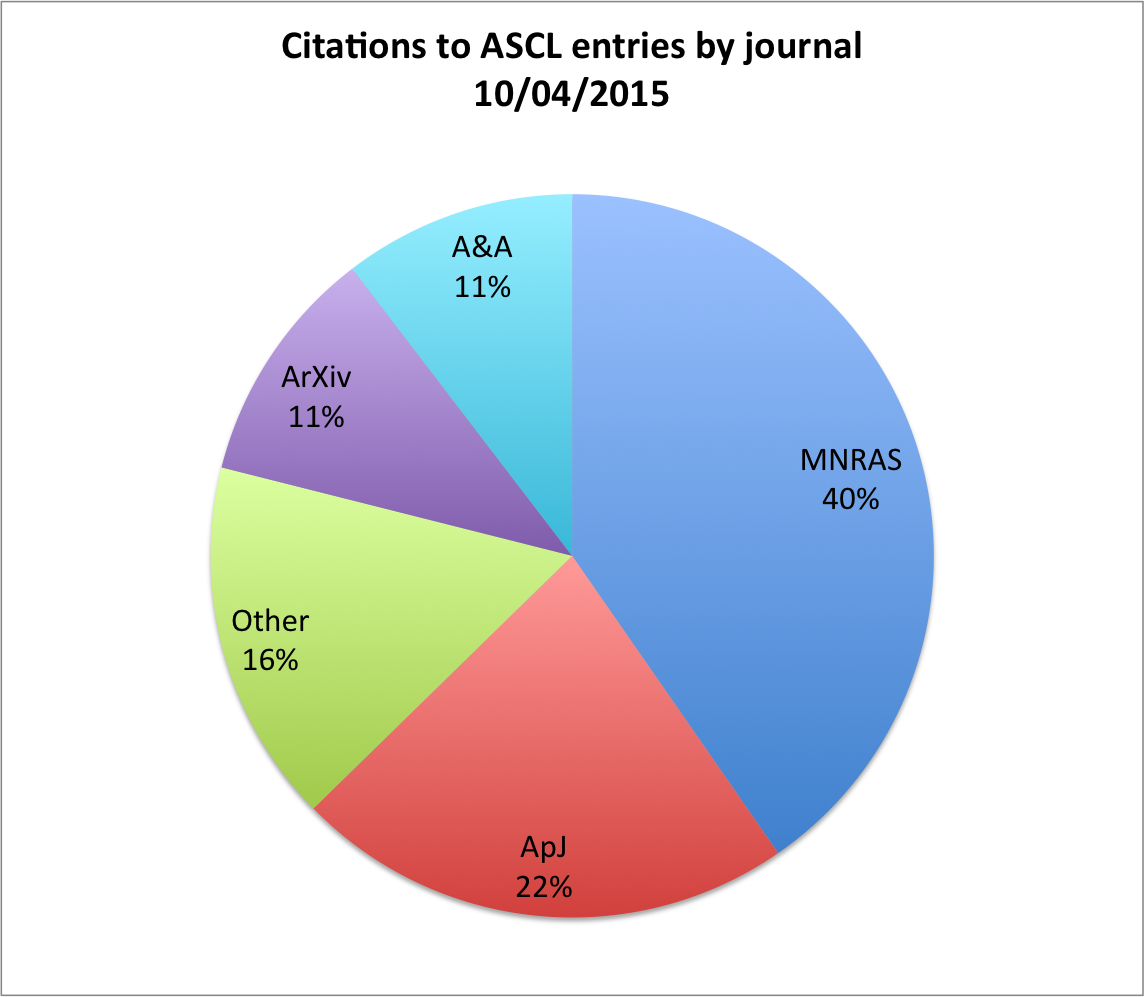
 I had software citations on my mind all last week, as the 3rd Workshop on Sustainable Software for Science: Practice and Experiences (WSSSPE3) was held last Monday and Tuesday in Boulder, CO, and I spent a good bit of my time there in the work group for Hacking the credit and citation ecosystem (making it work, or work better, for software). This made me curious as to which journals have citations to ASCL entries, and which have the most citations to ASCL entries. I was pretty sure I knew the answer to the latter, but it's always good to test what one knows. So I went looking, and this what I found...
These three journals and arXiv hold 84% of citations to ASCL entries:
Monthly Notices of the Royal Astronomical Society
The Astrophysical Journal
ArXiv e-prints
Astronomy and AstrophysicsOther publications with citations to the ASCL include:
The Astronomical Journal
Astronomy and Computing
The Astrophysical Journal Supplement Series
Computational Astrophysics and Cosmology
Computer Physics Communications
Galaxies
Icarus
Journal of Cosmology and Astro-Particle Physics
Journal of Physics Conference SeriesJournal of Physics G Nuclear Physics
The Messenger
Physical Review C
Physical Review D
Physical Review Letters
Physics Uspekhi
Publications of the Astronomical Society of Japan
Publications of the Astronomical Society of the Pacific
Revista Mexicana de Astronomia y AstrofisicaProceedings, too, including:
18th European White Dwarf Workshop
19th European Workshop on White Dwarfs
Astronomical Society of India Conference Series
Asymmetrical Planetary Nebulae VI ConferenceEAS Publications Series
IAU Symposium
SF2A-2014: Proceedings of the Annual meeting of the French Society of Astronomy and Astrophysics
Society of Photo-Optical Instrumentation Engineers (SPIE) Conference SeriesI appreciate ADS all over again for making it possible to compile this information so quickly.
-
Already it's shaping up to be a software maven's dream AAS meeting, with workshops and Special Sessions focused on expanding your software skills and a Hack Day to put them to use! We'll have a comprehensive listing closer to the meeting date, but here are the activities already on the schedule, with more to come!
Introduction to Software Carpentry 2 Day Workshop
Astrostatistics and R
Using Python for Astronomical Data Analysis
SciCoder Presents: Developing Larger Software Projects
Bayesian Methods in Astronomy: Hands-on Statistics
Tools and Tips for Better Software (aka Pain Reduction for Code Authors)
Lectures in AstroStatistics
Hack Day -
Ten codes were added to the ASCL in August 2015:
ColorPro: PSF-corrected aperture-matched photometry
FRELLED: FITS Realtime Explorer of Low Latency in Every Dimension
HMcode: Halo-model matter power spectrum computation
NGMIX: Gaussian mixture models for 2D images
NICOLE: NLTE Stokes Synthesis/Inversion CodeREDUCEME: Long-slit spectroscopic data reduction and analysis
SExSeg: SExtractor segmentation
SHDOM: Spherical Harmonic Discrete Ordinate Method for Atmospheric Radiative Transfer
TreeCorr: Two-point correlation functions
Trilogy: FITS image conversion software -
In July 2014, the ASCL moved to its current infrastructure; we left the older site up to give those who use the ASCL time to adjust to the new site and change their bookmarks. Now it's time -- some might say high time! -- that the previous site be retired. On or about September 4, the old ASCL site, both the WordPress site and the discussion forum housing the code entries, will no longer be accessible. All code entries housed on the old site will redirect to the entries here, and other pages will redirect to ascl.net. If you have questions or concerns about this change, please comment below or email me at aallen@ascl.net. Thank you!
-
From feedback we received about the "Ref" field, we've relabeled that field to lessen the confusion about the article link(s) in the Code Record. What had appeared is:

What now appears is:

We supply a link, too, to a page that explains what the Website, Appears in, and Bibcode fields are, and hope this makes things clearer.If you have suggestions for the ASCL, please feel free to post them here or email editor@ascl.net. Thank you!
-
Twenty codes were added to the ASCL in July 2015:
3D-Barolo: 3D fitting tool for the kinematics of galaxies
abo-cross: Hydrogen broadening cross-section calculator
Astrochem: Abundances of chemical species in the interstellar medium
AstroStat: Statistical analysis tool
DALI: Derivative Approximation for LIkelihoodsDRAMA: Instrumentation software environment
FAT: Fully Automated TiRiFiC
getsources: Multi-scale, multi-wavelength source extraction
HLINOP: Hydrogen LINe OPacity in stellar atmospheres
IEHI: Ionization Equilibrium for Heavy IonsK-Inpainting: Inpainting for Kepler
L-PICOLA: Fast dark matter simulation code
Least Asymmetry: Centering Method
Pelican: Pipeline for Extensible, Lightweight Imaging and CAlibratioN
PPInteractions: Secondary particle spectra from proton-proton interactionspyro: Python-based tutorial for computational methods for hydrodynamics
REDSPEC: NIRSPEC data reduction
slimplectic: Discrete non-conservative numerical integrator
SUPERBOX: Particle-multi-mesh code to simulate galaxies
Toyz: Large datasets and astronomical images analysis framework